Think of your website as your digital storefront. For a long time, we relied on the equivalent of a welcome mat and some signs—a homepage and a navigation bar—to help people find their way. Marketing chatbots have completely changed the game. It’s like having a dedicated, hyper-efficient concierge standing at the door, ready to greet every single person who walks in, 24/7. This person can answer questions, point them to the right aisle, and even help them check out.
That’s the fundamental shift we’re seeing: from static web pages to dynamic, two-way conversations.
The New Face of Digital Conversation
We live in an on-demand world. Customers don’t just want instant answers; they expect them. Making someone wait for an email reply or forcing them to dig through a complex website is a surefire way to lose their interest. Marketing chatbots step right into this gap, turning what used to be a passive browsing session into an active, helpful dialogue that actually gets things done.
Here’s another way to look at it: a standard website is like a public library. You walk in, and it’s up to you to find the right section and the right book. A website with a chatbot is like having a personal librarian who walks up, asks what you’re looking for, and pulls the perfect resources for you on the spot.
Why Conversational AI Is Now Essential
This move toward conversational marketing isn’t just a fleeting trend. It’s a direct response to how people behave now. We’re all used to messaging apps and quick, direct interactions. Chatbots simply bring that same familiar experience to your brand. They deliver on several key fronts:
- Instant Engagement: They greet visitors the second they land on your site, grabbing their attention before they have a chance to leave.
- 24/7 Availability: Your marketing and lead generation don’t stop when your team clocks out. The bot is always on.
- Scalable Personalization: You can provide tailored guidance and answers to one, ten, or a hundred visitors all at the same time, without missing a beat.
This technology finally closes the gap between what customers expect and what businesses can realistically deliver. It’s both incredibly efficient and surprisingly personal. The numbers back this up, too. The global chatbot market was recently valued at $7.76 billion and is expected to hit $9.56 billion, growing at a compound annual rate of about 23.3% through 2030. You can explore more chatbot statistics to see just how big their impact is.
A well-designed chatbot does more than just answer questions; it proactively nurtures relationships. It turns a monologue (your website) into a dialogue, making every visitor feel seen and valued from their very first click.
At the end of the day, using chatbots in your marketing is about treating every website visitor as a potential relationship. By starting a helpful conversation from the get-go, you build a foundation of trust that leads to better leads, higher conversions, and real brand loyalty.
Understanding How Marketing Chatbots Work
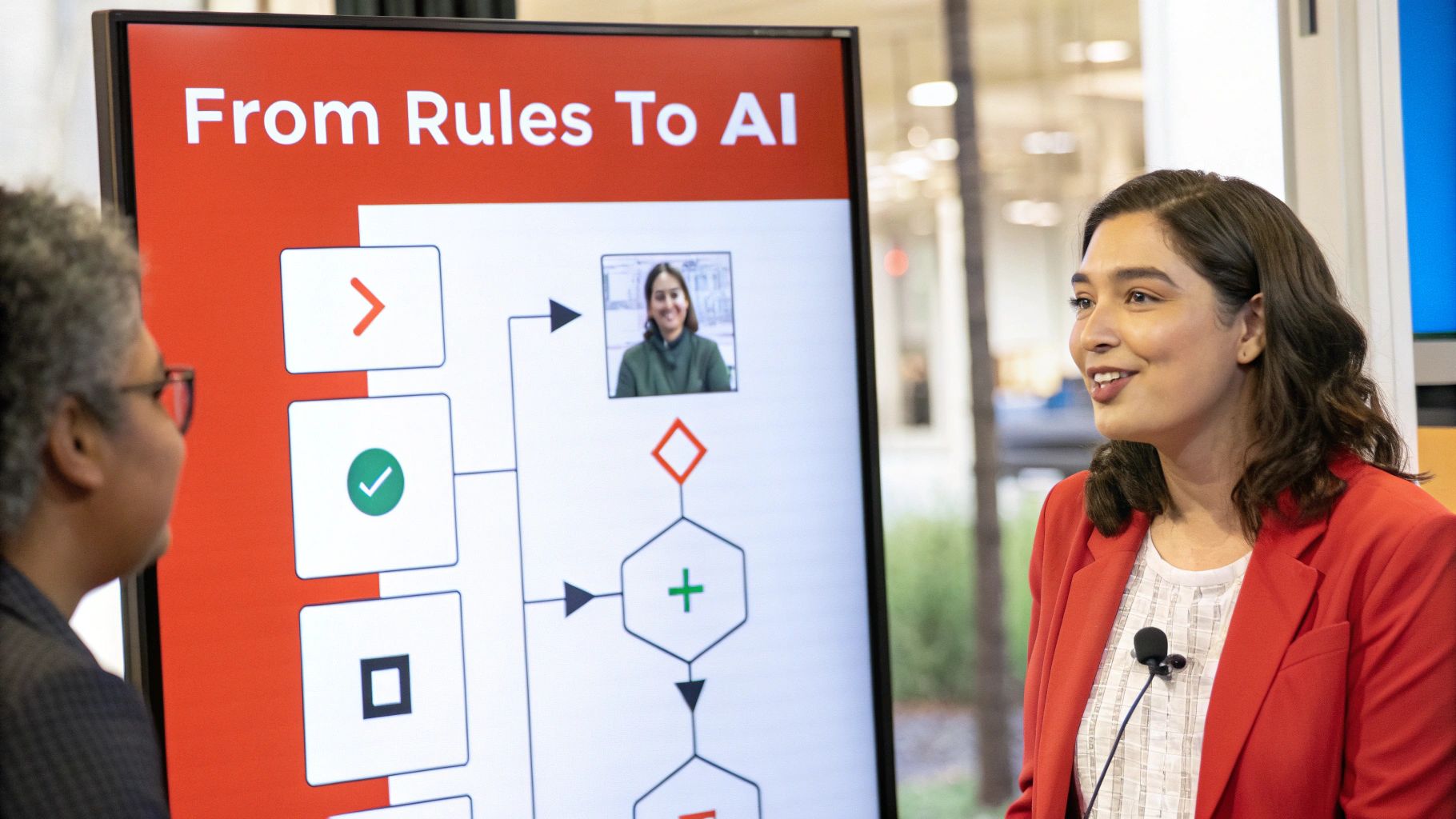
To really get what chatbots for marketing can do, it helps to peek under the hood a bit. At their core, these tools are built to mimic human conversation, but they pull it off in two very different ways. Knowing the difference is crucial for picking the right tool for your business.
I like to think of it this way: you have two types of conversational assistants. The first is like a tour guide with a fixed script, and the second is like a quick-thinking apprentice who learns as they go.
The Scripted Storyteller: Rule-Based Chatbots
First up, you have the rule-based chatbot. Picture a choose-your-own-adventure book. You can only pick from the options you’re given (“Turn left” or “Open the door”), and each choice takes you down a specific, pre-written path.
Rule-based chatbots work exactly like that. You map out the entire conversation using a visual builder, essentially creating a decision tree. The chatbot then steers users through the flow with buttons, menus, and multiple-choice options.
These bots are perfect for straightforward tasks where you can easily predict what the user will ask. Their biggest perks are:
- Total Control: You define every single conversation path, meaning the bot will never go rogue or say something unexpected.
- Simplicity: They are much easier and faster to build, often with no coding required.
- Reliability: For simple jobs like scheduling a demo or sending a query to the right department, they get the job done efficiently.
The downside? They’re rigid. If a user types something that isn’t part of the script, the bot hits a wall and usually spits out a generic “Sorry, I don’t understand.”
The Learning Apprentice: AI-Powered Chatbots
The second, more advanced type is the AI-powered chatbot. This bot is less of a script-follower and more of a learning apprentice. It can figure out the intent behind what someone is asking, even if the wording is new or a bit clumsy.
This is where Natural Language Processing (NLP) comes into play. Don’t let the jargon scare you. NLP is basically the “brain” that helps the bot understand human language—typos, slang, and all. It allows the chatbot to interpret different phrasings and get to the heart of what the user actually wants.
An AI chatbot doesn’t just look for keywords; it understands context. If someone asks, “How much to ship to Boston?” or “Boston shipping cost?” the AI knows they’re asking the same thing and gives the right answer.
This ability to handle open-ended text makes the whole conversation feel much more natural. For instance, a visitor could type, “Do you have any blue sweaters under $50?” An AI bot can parse all three of those criteria—product, color, and price—to pull up a perfect, highly-relevant recommendation. This is how smart marketing chatbots turn a simple question into a qualified lead or a sale.
These AI models are trained on huge amounts of data, so they’re constantly getting better at holding helpful, relevant conversations. They can handle a much wider range of questions and create a more personalized experience, making them a seriously powerful tool for engaging visitors and qualifying leads around the clock.
Why Bother With a Marketing Chatbot, Anyway?
It’s easy to get caught up in the technology, but let’s talk business. Why should you actually care about using a chatbot for your marketing? It’s not about chasing the latest shiny object; it’s a strategic move that delivers real results in efficiency, customer engagement, and ultimately, your bottom line.
Think of it this way: your website is your digital storefront. A chatbot is like having the perfect employee standing at the door—one who works 24/7, can talk to hundreds of people at once without breaking a sweat, and perfectly executes your marketing strategy every single time. This little digital assistant turns your passive website into an active, conversation-starting machine.
Let’s break down the value into three key areas.
Pillar 1: Capture Leads Around the Clock
Your website visitors don’t stick to a 9-to-5 schedule, so why should your lead generation? A marketing chatbot is your always-on greeter, making sure no potential customer falls through the cracks, whether they show up at 3 PM or 3 AM.
Instead of making someone hunt for a contact form, a chatbot can pop up with a friendly, helpful message. It can ask smart qualifying questions—”What’s your budget?” or “What are you hoping to achieve?”—to figure out if they’re a solid lead. This means your sales team walks in every morning to a pipeline of warm, pre-vetted prospects instead of a cold inbox full of maybes.
This constant availability creates more opportunities. You’re catching people right when their interest is highest, giving them instant answers and a clear path forward.
Pillar 2: Speed Up Sales and Boost Conversions
In the online world, speed sells. A few minutes of delay can be the difference between a closed deal and a lost customer. Chatbots get rid of that waiting game by offering immediate answers and personalized guidance, acting as a virtual sales assistant right when people need it most.
Imagine an e-commerce chatbot in action:
- It offers instant product recommendations. A customer can just type what they’re looking for, and the bot pulls up the perfect options, just like a great retail associate.
- It answers common sales questions on the spot. No more waiting for an email reply about shipping, returns, or sizing.
- It guides people straight to checkout. The bot can help them find their cart or apply a discount, smoothing out the bumps that often lead to abandoned carts.
A huge part of the business case comes down to hard numbers. For instance, studies on AI chatbots in affiliate marketing show they can even double commissions. By making the journey from browsing to buying as seamless as possible, chatbots give your conversion rates a serious lift.
To really see the difference, let’s compare how chatbots change the game for common marketing goals.
How Chatbots Impact Key Marketing Metrics
This table shows the clear performance boost businesses see when they add chatbots to their marketing mix.
| Marketing Goal | Traditional Method | Chatbot-Enhanced Method | Key Benefit |
|---|---|---|---|
| Lead Generation | Static contact forms, waiting for email replies. | Proactive chat pop-ups, 24/7 lead qualification. | Higher lead volume and better lead quality. |
| Sales Conversion | Users navigate site alone, email support for questions. | Instant product recommendations, on-the-spot FAQ answers. | Reduced cart abandonment and faster sales cycle. |
| User Engagement | High bounce rates as users search for information. | Interactive conversations, personalized content delivery. | Longer time on site and deeper user interaction. |
| Customer Support | Support tickets with 24-48 hour response times. | Instant resolution for common queries, seamless human handoff. | Improved customer satisfaction and lower support costs. |
It’s clear that chatbots don’t just automate tasks; they fundamentally improve the way you interact with potential customers, leading to better outcomes across the board.
Pillar 3: Deepen Customer Engagement and Slash Costs
Finally, chatbots help you build stronger relationships from the very first click. By providing immediate, helpful, and personalized support, they make visitors feel seen and understood. That instant connection builds trust and keeps people on your site longer.
A marketing chatbot turns every interaction into an opportunity. It collects valuable insights, answers questions instantly, and guides users, all while creating a positive and memorable brand experience.
This improved engagement comes with a major bonus: serious cost savings. By handling all the routine, frequently asked questions, chatbots free up your human team to focus on the complex, high-stakes conversations that truly need a human touch. This is a massive driver for efficiency. In fact, it’s estimated that chatbots will save companies roughly $8 billion in customer support costs, cutting expenses by as much as 30%. You can dig into more chatbot cost savings from SlickText.
When you combine a better customer experience with a leaner operation, the return on investment becomes impossible to ignore.
Real-World Wins: Proven Use Cases for Marketing Chatbots
Theory is great, but the true power of marketing chatbots shines when you see them solving real-world problems. These aren’t just about automating tasks; they’re about fundamentally changing how brands connect with people at the most important moments.
Let’s walk through four scenarios where a smart chatbot becomes a game-changing marketing asset. Each one tells a story of a common business headache and the elegant solution a chatbot provides.
The B2B Lead Qualification Concierge
Picture a B2B software company’s website. For years, their main lead-gen tool was a lonely “Request a Demo” form hidden on the contact page. Busy executives would land on the site, poke around for a minute, and then vanish because filling out a form felt like too big of a commitment.
So, they brought in a chatbot to act as a friendly, proactive concierge.
- The Problem: High-value traffic was bouncing, and the sales team was swamped with unqualified inquiries from the few people who actually filled out the form. It was a classic case of wasted time and missed opportunities.
- The Chatbot Solution: Now, a chatbot greets visitors on key pages with a simple, disarming question like, “Working on a specific project today?” It then guides them through a quick, conversational flow, asking about their company size, industry, and biggest pain points.
- The Outcome: The bot pre-qualifies leads 24/7, making sure the sales team only talks to high-intent prospects. This single change can dramatically increase qualified lead volume while filtering out the noise.
Think of the chatbot as the perfect gatekeeper. It efficiently separates the curious browsers from the serious buyers, ensuring your sales team’s calendar is packed with promising conversations, not tire-kickers.
The E-commerce Personal Shopper
Now, imagine an online fashion store. Customers were getting lost in a sea of options. They’d click through dozens of pages, add a few things to their cart, and then leave, overwhelmed by decision paralysis.
This is where a chatbot steps in as a virtual personal shopper.
- The Problem: Sky-high cart abandonment rates were killing sales. Shoppers needed personalized guidance to feel confident enough to click “buy.”
- The Chatbot Solution: The chatbot starts a conversation by asking about the occasion, style preferences, and budget. Based on the replies, it pulls together a curated selection of products, complete with pictures and direct links. It’s like having a personal stylist right in the chat window.
- The Outcome: The retailer saw a measurable drop in cart abandonment. The chatbot not only helped people find what they wanted faster but also boosted the average order value by suggesting matching accessories and complementary items.
The Content Delivery Expert
A popular marketing blog was crushing it with SEO but struggled to keep readers engaged. A visitor would land on one article, read it, and then bounce—completely missing the trove of related content that could have turned them into a loyal subscriber. For more on this, check out our guide to using a chatbot for your website.
To fix this leaky bucket, the blog implemented a chatbot as a content delivery expert.
- The Problem: User engagement was dead-end. The blog wasn’t converting its hard-won traffic into a dedicated audience.
- The Chatbot Solution: As someone scrolls toward the end of a post, the chatbot pops up with a helpful nudge: “Hey, enjoyed this post on SEO? I found three other articles about analytics you might like.” It then serves up the links right there in the chat.
- The Outcome: Time-on-site and pages-per-session shot up. The chatbot turned passive readers into active explorers, which led to a significant rise in newsletter sign-ups as people realized how much value the blog offered. For more real-world illustrations of how marketing automation drives conversions, you can explore these powerful marketing automation examples.
The Webinar Registration Assistant
Finally, think about a company running monthly webinars. Their sign-up process was a long, clunky landing page form that scared people away. On top of that, the marketing team was drowning in emails asking the same repetitive questions about the agenda, speakers, and schedule.
A chatbot was brought in to clean up the whole mess.
- The Problem: A clunky registration process was hurting attendance, and the team was bogged down with manual, low-value support tasks.
- The Chatbot Solution: The chatbot was placed right on the webinar landing page. It instantly answered FAQs, shared the agenda, and captured registration details—just a name and email—through a simple two-step chat. It even sent a calendar invite automatically when the conversation was done.
- The Outcome: Webinar sign-ups jumped by over 20% simply because the experience was so much smoother. The marketing team got hours back each week, freeing them up to focus on promoting the event instead of managing admin.
Your Blueprint for Building a Marketing Chatbot
The idea of building a chatbot might sound like you need a team of developers, but the reality is much simpler. It’s less about coding and more about having a smart strategy. Modern tools have made it surprisingly easy for anyone to get started.
Think of it like putting together a piece of IKEA furniture. You don’t have to engineer the parts; you just need a good set of instructions to assemble them into something useful. This five-step plan is your instruction manual for creating a chatbot that actually delivers results.
Stage 1: Define Your Primary Goal
Before you even look at a single piece of software, stop and ask yourself one critical question: What is the number one job I need this chatbot to do?
Trying to build a bot that does everything at once is a surefire way to create something that does nothing well. Instead, zero in on a single, specific goal.
Are you trying to:
- Generate more qualified leads? Then the bot’s mission is to ask the right questions and get meetings booked.
- Cut down on support questions? The bot should be an expert at answering your top 5-10 most common customer queries.
- Drive webinar registrations? The bot needs to make signing up completely effortless.
Pinpointing this goal from the outset is crucial. It will shape every decision you make, from the conversation design to the platform you choose. A clear objective keeps you focused and ensures your bot provides real value right away.
Stage 2: Choose the Right Platform
Once you know what you’re building, you can pick the right tools for the job. The chatbot market is crowded, but finding the right platform comes down to your specific goal, budget, and how tech-savvy you feel.
For most marketers, a no-code or low-code platform is the best place to start. These tools have visual, drag-and-drop interfaces that let you design conversations without touching a line of code. They hit that sweet spot between being powerful and easy to use.
A great platform is like a well-organized workshop. It has all the tools you need laid out and ready to go, letting you build amazing things without needing an engineering degree just to get started.
When you’re comparing options, look for features like pre-made templates, seamless integrations with your existing tools (like your CRM), and solid analytics. Most offer free trials, so take a few for a test drive before you commit.
To help you navigate the options, here’s a breakdown of the different types of chatbot platforms available.
Choosing Your Ideal Chatbot Platform
This table compares the main categories of chatbot builders to help you find the best match for your needs.
| Platform Type | Best For | Technical Skill Required | Typical Cost | Example |
|---|---|---|---|---|
| No-Code Visual Builders | Marketers and small business owners creating rule-based bots for lead gen or FAQs. | None. Drag-and-drop interface. | $ to $$ | Tidio |
| Low-Code Platforms | Teams that want more customization and complex integrations without full-on coding. | Basic. Some familiarity with APIs or scripting helps. | $$ to $$$ | Drift |
| AI/NLP-Powered Platforms | Businesses needing sophisticated, human-like conversations and customer support. | Moderate. Requires training the AI model with data. | $$$ to $$$$ | Intercom |
| Open-Source Frameworks | Developers building a completely custom chatbot from the ground up. | Advanced. Requires strong programming skills. | Free (Hosting/Dev costs) | Rasa |
Ultimately, the best platform is the one that empowers you to achieve your goal from Stage 1 without creating a technical headache.
Stage 3: Design the Conversation Flow
This is where your chatbot’s personality comes to life. A great conversation feels natural and helpful, gently guiding the user toward the goal you set earlier. I always recommend mapping it out first, either on a whiteboard or with a simple flowchart tool.
Put yourself in your user’s shoes. What’s the first thing they need to know? What questions are they likely to have? How can you make the interaction feel less like a robot and more like a helpful assistant?
A few tips for a winning flow:
- Start with a clear welcome. Immediately tell people what the bot can help them with.
- Use buttons and quick replies. These are much faster and easier for users than typing everything out.
- Keep your messages short and punchy. No one wants to read a wall of text from a bot.
- Always have an escape hatch. Make it obvious how a user can talk to a real person if they get stuck.
The process flow below shows how different goals—like lead generation or e-commerce—require completely different conversational paths.
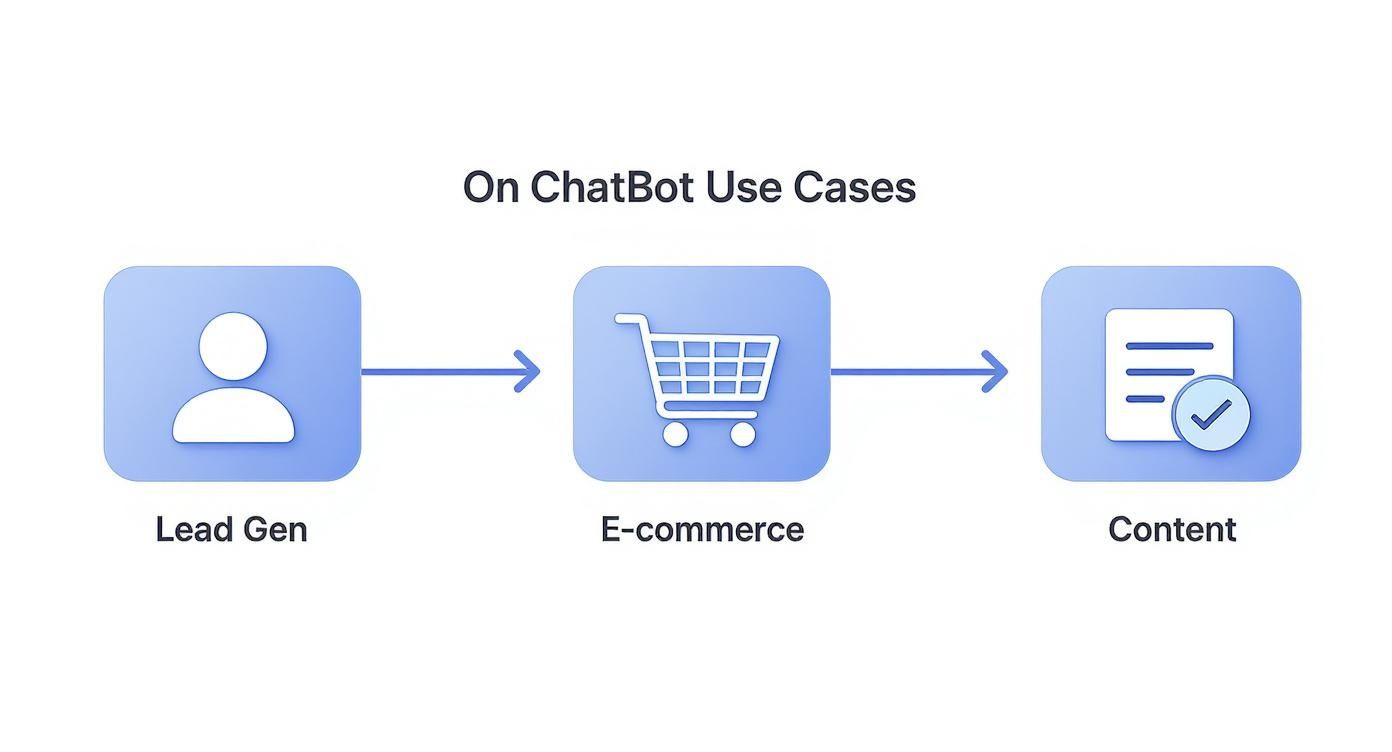
As you can see, a bot’s design has to be built for a specific purpose, changing its conversational journey to hit a particular marketing target.
Stage 4: Build and Test Your Chatbot
Alright, time to roll up your sleeves and build. Using the conversation map you designed, start putting the pieces together in your chosen platform. Write the messages, connect the dots with your logic, and set up any integrations.
For example, if you’re focused on lead generation, connecting your bot to your CRM is a game-changer. You can find excellent guides on how to integrate WhatsApp with a CRM to see how you can automatically capture and organize new leads.
Testing is not optional. Before your bot ever talks to a real customer, you need to try and break it. Ask it strange questions. Take unexpected turns in the conversation. Have a few colleagues do the same and give you unfiltered feedback. This is how you’ll find the awkward phrasing and confusing dead ends before they frustrate a potential lead.
Stage 5: Launch and Optimize Performance
Getting your chatbot live isn’t the finish line—it’s the starting line. The real wins come from watching how people interact with it and continuously making it better.
Get comfortable in your platform’s analytics dashboard. You’ll want to keep a close eye on a few key numbers:
- Engagement Rate: Are people actually starting conversations?
- Goal Completion Rate: Of those who start, how many are making it to the finish line?
- Drop-off Points: Where in the flow are people getting stuck and leaving?
This data is pure gold. It tells you exactly where to make improvements. If a lot of users are abandoning the chat at a specific question, you know you need to rephrase it. A truly effective marketing chatbot is never really “done.” It’s a living tool that you refine over time to get better and better results.
Best Practices for a High-Performing Chatbot
Building a chatbot is just step one. The real goal is to turn it into a powerhouse marketing tool that actually works. A great bot feels like talking to a sharp, helpful assistant, but a bad one is just an annoying digital wall.
The difference isn’t about complex technology; it’s about a handful of core principles that put the user’s experience first. Think of your chatbot as the newest member of your team. You’d want them to be on-brand and easy to understand, right? The same goes for your bot. Let’s make every conversation count.
Define Your Bot’s Personality
Your chatbot shouldn’t sound like a generic robot. It needs to feel like a genuine part of your brand. So, before you write a single line of dialogue, decide what it should sound like. Is your brand professional and straight-to-the-point? Or is it more casual, friendly, and maybe even a little witty?
Whatever you choose, that personality must shine through in every single interaction. This consistency is what makes the experience feel authentic and builds a real connection with your audience. For a closer look at getting this right from the start, our guide on how to make a chatbot walks you through establishing your bot’s identity.
Keep Conversations Clear and Concise
Let’s be honest: when people talk to a chatbot, they want answers, and they want them fast. They don’t have time for a novel. Keep your bot’s messages short, scannable, and directly on topic. Long paragraphs are the ultimate conversation killer.
A few simple tricks can make a huge difference:
- Buttons and Quick Replies are Your Best Friend: Don’t force users to type everything out. Give them clickable options. It’s faster for them and cuts down on typos and misunderstandings.
- Break It Down: If you have to deliver a lot of information, send it in a series of short, quick messages instead of one giant text block. Think of it like a real text conversation.
- Be Direct: No fluff. If the bot needs something, it should ask for it clearly and briefly explain why.
Always Provide an Escape Hatch
No matter how intelligent your bot is, it won’t be able to answer everything. Some questions are just too complex, and some people simply prefer talking to a human. This is why you must always offer a clear and easy way to connect with a person.
Nothing is more frustrating than being stuck in an endless loop with a bot that doesn’t understand you. An easy-to-find “Talk to a Human” button isn’t a sign of failure—it’s a sign you’ve built a smart, user-first system.
This “escape hatch” is your safety net. It prevents you from losing a frustrated lead and shows your customers you’re committed to helping them, whether that’s with a bot or a person. By sticking to these practices, you’ll create a marketing chatbot that doesn’t just chat, but actually drives real business growth.
Common Questions About Marketing Chatbots
Even when you see all the benefits laid out, jumping into a new tool always comes with a few nagging questions. It’s smart to get those cleared up before you go all-in on a chatbot strategy. Let’s tackle the questions we hear most often from marketers just like you.
Getting these concerns out of the way will help you move forward with confidence and make sure your first marketing chatbot is a win right from the start.
Will a Chatbot Make My Brand Feel Robotic?
This is probably the biggest fear we hear, but the short answer is no—not if you do it right. A well-designed chatbot doesn’t replace your brand’s human touch; it scales it.
The secret is to give it a genuine personality that actually sounds like your brand. Use the same conversational language, emojis, and maybe even a bit of humor that you’d use in your social media or emails. Think of it less like a machine and more like a super-efficient assistant you’ve trained yourself. And here’s the most important part: always give people a clear, easy-to-find option to talk to a human. That way, the bot is a helpful first step, not a frustrating dead end.
How Much Does Building a Marketing Chatbot Cost?
This is a classic “it depends” situation, but the good news is you don’t need a massive budget to get started. The price tag can swing pretty wildly based on how complex you need it to be.
- Simple, rule-based chatbots can be built on no-code platforms with plans that start as low as $50 a month. These are great for basic lead capture or answering simple questions.
- Advanced, AI-powered chatbots that can handle more complex conversations and integrate with your other tools usually run from several hundred to a few thousand dollars per month.
- A fully custom-developed enterprise solution is a much bigger project and can be a significant one-time investment.
The best way to approach it is to define one clear goal for your first bot and pick a platform that lets you start small and add more firepower as you grow.
Don’t overcomplicate things right out of the gate. A simple chatbot that solves one specific problem incredibly well is far more valuable than a complex, expensive one that tries to do everything and fails. Start with your biggest pain point and build from there.
How Do I Measure the ROI of My Chatbot?
Measuring your chatbot’s return on investment comes right back to the goal you set for it in the first place. If you don’t know what you’re trying to achieve, you can’t measure whether you succeeded.
Luckily, most chatbot platforms have built-in analytics that make this easy. You just need to know what to look for. To prove your bot is pulling its weight, keep a close eye on these numbers:
- Number of qualified leads generated
- Lead-to-customer conversion rate
- Cost per lead (and how it stacks up against your other channels)
- Sales revenue directly tied to the bot
- Reduction in time your team spends on repetitive questions
When you track these metrics, you can walk into any meeting and show exactly how your chatbots for marketing are making a real impact on the bottom line.
Ready to turn your website traffic into qualified leads 24/7? LeadBlaze is an AI sales assistant that engages every visitor, answers their questions, and captures the details your sales team needs—all automatically. Start your free 7-day trial and see the difference a smart chatbot can make. Get started with LeadBlaze today!