Your website keeps working after your team clocks out. Visitors land on service pages at night, compare options on Saturday, and hit your pricing page during a lunch break you never see. Then they face the same dead end: a form, a voicemail box, or silence.
That’s the core problem behind the live chat vs chatbot debate. It isn’t about which widget looks better in the corner of your site. It’s about whether you capture demand when it shows up, or let it disappear because no one was available to respond.
Your Website Is Busy But Your Sales Team Is Not
A common SMB scenario looks like this. You invest in SEO, run ads, post on social, maybe even get referrals flowing. Traffic shows up. A few people are ready to buy. But after 5 p.m., on weekends, or during busy stretches, nobody answers questions in real time.
So the visitor leaves.
That’s why chat matters now. Live chat has an 85% satisfaction rate, second only to phone support, and 53% of U.S. online adults used live chat in 2023 to contact a company, according to Help Scout’s roundup of live chat statistics. Customers don’t see real-time chat as a bonus anymore. They expect it when they want fast help.

The missed lead problem
If you run a clinic, a law firm, an agency, a contractor business, or a local service company, you’ve seen this firsthand. A prospect has a simple question before booking. They don’t want to wait for an email. They want an answer now.
If they get it, you stay in the running. If they don’t, they move on.
Your website doesn’t lose leads because people hate your business. It loses leads because delay kills intent.
The two obvious options
Most owners land on one of two solutions:
- Live chat: a human responds in real time.
- Chatbot: software handles the first interaction automatically.
Both can help. Both can fail.
A human agent can build trust, answer nuanced questions, and rescue a valuable sale. A bot can respond instantly, every time, without breaks or scheduling headaches. The mistake is treating this like a simple either-or purchase decision.
For most SMBs, the smarter question is operational: how do you build a chat system that captures leads all day without burning payroll on low-value conversations?
The Human Touch Understanding Live Chat
Live chat means a real person is on the other end. That matters more than software vendors admit. When a prospect is confused, hesitant, or comparing expensive options, a trained human can read context, answer follow-up questions, and guide the conversation toward a sale.
That’s where live chat earns its keep.
Where live chat wins
Live chat is strongest when the conversation has friction. Pricing objections. Service fit questions. Sensitive support issues. High-consideration purchases. Humans handle those moments better because they can adapt.
Sprinklr and Hire Horatio both make the same core point in their comparison guidance: live chat is better for complex queries, personalization, and empathy, while bots are better for repetitive volume and round-the-clock coverage. If you want a deeper look at how teams use human chat effectively, this guide on live chat support is a useful reference.
A good agent can also do something a form can’t. They can ask better questions in the moment.
Where live chat breaks down
The operational downside is obvious. Live chat depends on staffing.
If nobody is online, the channel isn’t live. If too many visitors show up at once, wait times rise. If your team is juggling several chats and phone calls, quality drops fast. You can’t pretend around that constraint. Human support is limited by schedules, attention, and budget.
Practical rule: Don’t use expensive humans to answer cheap questions.
That’s the live chat trap for SMBs. Owners install it expecting more leads, then realize they’ve created a labor problem. Someone now has to monitor it, answer repetitive questions, route inquiries, and stay available during demand spikes.
My blunt take
Use live chat when the conversation is valuable enough to justify a human. If your average deal is meaningful, the sales cycle needs trust, or your buyers have nuanced questions, live chat makes sense.
If your team can’t reliably cover the channel, though, live chat by itself is incomplete. It gives you a premium experience during staffed hours and a dead channel the rest of the time. That’s not a system. That’s partial coverage.
The Automation Engine Understanding Chatbots
A chatbot is the opposite model. Instead of waiting for a person to answer, the site responds immediately through automation. That can be a basic scripted flow or an AI-driven assistant that pulls from your site content and handles more natural conversations.
For SMB owners, the appeal is simple. Coverage without staffing.
Why chatbots are growing fast
The business case is strong. According to Master of Code’s chatbot statistics roundup, bots can manage 80% of routine tasks, deliver answers three times faster on average than traditional support responses, and 62% of consumers prefer using a digital assistant over waiting for a human. The same source says the chatbot market is growing at 23.3% annually and is projected to reach $15.5 billion by 2028.
That doesn’t mean customers want a bad bot. It means they’d rather get immediate help than wait in line.
If you’re exploring setup options, this guide to a chatbot for website use cases shows the practical side of deploying one.
What chatbots are good at
Bots shine in predictable conversations. They can:
- Answer FAQs: hours, locations, policies, service areas, intake steps.
- Capture lead details: name, email, phone, service interest, timeline.
- Route inquiries: sales, support, billing, or booking.
- Handle after-hours coverage: they never clock out.
Most website conversations aren’t complex. They start with simple intent signals. A visitor wants to know if you serve their city, whether you take appointments, or how your process works. A bot can handle that instantly.
Where chatbots frustrate people
The weakness is just as clear. Bots can feel rigid, miss nuance, and fail badly when the conversation goes off-script. If someone has a sensitive issue or a detailed buying question, a shallow bot becomes a wall instead of a bridge.
That’s why I don’t recommend a cheap, script-only chatbot unless your use case is narrow and transactional. If the bot can’t answer intelligently or hand off gracefully, it creates a worse experience than a simple contact form.
Fast answers help. Wrong answers drive people away.
The right way to think about chatbots is this: they are not there to impersonate your best salesperson. They are there to absorb repetitive work, respond instantly, and qualify who deserves human time.
A Head-to-Head Comparison for SMBs
If you strip away the hype, the live chat vs chatbot decision comes down to one question: where do you want your business to spend human effort?
Here’s the quick comparison most owners really need.
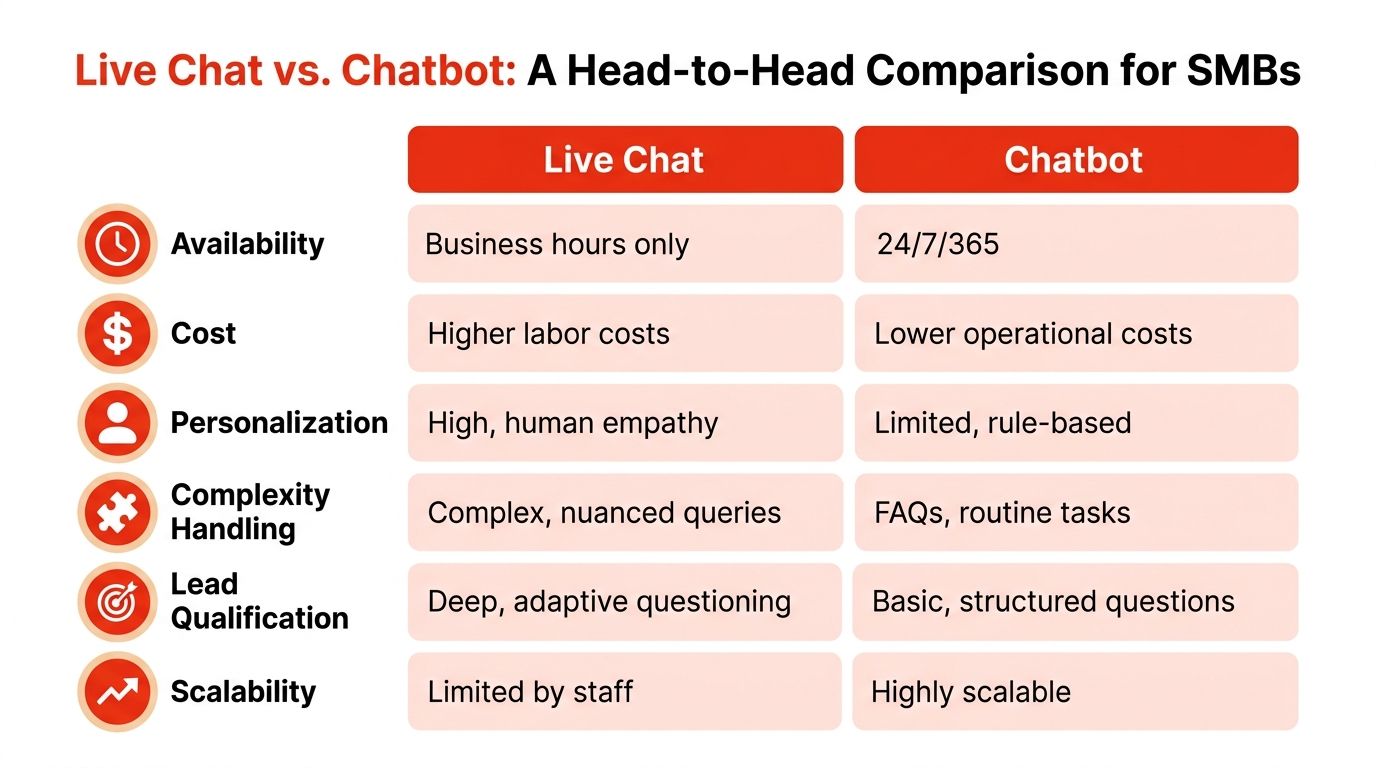
| Criterion | Live Chat (Human Agent) | Chatbot (Automated) |
|---|---|---|
| Availability | Limited by staff schedule | Available 24/7 |
| Cost structure | Higher ongoing labor commitment | Lower operational burden after setup |
| Personalization | Strong human empathy and judgment | Limited, depends on design and AI quality |
| Complexity handling | Best for nuanced or sensitive conversations | Best for routine and repetitive requests |
| Lead qualification | Adaptive, deeper discovery | Structured, consistent qualification |
| Scalability | Constrained by team capacity | Handles many conversations in parallel |
| Speed | Can be fast, but depends on queue and staffing | Immediate first response |
Availability and scale
This is the cleanest difference. Sprinklr's comparison notes that live chat is limited by agent availability and concurrency, while chatbots can respond 24/7 and handle multiple conversations in parallel in a way live teams can't maintain cost-effectively. It also notes that live chat is better for complex issues and empathy, while chatbots are stronger for repetitive questions and consistency, as outlined in Sprinklr's live chat vs chatbot comparison.
If you run a lean team, this isn't theoretical. It shows up every evening, every weekend, and every time a campaign drives a traffic spike.
Cost and operational drag
Live chat looks affordable until you account for behavior, not software. Somebody has to watch it, respond quickly, cover absences, and maintain quality. That's labor, management, and inconsistency risk.
Chatbots shift that equation. You invest in setup and refinement, but the day-to-day load is lighter. For many SMBs, that alone makes automation the better starting point.
If you're weighing broader automation choices, this piece on choosing AI for small business is useful because it frames the decision around actual operating constraints instead of novelty.
Customer experience and lead quality
Owners often get tripped up. They assume “human” always means “better experience.” Not always.
A fast, competent bot often delivers a better first interaction than an unavailable human. But when a conversation turns emotional, technical, or high-value, a real person still wins.
So the scorecard looks like this:
- Use live chat for consultative sales, objection handling, and sensitive support.
- Use chatbots for instant response, after-hours coverage, and repetitive qualification.
- Don't use either badly. A slow live chat and a dumb bot are equally damaging.
My recommendation for SMBs
If you can only choose one, start with the option that protects coverage. For most small businesses, that means chatbot-first.
Why? Because missed conversations are more expensive than imperfect ones. You can improve a bot. You can't recover the lead who left because nobody answered.
That doesn't make live chat obsolete. It makes it specialized. Use humans where their judgment changes the outcome. Use automation everywhere else.
Choosing Your Strategy When to Use Each Tool
The wrong setup usually comes from copying a bigger company. SMBs don't need every channel staffed all day. They need a chat system that fits their sales process.
Hire Horatio addresses the fundamental issue: the question isn't just live chat vs chatbot, but how to handle demand when you can't sustain human coverage for every inquiry, especially as customers increasingly expect 24/7 availability, as discussed in their chatbot vs live chat breakdown.
Use live chat when the conversation closes business
Pick live chat if your buyer needs reassurance before they commit.
This fits businesses like:
- High-ticket services: legal, consulting, B2B services, home renovation, specialized healthcare.
- Complex buying paths: products or services that require explanation, comparison, or custom scoping.
- Sensitive interactions: situations where tone and trust matter.
In those cases, a human isn't a luxury. They're part of the product.
Use a chatbot when speed matters more than nuance
If your site gets the same questions over and over, automate them.
Good chatbot-first scenarios include:
- Booking and intake: appointment requests, quote requests, consultation screening.
- After-hours lead capture: nights, weekends, holidays.
- Basic filtering: service area, budget fit, urgency, timeline, product interest.
This is especially effective for clinics, local services, agencies, and multi-location businesses. Most inbound traffic doesn't need a salesperson immediately. It needs direction.
If your team keeps answering “Do you serve my area?” by hand, you don't have a staffing problem. You have an automation problem.
Use both when your funnel has mixed intent
Many businesses have two very different kinds of visitors. Some want a quick factual answer. Others are close to buying and need a real conversation. That's where a split model works best.
Use automation to greet everyone, answer standard questions, and collect intent. Bring in humans when the lead is qualified or the issue gets complicated.
A simple decision filter works well:
- Is the question repetitive? Let the bot take it.
- Is the lead serious but not fully qualified yet? Let the bot gather details.
- Is the prospect high-intent, confused, or evaluating options? Route to a person.
That's the version of live chat vs chatbot that makes money. Not ideology. Workflow.
The Hybrid Model An AI Sales Assistant
The best answer for most SMBs isn't live chat or chatbot. It's a hybrid system, built around an AI-first layer that handles the bulk of conversations and escalates the right ones to people.
That's the modern model because it respects both economics and customer behavior.
Why AI-first beats tool-first
Comm100 reported in its 2026 benchmark, based on more than 220 million live-chat interactions, that AI agents achieved a 75.3% chat handling rate, which means an AI layer can absorb most incoming volume before a human needs to step in, according to Comm100's live chat benchmark report.
That's the shift SMB owners should pay attention to. You don't need humans sitting in every first-touch conversation. You need humans stepping into the right conversations.
What a smart hybrid system does
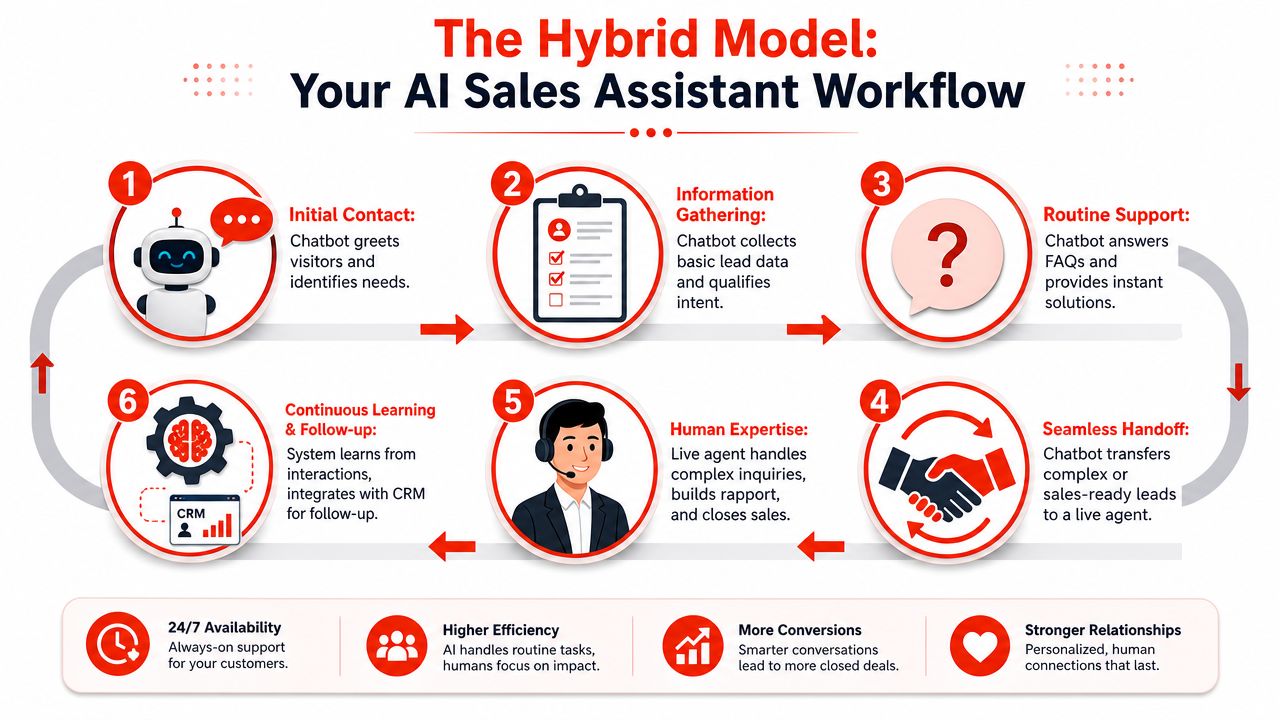
A useful AI sales assistant should do six things well:
- Greet every visitor instantly
- Answer common questions from your site content
- Collect the lead details your team needs
- Qualify based on your rules
- Hand off complex or sales-ready conversations
- Summarize the exchange so your team doesn't read transcripts all day
That's different from an old-school bot that just asks for an email and stalls.
If you want to see the logic visually, this walkthrough helps:
What this looks like in practice
For SMBs, the hybrid model usually works like this. The AI handles first contact and routine support. It qualifies the visitor, then pushes only the serious or nuanced conversations to a human.
That's where a tool like LeadBlaze's guide to AI sales assistant software fits into the discussion. LeadBlaze itself is one example of this model. It learns from site content, answers questions, captures lead data based on custom rules, and gives teams concise summaries instead of forcing them to sift through full chat logs.
There's also a useful lesson here from adjacent marketing workflows. If your team already uses AI to streamline quiz creation for marketing, you've seen the same principle at work. Let automation do structured discovery. Let humans take over when judgment matters.
My recommendation is direct. Build your chat stack around AI-first coverage, then layer human intervention on top. That's how you stay responsive without staffing your website like a call center.
Implementing Your 24/7 Lead Generation Engine
Most SMBs overcomplicate this. You don't need a massive support operation. You need a working lead capture system that responds fast, qualifies cleanly, and routes the right conversations.
Use this checklist
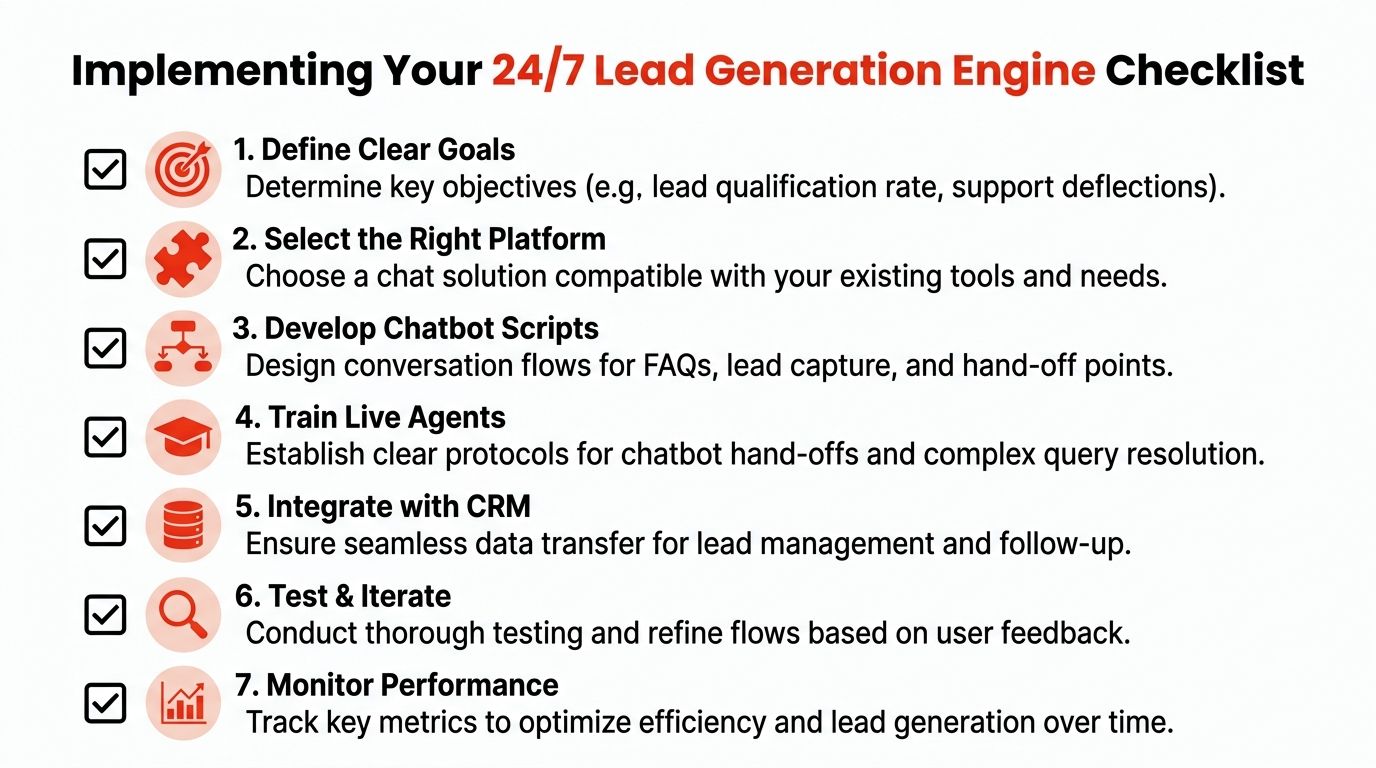
- Define the primary goal. Decide whether chat should book appointments, qualify leads, answer FAQs, or all three.
- Set qualification rules. Know what makes someone worth a callback. Service type, location, urgency, budget, timeline, or fit.
- Map your routine questions. Pull them from emails, calls, DMs, and contact form submissions.
- Choose a tool that fits your stack. It should be easy to install, simple to manage, and able to hand off cleanly.
- Connect it to follow-up. CRM, email notifications, calendar workflows, or team alerts.
- Train the handoff. Decide when automation should stop and a human should step in.
- Review outcomes, not vanity metrics. Focus on qualified leads and booked conversations, not just chat volume.
Don't skip the knowledge layer
If you want better AI answers, feed the system better business context. Clean service pages, FAQs, pricing explanations, and intake details all improve chat quality. Teams building richer AI workflows often look at tools like a Web Scraping API for RAG to structure website content for retrieval and answer generation. The specific tool matters less than the principle. Good inputs produce useful conversations.
A solid implementation doesn't need months. It needs clarity. Decide what the system should capture, what it should answer, and when a human should take over.
If you want a practical way to put this into action, LeadBlaze gives SMBs a 24/7 AI sales assistant that can learn from your site, qualify visitors, and hand your team clean lead summaries instead of missed form fills. It's a simple way to turn website traffic into conversations your team can close.