Your Instagram posts get likes. A few people save them. Some even reply to Stories. But when you look at your pipeline, there’s barely anything there.
That gap frustrates a lot of businesses because the account looks active from the outside. The problem usually isn’t reach. It’s the missing system between attention and action. People see the content, then hit a dead end. They land on a vague profile, a generic link page, or a cold contact form that asks too much and explains too little.
Instagram is big enough to matter at serious scale. In January 2025, Meta’s planning tools showed Instagram ads reached 1.74 billion users globally, equal to 31.3% of all internet users, according to DataReportal’s Instagram statistics roundup. That gives businesses a large top of funnel for profile visits, DMs, and click-to-site traffic. If you’re trying to generate leads on instagram, the opportunity is real. The execution is where most funnels break.
A lot of businesses also overcomplicate the front end. If you want a useful companion read on tightening your account positioning before you rebuild the funnel, OneURL’s Instagram marketing insights are worth reviewing.
Introduction Turn Your Feed into a Funnel
Instagram isn’t just a place to post attractive content and hope something good happens. It works best when every profile visit, comment, DM, and link click has a defined next step.
The businesses that consistently generate leads on instagram usually do four things well:
- They simplify the profile. One audience, one promise, one main action.
- They publish content with intent. Not just engagement bait, but content that creates inquiry.
- They move people into conversation fast. DMs outperform passive browsing because intent is highest in the moment.
- They fix the website handoff. Warm traffic should never land on a page that feels colder than the Instagram post that sent it.
Practical rule: If someone discovers you on Instagram and can’t tell what to do in five seconds, the funnel is leaking.
This matters even more now because Instagram has become a stronger commerce and consideration environment. People don’t just browse there. They research, compare, message, and act. The smartest approach is to treat Instagram as the opening move, not the entire sales process.
Turn Your Instagram Profile into a Lead Magnet
Most profile optimization advice is too cosmetic. A lead-focused profile isn’t about looking polished. It’s about reducing hesitation.
Someone lands on your profile with one question in mind: “Is this for me?” Your job is to answer that instantly, then give them one obvious next step. That means your profile should behave like a mini landing page, not a scrapbook of everything your business has ever done.
Build a single path, not a menu
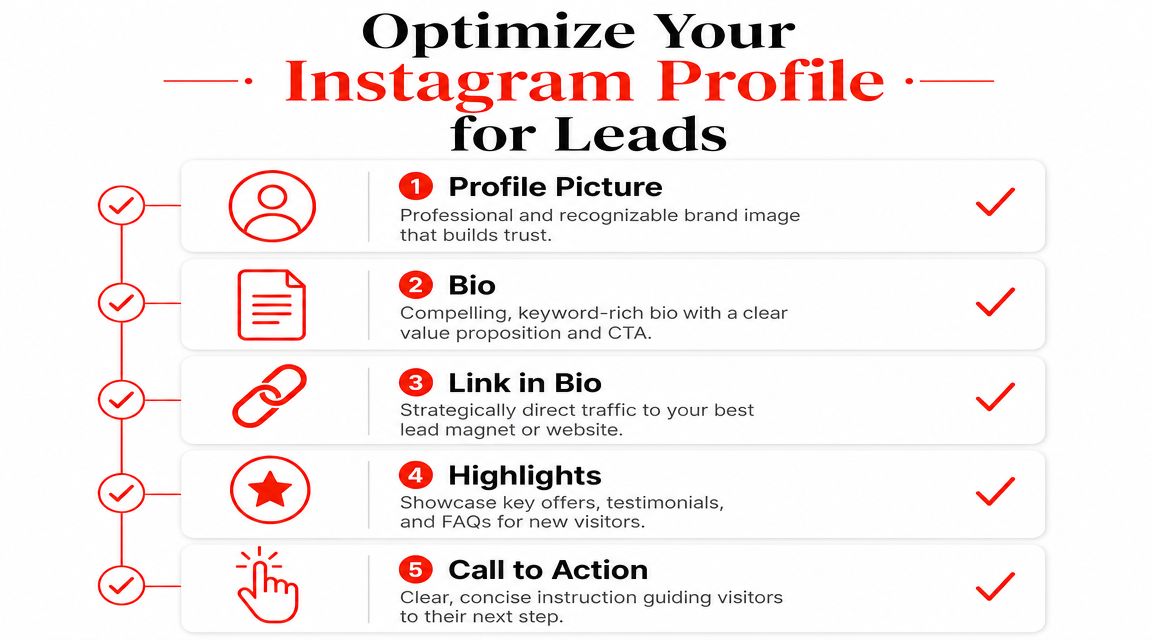
Experts consistently recommend turning Instagram into a single-path funnel with a clear bio, one primary CTA, and a destination that captures an owned contact point like an email, as explained in Metricool’s guide to Instagram lead generation. Generic wording like “check the link in bio” weakens response because it asks for effort without offering a reason.
A better profile usually follows this structure:
| Profile element | What it should do | Common mistake |
|---|---|---|
| Name field | Help search visibility with a clear service keyword | Using only a brand name when nobody searches for it |
| Bio | State who you help and what outcome you deliver | Writing a slogan that sounds clever but says nothing |
| CTA | Offer one clear next step | Giving three options and splitting intent |
| Link | Send traffic to one focused destination | Sending everyone to a cluttered homepage |
| Highlights | Reduce doubts with proof and FAQs | Treating Highlights like random archives |
A local service business can make this simple fast. A remodeler might use a name field like “Dallas Home Remodeler,” a bio that says who they work with, and one CTA tied to a quote request or planning guide. A consultant might offer a checklist. A clinic might offer a booking page with pre-visit questions.
What strong profiles do differently
The strongest profiles don't try to serve every visitor. They qualify by design.
- They call out the audience clearly. “Helping first-time homebuyers” is better than “We help people succeed.”
- They lead with a value exchange. A guide, estimate, audit, checklist, or consultation works because the visitor knows what they get.
- They reduce navigation choices. One CTA beats five weak ones.
- They use Highlights as proof assets. Testimonials, process, before-and-after examples, pricing basics, and FAQs all lower resistance.
If your bio could belong to ten competitors, it won't convert well.
If you're using Instagram messaging in your funnel, it also helps to understand how business messaging works operationally. This breakdown of Instagram business chat setup and use cases is a useful reference when you're tightening the path from profile visit to inquiry.
A quick profile test
Open your profile and check whether a new visitor can answer these three questions without scrolling:
- What do you offer?
- Who is it for?
- What should I do next?
If any answer is fuzzy, fix that before you create more content. More traffic won't solve a profile that doesn't convert.
Design Content That Sparks Action and Inquiry
A lot of content gets attention but produces weak business results because it stops at awareness. Good lead-gen content creates movement. It should make the viewer do something measurable next, usually comment, DM, click, or reply.
The reason this matters is straightforward. Instagram has commercial intent baked into user behavior. The 2025 Sprout Social Index found that 29% of users make purchases on Instagram, and 32% plan to spend more time on the platform in 2026, according to Sprout Social's Instagram statistics. That means content that bridges discovery and inquiry isn't fighting the platform. It's aligned with how people already use it.

Match content format to buyer intent
Different formats do different jobs. Treating every post the same is one reason leads on instagram stall out.
Reels are best for interruption and discovery. They work when you open on a specific pain point and show a clear angle or outcome.
Stories are better for trust and immediacy. They help people see the human side of the business, the process, and the proof.
Feed posts and carousels are strong for clarity. They give you room to teach, compare options, and frame an offer.
Here's what that looks like in practice:
- Problem-solution Reel: A contractor shows three signs of water damage homeowners miss, then invites viewers to comment a keyword for an inspection checklist.
- Trust-building Stories: A dentist walks through what happens during a first visit, answers common objections, and uses replies to start conversations.
- Direct-offer carousel: A consultant breaks down common mistakes in ad setup and ends with a CTA to request an audit.
Link-in-bio page or dedicated landing page
Many funnels become less effective. Businesses often send traffic to a generic multi-link page because it feels convenient. It usually isn't the best conversion choice for warm Instagram traffic.
A simple comparison makes the trade-off clear:
| Destination | Better for | Weakness |
|---|---|---|
| Multi-link bio page | Broad navigation, multiple audience segments | Splits attention and creates decision fatigue |
| Dedicated landing page | One offer, one campaign, one audience | Requires more intentional setup |
If a post promotes one checklist, quiz, booking offer, or consultation, send that traffic to a dedicated landing page built for that exact promise. Keep the message match tight. If the Reel says “Get the 5-step renovation planning checklist,” the landing page should repeat that exact value exchange, not redirect people into a maze of unrelated options.
What content usually fails
Some content looks busy but doesn't produce inquiry:
- Broad motivational posts that never connect to a service
- Trend-chasing Reels with no offer behind them
- Captions with vague CTAs like “let me know your thoughts”
- Link-in-bio mentions that don't explain what the click is for
Good content earns attention. Lead-gen content gives that attention somewhere useful to go.
When you're planning content, ask one hard question before publishing: what action should this post generate if it works?
Automate DMs to Qualify Leads While You Sleep
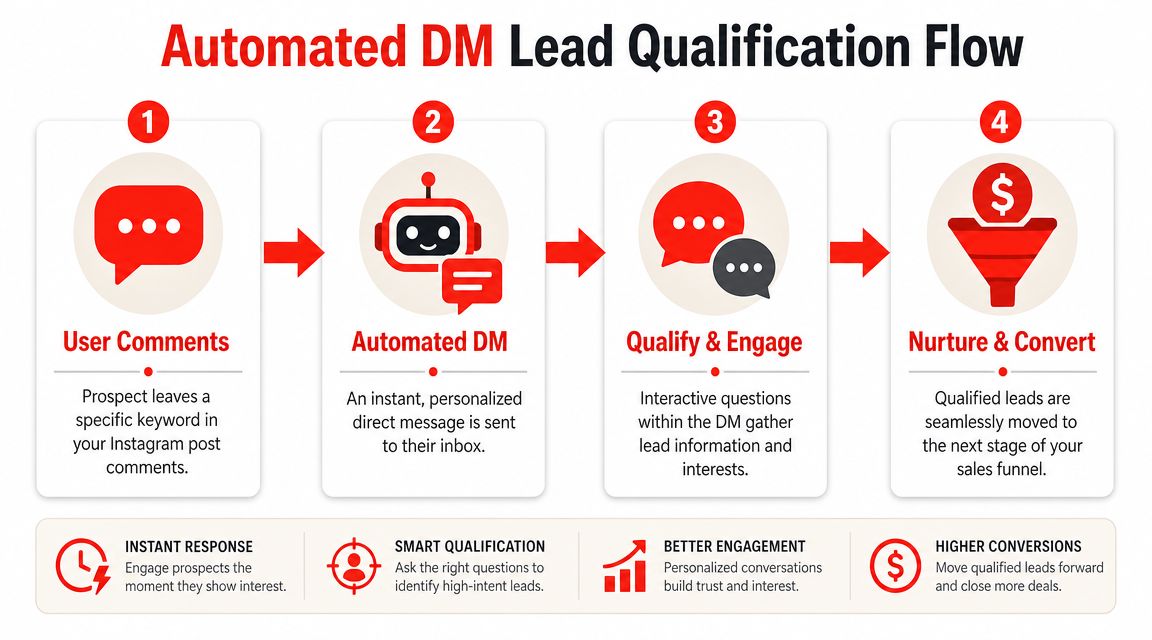
The cleanest Instagram lead workflow right now is simple. Publish content around a specific problem, ask people to comment a keyword, then trigger an automated DM that delivers the next step and starts qualification.
This works because public engagement is low friction and private conversation is high intent. Someone may hesitate to click a profile link, but commenting a keyword feels easy. Once they're in DMs, you can guide the interaction instead of hoping they keep browsing.
The comment-to-DM sequence
A strong workflow follows the “topic, hook, comment” structure. Expert guidance on this approach notes that a post with a specific CTA keyword, followed by an automated DM, can capture at least 3x more leads from the same content by moving people into direct conversation, as described in this walkthrough of the topic, hook, comment system.
Use a keyword that's unusually specific. Avoid common words that trigger accidental responses. A phrase with a number or a distinct label works better than something broad like “guide.”
A practical DM flow
Start with a post built around one offer. Then automate the handoff.
-
Post CTA
Ask viewers to comment a specific keyword to get the resource, checklist, quote guide, or booking link. -
Instant DM delivery
Send a short message that confirms the request and delivers the promised asset. -
Qualification question
Ask for one useful detail before pushing the conversation forward. That could be business email, project type, location, budget range, or timeline. -
Routing
Qualified leads get the next step. Unqualified leads still get help, but not the same sales path.
Here's a simple script:
Comment “PLAN7” and I'll send the checklist.
Then in DM:
Thanks, here it is. Before I send the full version, what kind of project are you planning?
Then:
Got it. What's the best email to send the checklist and follow-up notes to?
That one question changes everything. You're no longer collecting random interest. You're collecting intent with context.
A short video example helps if you want to see the logic in motion:
What to automate and what to keep human
Automation should handle speed, consistency, and first-pass filtering. It shouldn't pretend to be a closer for every situation.
Use automation for:
- Asset delivery
- Basic qualification
- Routing to booking or landing pages
- Tagging by interest or intent
Keep human follow-up for:
- Complex questions
- Pricing conversations
- Objection handling
- High-value sales opportunities
If you're choosing tooling, Mifu's insights on marketing automation are useful for thinking through how automation fits into a broader stack instead of acting as an isolated tactic.
Where most DM automations fall short
The common failure isn't technical. It's strategic. Businesses automate the delivery but skip the qualification step.
That creates a flood of conversations that look active but don't turn into quality pipeline. The fix is light friction. Ask one or two questions that reveal seriousness without making the interaction feel like an application form.
Convert Instagram Traffic with Smart Website Capture
The biggest leak in most Instagram funnels happens after the click.
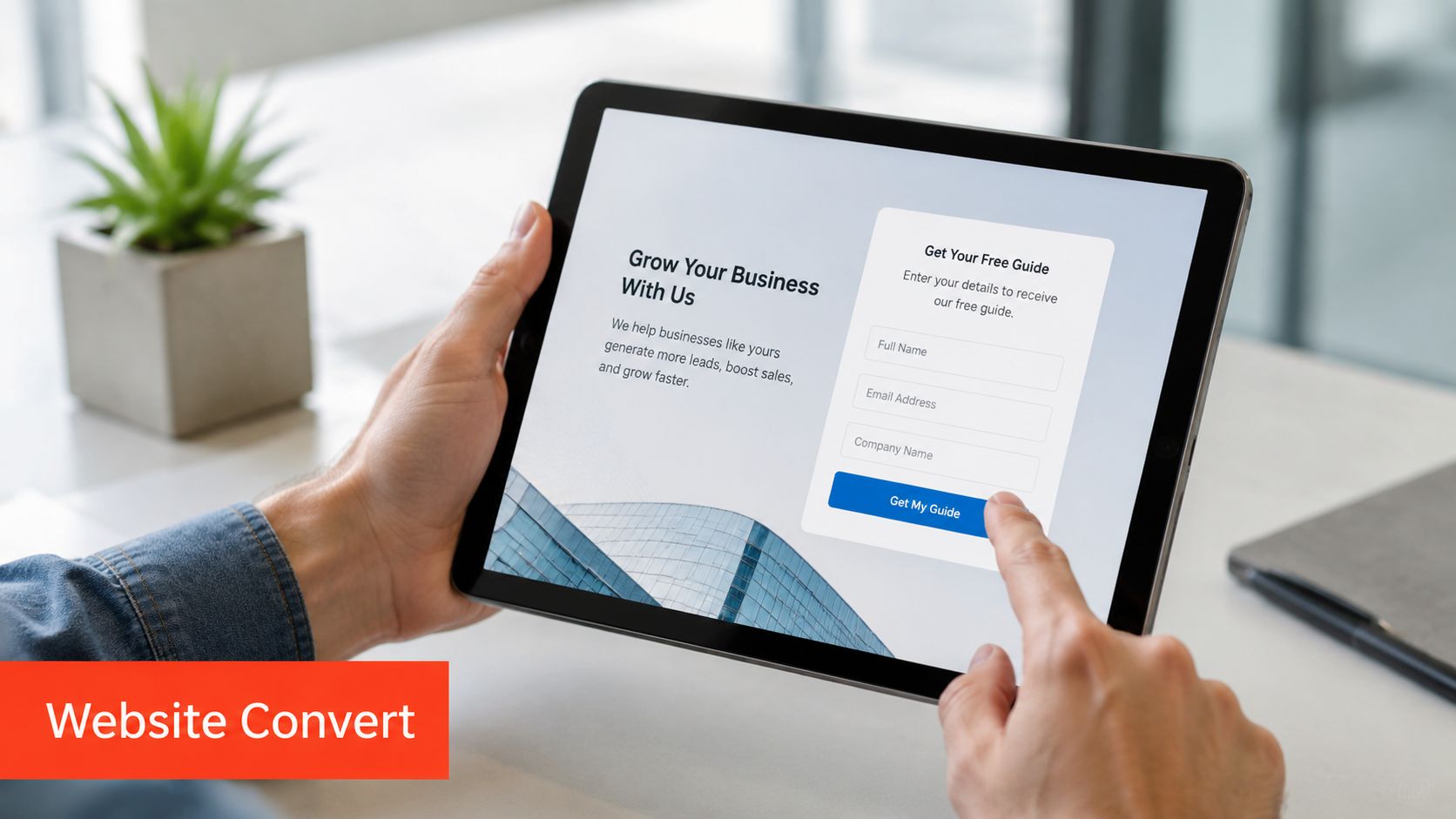
A person sees your post, responds to your CTA, and visits your website from a phone. They are warm. They already know who you are. Then the site greets them with a generic “Contact Us” page, a slow-loading form, or a wall of text that forces them to dig for basic answers. That wastes the intent you just paid for with content, time, or ad spend.
Why static forms underperform with warm social traffic
Instagram traffic behaves differently from high-intent branded search. Search visitors often arrive ready to compare vendors in a more deliberate mode. Instagram visitors are interest-rich but context-light. They need momentum, clarity, and fast answers.
That makes static forms a poor handoff in many cases. Forms ask the visitor to do all the work upfront. They don't answer questions, reduce uncertainty, or adapt based on fit.
Marketers are increasingly focused on qualifying leads without killing conversion, using qualification logic in DM automation and booking flows to filter low-intent prospects, as discussed in Sked Social's guide to Instagram lead generation. The same principle should continue on your website.
A better handoff from Instagram to site
The handoff should feel like a continuation of the conversation, not a reset.
A stronger setup includes:
- Message match so the landing page repeats the exact offer from the post or DM
- Mobile-first layout because Instagram traffic arrives from phones first
- Fast qualification through conversational prompts instead of a long blank form
- Immediate answers to common questions like timing, service area, fit, or process
AI assistants on the website become useful as they can greet visitors instantly, answer questions based on your site content, collect key details, and route people based on fit without forcing every visitor into the same static workflow.
If you're exploring that approach, this guide to lead generation chatbots for website conversion is a practical place to start.
Warm traffic shouldn't have to hunt for basic information after clicking from Instagram.
What qualification should happen on the website
The website doesn't need to interrogate people. It needs to sort them.
Here are good qualification categories to capture conversationally:
| Qualification area | Example prompt | Why it matters |
|---|---|---|
| Need | What are you looking for help with? | Routes by service line |
| Timing | Are you looking to start soon or researching options? | Separates active buyers from early-stage interest |
| Fit | Are you located in our service area? | Avoids wasted follow-up |
| Contact | What's the best email or phone number? | Moves the lead into owned channels |
That approach is especially effective for agencies, clinics, contractors, and local service businesses where not every inquiry is worth a sales call. The goal isn't more names in a spreadsheet. It's more conversations with the right people.
Measure What Matters and Scale with Ads
If you want better leads on instagram, stop judging performance by likes and follower growth alone. Those numbers can tell you whether content resonates, but they don't prove that your funnel is producing business value.
A weekly review should connect Instagram activity to lead behavior on your site. You need to know which content creates inquiries, which traffic converts, and where qualified opportunities originate.
The metrics that deserve attention
Use a simple hierarchy:
-
Content response metrics
Comments, DMs, Story replies, and link taps show whether the message sparked action. -
Traffic metrics
Look at visits from Instagram to campaign-specific pages, not just total traffic. -
Conversion metrics
Measure completed forms, booked calls, chat starts, or captured contact details from Instagram traffic. -
Quality metrics
Review whether those leads match your target customer, not just whether they arrived.
A simple weekly review process
Pull data from Instagram Insights and your website analytics side by side. If you need a stronger framework for reading account performance, optimizing Instagram performance analysis gives a useful lens for separating signal from noise.
Then review these questions:
-
Which post generated the most meaningful action?
Not the most likes. The most comments, DMs, or clicks tied to an offer. -
Which landing page held attention?
If people clicked but didn't convert, the handoff likely broke. -
Which source produced qualified leads?
Separate raw inquiries from people who fit your service, budget, or geography. -
What should be scaled?
Promote the content and offers that already convert organically before spending on ads.
If you want clearer attribution after the click, tools that track on-site behavior can help connect Instagram traffic to actual lead outcomes. This overview of website visitor tracking tools is a solid starting point.
When ads make sense
Instagram ads work best when they amplify a proven path. If a Reel, offer, or comment-to-DM workflow already produces quality inquiries organically, that's a strong candidate for paid distribution. If the profile is vague, the offer is weak, or the landing page drops visitors, ads will just accelerate the waste.
Paid should scale clarity, not compensate for confusion.
Conclusion Your Instagram Lead Playbook
The businesses that win on Instagram don't treat it like a gallery. They treat it like a funnel.
That means a profile with one clear path, content designed to create inquiry, DM automation that qualifies instead of just replying, and a website experience that continues the conversation instead of dropping it. That's the difference between “active on social” and consistently generating leads on instagram that your sales process can use.
Start with the bottleneck that's closest to the money. For most businesses, that's the profile, the DM flow, or the website handoff.
If your Instagram funnel is generating clicks but your website isn't turning that traffic into qualified conversations, LeadBlaze helps close the gap. It adds a 24/7 AI sales assistant to your site that can answer visitor questions, qualify leads based on your rules, and capture the details your team needs without relying on a cold contact form. For businesses that want faster response times and better lead quality from Instagram traffic, it's a practical next step.