Eighty-seven percent of B2B marketers report that content marketing successfully created brand awareness in the last 12 months, according to the Content Marketing Institute’s 2025 statistics. That should change how most small businesses think about marketing. Brand awareness isn’t a vanity goal for larger companies with spare budget. It’s often the first real constraint on growth.
A lot of small businesses don’t have a product problem. They have a visibility problem. Their service is solid, their customers stay, and referrals come in. But outside that existing circle, almost nobody knows they exist. Search results are crowded, social feeds move fast, and paid ads stop the moment the budget runs dry.
That’s why content works when it’s done properly. It compounds. A useful article, a clear service page, a practical video, or a well-timed email can keep attracting attention long after it’s published. Good content does more than just put your name in front of people; it gives them a reason to remember you.
The Challenge of Invisibility and How Content Changes the Game
Most owners start content marketing too late. They wait until lead flow slows down, then publish a few blog posts and hope traffic appears. That usually fails, not because content doesn’t work, but because they treat it like filler instead of infrastructure.
Obscurity is expensive. If buyers don’t recognize your name, every future sales conversation gets harder. You have to explain who you are, why you’re credible, and why someone should trust you. That slows down every deal and raises your customer acquisition cost, even if you never calculate it that way.
Content changes that dynamic by giving your market repeated exposure to your expertise before they ever talk to you. A buyer might find your article through search, see your explanation in a short video, then visit your site later after seeing your brand name again in their inbox or social feed. By the time they reach out, you’re no longer a stranger.
Why small businesses miss the opportunity
The usual mistake is equating content marketing with blogging for the sake of blogging. Publishing generic tips with no point of view won’t build awareness. Neither will copying what larger competitors post.
What works is content tied to real buyer questions, local demand, and your actual sales process. For a contractor, that might mean explaining project timelines, pricing factors, and common renovation mistakes. For a dental clinic, it could mean answering procedure questions in plain language and reducing anxiety before a patient books.
Practical rule: If a prospect asks the same question twice, it belongs in your content library.
Awareness is only useful if it leads somewhere
Many campaigns break down at this stage. They produce traffic, maybe even engagement, but not much business value. Awareness alone doesn’t pay the bills. It has to move into trust, inquiry, and lead qualification.
That’s the opportunity in content marketing brand awareness. Done well, it helps you become known by the right audience, not just a bigger audience. For a small business, that distinction matters more than reach for its own sake.
Understanding How Content Builds Brand Awareness
Traditional advertising interrupts. Content earns attention. That’s the difference.
An ad says, “Look at us.” Good content says, “Here’s something useful.” One pushes for immediate response. The other builds familiarity by helping first. Buyers usually prefer the second approach because it respects their timing and gives them a reason to stay engaged.
Content marketing generates 3x more leads than traditional marketing at 62% lower cost, and those leads convert 61% more effectively into sales, according to this 2025 content marketing roundup. For a small business, that matters because awareness can’t be separated from efficiency. If you need your brand to become more visible, you also need a channel you can afford to sustain.
Content works like a series of useful conversations
Think of content marketing as an ongoing conversation with people who aren’t ready to buy yet.
A cold sales pitch asks for trust upfront. Helpful content earns it gradually. A prospect reads a short guide, watches a demo, scans your FAQ page, then returns later for a deeper article. Every interaction reinforces the same impression. This business understands the problem. This team explains it clearly. They probably know what they’re doing.
That pattern creates three effects:
- Reciprocity: When you solve a problem early, people feel more open to hearing from you later.
- Authority: Clear, specific content signals expertise better than broad claims ever will.
- Familiarity: Repeated exposure makes your brand easier to remember when the need becomes urgent.
Why generic content fails
A lot of first-time content programs sound polished but say nothing. They use broad industry phrases, generic listicles, and recycled advice. That can fill a calendar, but it rarely builds recall.
Brand awareness grows when the content has a distinct viewpoint and serves a defined audience. If you run a local service business, you don’t need to publish like a national media company. You need to answer the exact questions your future customers type into Google, ask on calls, and compare across competitors.
One useful way to sharpen that point of view is to study how nearby or category competitors position themselves. A practical primer on competitor intelligence for marketers can help you spot topic gaps, repeated claims, and angles your brand can own.
The best awareness content doesn’t try to impress everyone. It makes the right people feel understood.
Brand awareness is built before buyers feel “ready”
This is the part owners often underestimate. Buyers form impressions before they submit a form or request a quote. If your content repeatedly shows up with useful answers, your brand becomes associated with competence long before the sales process starts.
That’s why content marketing brand awareness should be treated as pre-sales trust building, not just traffic generation. The click matters. The memory matters more.
Developing Your Brand Awareness Content Strategy
Most weak content programs don’t have a production problem. They have a strategy problem. The business publishes content without deciding who it’s for, what subjects it should own, or how the brand should sound when people encounter it repeatedly.
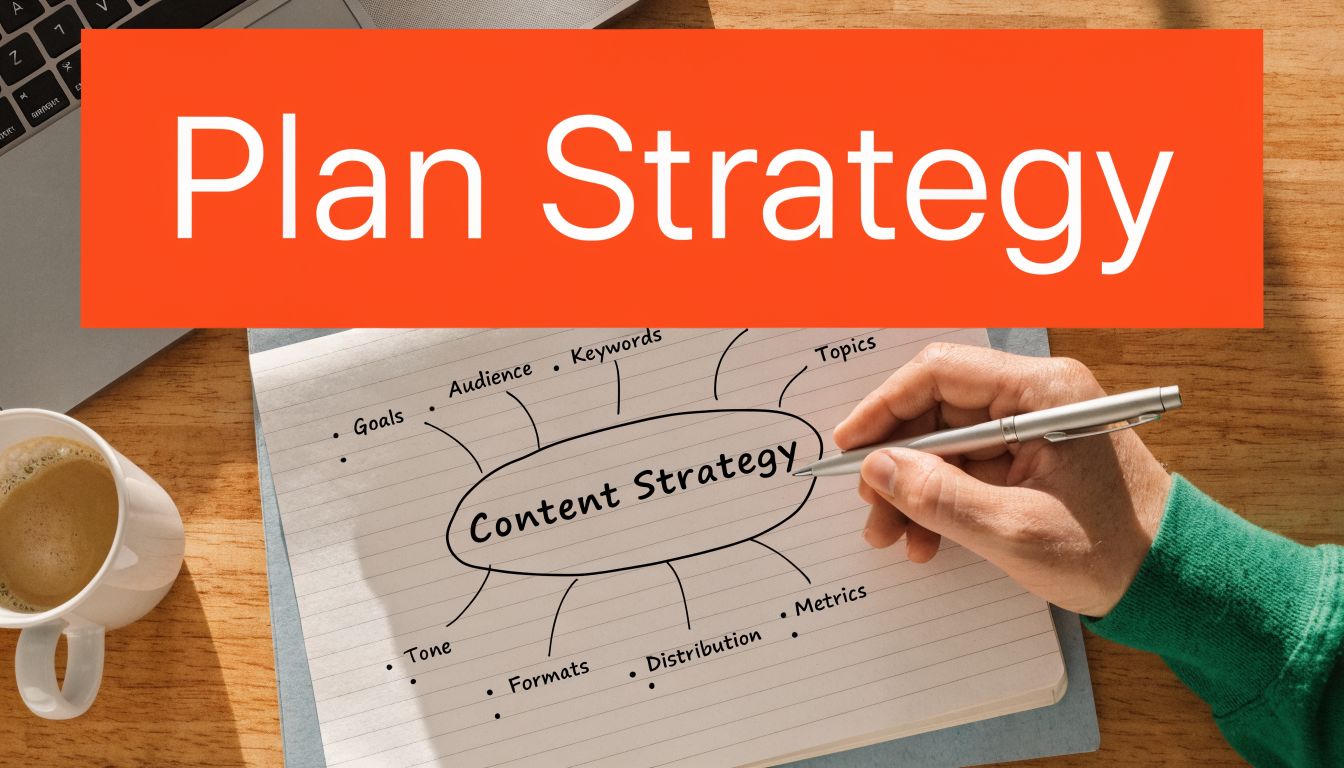
If you’re making your first serious push, keep the strategy simple. Build it around three decisions: Audience, Topics, and Voice. If those are clear, your content becomes easier to plan, easier to delegate, and much more likely to build recognition over time.
Start with audience clarity
You don’t need a bloated persona deck. You need a usable profile of the buyer you want your content to attract.
For a small business, the biggest trap is describing the audience too broadly. “Homeowners,” “small businesses,” or “people who need marketing” won’t guide strong content decisions. Narrow the picture until you can predict what that person worries about before they contact you.
Ask questions like these:
- What triggers the search: What happened that caused them to start looking now?
- What risk do they want to avoid: Are they afraid of wasting money, choosing the wrong provider, or looking foolish internally?
- What language do they use: Do they ask for outcomes, features, urgency, reassurance, or proof?
- What would make them bounce: Is your content too technical, too vague, too aggressive, or too polished to feel trustworthy?
When owners do this exercise truthfully, they usually discover they’ve been writing for peers or competitors, not buyers.
Choose a small set of topics you want to own
Good awareness strategy isn’t about covering everything. It’s about becoming strongly associated with a handful of useful subjects.
Pick topics at the intersection of customer need, business value, and proven expertise. That usually means focusing on problems you solve often, objections you handle repeatedly, and decisions buyers struggle to make.
A simple way to pressure-test your topic list:
- Commercial relevance: Does this subject attract people who could realistically become customers?
- Depth: Can your team say something specific and helpful beyond surface-level advice?
- Consistency: Can you create multiple formats around it, not just one article?
- Memorability: Does this topic reinforce what makes your business different?
If you’re a clinic, “what to expect” content may be stronger than broad health commentary. If you’re an agency, practical decision guides may outperform trend commentary. If you’re a contractor, scope, timing, and preparation questions are often stronger than design inspiration alone.
Define a voice people can recognize
A recognizable voice matters because awareness depends on repetition with consistency. If your blog sounds formal, your social posts sound playful, and your sales emails sound stiff, your audience doesn’t build a stable impression of your brand.
Your voice should match buyer expectations and your actual operating style. It shouldn’t be an invented personality.
Use these prompts to document it:
- How should the brand feel: Calm, direct, expert, friendly, reassuring, premium, plainspoken?
- What should you avoid: Jargon, hype, sarcasm, dense explanations, hard-selling language?
- How do you explain complex topics: With analogies, checklists, examples, or concise summaries?
- What should every piece of content leave behind: Clarity, confidence, urgency, relief, trust?
For teams that need help making voice more intentional, this guide on using brand archetypes to grow your audience is useful because it gives language for patterns many businesses already have but haven’t named.
A documented voice doesn’t make content sound robotic. It prevents your brand from sounding different every time someone touches the keyboard.
Keep strategy tight enough to use
The best content strategy for a small business often fits on one page. It doesn’t need a workshop, a slide deck, or abstract mission language. It needs decisions your team can apply next week.
A practical version might include:
- One primary audience segment
- Three to five core topics
- A short voice guide
- A list of questions buyers ask before contacting you
- A distribution rhythm your team can consistently maintain
If your strategy can’t help you decide what to publish this month, it isn’t finished yet.
Choosing the Right Content and Channels for Maximum Reach
Once the strategy is clear, execution becomes a resource allocation problem. You have limited time, limited creative capacity, and probably a limited budget. That means you can’t be everywhere, and you shouldn’t try.
The right move is usually to pick a few content formats you can produce consistently and distribute them across multiple channels. That’s important because multi-channel content distribution requires 5 to 7 targeted touchpoints to achieve 65 to 70 percent consumer recall rates, with a direct link to 25 to 40 percent uplifts in direct traffic, according to Uplift Content’s brand awareness analysis.
For most SMBs, the lesson isn’t “publish more.” It’s “repeat useful ideas across places your buyers already pay attention.”
What to prioritize first
Start with durable content before chasing fast content.
Durable content includes service pages, FAQ pages, how-to articles, comparison pieces, and educational videos tied to real buying questions. These assets keep working after publication and can be reused in email, social, and sales conversations. Fast content, like trend-based posts or reactive updates, can help reach, but it doesn’t usually form the foundation of awareness.
A common pattern that works:
- Blog content for search visibility
- Short video for social reach and trust
- Email for repeat exposure
- Selective social posting for distribution, not endless content production
If you’re exploring conversational tools alongside these channels, this breakdown of chatbots in marketing is useful for understanding where automated engagement fits and where it doesn’t.
Content and Channel Matrix for Brand Awareness
| Content Type | Primary Goal | Best Channels | SMB Effort Level |
|---|---|---|---|
| Educational blog posts | Build search visibility and answer buyer questions | Website, search, email newsletter, LinkedIn | Med |
| Short-form video | Increase familiarity and make expertise feel more human | Instagram, Facebook, YouTube Shorts, LinkedIn | Med |
| Downloadable guides | Capture higher-intent interest around complex decisions | Website landing pages, email, partner referrals | High |
| FAQ content | Remove friction and reinforce trust | Website, sales follow-up, search | Low |
| Case-based explainers | Show how you think without relying on hype | Website blog, email, LinkedIn | Med |
| Email newsletter | Maintain recall with people who aren’t ready yet | Email, website signup flows | Low |
| Customer story clips | Make your service feel real and relatable | Social, website, proposal follow-ups | Med |
Trade-offs that matter for small teams
Blogs are often the best starting point because they support search, sales enablement, and repurposing. But they require patience. You won't get the same immediate feedback you get from social content.
Video creates faster familiarity, especially for service businesses where trust is personal. The trade-off is production friction. If your team hesitates every time a camera appears, video becomes irregular fast. In that case, short screen-share explainers or simple talking-head clips are better than ambitious polished shoots that never happen.
Email is underrated for awareness. Many owners treat it only as a sales channel, but it’s also where brand memory gets reinforced over time. A short, useful monthly email can do more for recall than sporadic posting across five social platforms.
When partnerships expand reach
Some audiences are hard to reach through owned channels alone. In those cases, borrowed distribution can help. Guest appearances, co-created webinars, local partnerships, and creator collaborations can put your brand in front of a warmer audience.
If you go that route, relevance matters more than size. A niche creator with trust in your market can outperform broad exposure with the wrong crowd. Businesses that want outside help evaluating that path can review what an influencer marketing agency typically handles, then decide whether partnership outreach is something to do in-house or outsource.
Don't choose channels by popularity. Choose them by whether your buyers will actually encounter your content there more than once.
A practical distribution rhythm
A workable plan for a lean team often looks better than an ambitious one. For example, one useful article can become:
- A short email summary
- Several social posts with different hooks
- A script for a short video
- An FAQ update on a service page
- A sales follow-up resource
That gives you repeated touchpoints without inventing a new idea every day. Reach grows when the message travels, not just when the asset gets published.
How to Measure Content Marketing Brand Awareness
Most businesses either overmeasure the wrong things or undermeasure everything. They watch likes, pageviews, and occasional spikes in traffic, then struggle to answer a simple question: are more of the right people becoming aware of the brand?
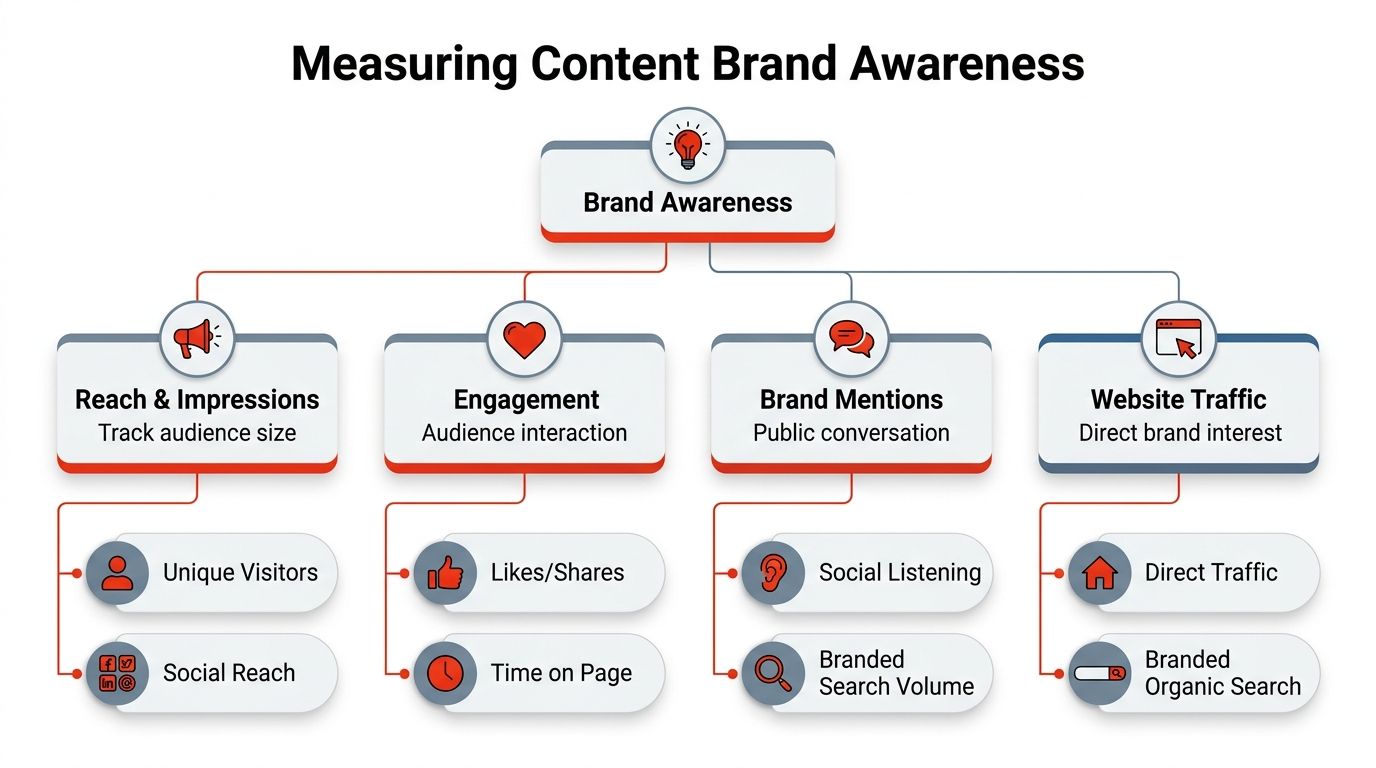
The cleanest way to measure content marketing brand awareness is to use a pyramid. At the bottom are easy signals that suggest exposure. In the middle are actions that show interest is forming. At the top are the harder indicators that show your brand is occupying mindshare.
Leading indicators
These are the first signs your content is being seen and interacted with. They don't prove awareness on their own, but they tell you whether distribution and topic selection are gaining traction.
Look at metrics like:
- Organic traffic: Are more people reaching your site through search?
- Social engagement: Are posts getting comments, shares, or saves, not just impressions?
- Time on page: Are visitors consuming the content?
- Returning visitors: Are people coming back after the first interaction?
Google Analytics and native social dashboards are enough to track most of this. If you want a stronger picture of who is revisiting key pages, tools covered in this guide to website visitor tracking tools can help connect visibility with later buying behavior.
Connecting metrics
These sit between attention and true awareness. They suggest your content has moved from passive exposure into active interest.
Useful examples include newsletter sign-ups, resource downloads, contact page visits, and repeat visits to service pages. None of these guarantees someone will become a customer, but they show that the audience isn't just passing through.
This is also where context matters. A service guide that drives fewer visits but leads readers deeper into your site may be more valuable than a broad post that attracts the wrong traffic. Small businesses often miss this because they reward volume instead of progression.
Key metric filter: If a metric can't help you make a better content decision next month, it doesn't deserve much attention this month.
True awareness indicators
These are the signals that matter most because they show your brand is becoming known, not merely seen.
One of the strongest is share of voice, which is calculated as your brand’s portion of total conversations in your category or topic space, as explained in Developer Media’s overview of technical content and brand awareness. If more people mention your brand relative to competitors, your awareness position is improving.
Other high-value indicators include:
- Direct traffic: People type your brand or URL directly because they already know you
- Branded search behavior: Search interest includes your company name, not just generic category terms
- Brand mentions: Your business comes up in social posts, discussions, newsletters, or partner content
How to make the measurement useful
You don't need enterprise attribution software to do this well. A simple monthly review is enough if it’s consistent.
Track three things together:
| Layer | What to watch | Why it matters |
|---|---|---|
| Leading | Organic visits, engagement, content consumption | Shows whether content is being discovered and used |
| Connecting | Sign-ups, repeat visits, service page depth | Shows interest is becoming more intentional |
| True awareness | Direct traffic, branded search behavior, mentions, share of voice | Shows your brand is sticking in the market |
The mistake is treating all three layers as equal. They're not. Leading indicators tell you whether the engine is running. True awareness indicators tell you whether the market remembers your name.
Converting Brand Awareness into Qualified Leads
Many content programs often stall. Traffic improves. More people know the brand. A few more visitors hit the site. But the sales pipeline barely changes.
The reason is simple. Awareness creates opportunity, not qualification.
There’s a documented gap in how marketers connect awareness campaigns to lead quality. Contently’s analysis of brand awareness problems highlights that businesses often struggle to answer a basic question: are awareness efforts attracting the right prospects, or just more attention? For small businesses, that's not a reporting issue. It's a revenue issue.
Why passive websites waste hard-earned attention
A typical SMB site still handles awareness poorly. A visitor arrives from search or social, skims a page, maybe clicks pricing or services, then hits a static form that asks them to “get in touch.” There’s no conversation, no clarification, no triage.
That creates friction at exactly the wrong moment. Someone may be interested but not ready to fill out a generic form. Someone else may be ready to buy but have one unanswered question. Another visitor may be a poor-fit lead who still takes up team time later.
Content can bring people in, but your site has to do something useful with that attention once it arrives.
What real-time AI engagement changes
Real-time AI engagement closes that gap because it turns a passive visit into an active exchange. Instead of waiting for a visitor to self-sort perfectly, the site can respond immediately, answer common questions, and guide the next step based on intent.
That matters for three reasons.
It captures intent while it’s still fresh
A visitor who lands on your site from a content asset has context in mind right now. They may be comparing providers, checking fit, or trying to understand urgency. If nobody engages them in that moment, interest fades fast.
An AI assistant can greet the visitor, respond using the information already on your site, and keep the interaction moving. That preserves the value your content created instead of handing it off to a dead end.
It improves qualification before the handoff
Not every inquiry deserves the same sales follow-up. Some leads need scheduling. Some need education. Some aren't a fit at all.
A well-configured AI assistant can ask practical questions tied to your sales process, such as location, service type, budget range, urgency, or project scope. That gives your team cleaner inbound context before a human ever steps in. Awareness becomes more than a traffic play. It becomes a filter.
If your content attracts attention but your website can't sort intent, your team ends up paying to educate, chase, and disqualify people manually.
It keeps your brand voice consistent outside business hours
This is the operational issue many businesses ignore. Awareness doesn't happen on a nine-to-five schedule. People read, compare, and revisit sites at night, on weekends, and between meetings. If your website only “works” when someone on your team is available, your brand experience becomes inconsistent.
An AI assistant can maintain a stable tone, answer routine questions, and collect the details your team needs. That doesn't replace human sales judgment. It protects it by handling the first layer consistently.
Here’s a product walkthrough that shows how this kind of interaction works in practice:
What to look for in an awareness-to-lead system
If you're evaluating tools in this category, focus on whether they support your existing process instead of adding complexity.
Look for these capabilities:
- Brand control: Can you shape tone, messaging, and what the assistant should or shouldn't say?
- Qualification logic: Can it collect the details that define a good lead for your business?
- Useful summaries: Does your team get concise context, or do they have to read long transcripts?
- Simple implementation: Can it go live quickly without turning into a dev project?
A lot of businesses spend months improving awareness and then lose the gain at the conversion layer. That's avoidable. The website should do more than display information. It should help identify who’s ready, who needs nurturing, and who doesn't belong in the pipeline.
Your Path to Building a Lasting Brand Presence
Content marketing brand awareness works best when you stop treating it like a campaign and start treating it like a system. The businesses that win aren't always the loudest. They're the ones buyers keep encountering in useful, relevant, and consistent ways.
That system is simpler than people think when it’s built in the right order:
- Understand: Know why content earns attention differently from ads, and why trust usually forms before contact.
- Strategize: Define a narrow audience, a focused topic set, and a voice your market can recognize.
- Execute: Choose formats and channels your team can sustain, then distribute each idea across multiple touchpoints.
- Measure: Watch signals that move from exposure to interest to real awareness, especially direct traffic, branded behavior, and share of voice.
- Convert: Make sure the site can engage visitors and qualify intent while attention is still active.
Each step strengthens the next. Strategy improves execution. Execution gives you better data. Better data helps you refine what attracts the right audience. Better conversion makes the whole system worth funding again.
The strongest brand presence isn't built by occasional bursts of activity. It's built by showing up usefully, over and over, until your market starts to remember you without being prompted.
If you're a small business owner, this should be good news. You don't need to outspend larger competitors to become better known. You need a sharper message, more discipline in what you publish, and a site that can do more with the attention your content earns.
Stay consistent long enough, and awareness stops feeling abstract. It starts showing up in better conversations, warmer leads, and less time spent proving who you are.
If you want your website to do more than collect cold form fills, LeadBlaze helps turn your content-driven traffic into qualified conversations around the clock. It learns from your site, answers visitor questions, captures the details that matter to your sales process, and keeps your brand voice consistent even when your team is offline. For small businesses investing in awareness, it’s a practical way to connect visibility with real pipeline value.