
You lose a deal on Tuesday afternoon.
The prospect sounded warm. They asked good questions. They liked your pricing. Then they went quiet. A day later, you learn why. A competitor rolled out a new service package over the weekend, wrapped it in sharper messaging, and made the buyer feel like they were already one step ahead.
That moment stings because it usually isn’t about effort. It’s about visibility. You were working hard, but you were working without a clear view of the field.
For this, competitor intelligence is vital.
If you’ve ever wondered what is competitor intelligence, the simple answer is this: it’s the habit of collecting and using public information about competitors so you can make smarter decisions. Not spying. Not copying. Not obsessing over every move. Just building enough awareness to spot threats early, notice openings, and respond with intention.
For a small business, that can feel like a big-company discipline. It doesn’t have to be. You don’t need a research department or a giant software budget. You need a practical way to watch the market without drowning in data.
Consider it a weather forecast for your business. You can’t control the storm, but you can carry an umbrella, change the route, or leave earlier. Competitor intelligence works the same way. It helps you prepare instead of react.
Beyond Looking Over Your Shoulder
Most business owners start with a narrow view of competitors. They check a rival’s website once in a while, glance at pricing, and move on. That’s understandable, but it’s not enough when your market shifts faster than your team can hold a meeting.
Competitor intelligence is broader than occasional checking. It’s a repeatable way to notice what rivals are changing, why they might be changing it, and what that means for your next move.
A lot of people get stuck on the word “competitor.” They think it means a head-to-head battle. In practice, it often means something quieter. A competitor might be taking your leads with clearer offers, better response times, stronger positioning, or more relevant content. You don’t lose because their product is wildly better. You lose because they understood the buyer’s moment better.
What competitor intelligence really means
At its simplest, competitor intelligence answers questions like these:
- What are they selling now
- How are they describing the value
- Who are they trying to attract
- What signals suggest they’re expanding, repositioning, or struggling
- Where are customers still underserved
Those answers let you act with more confidence.
Competitor intelligence isn’t about watching others for entertainment. It’s about reducing guesswork in your own decisions.
What it is not
Readers often get confused on this point.
Competitor intelligence is not:
- Espionage: You’re using public, ethical sources.
- Copying: The goal is differentiation, not imitation.
- A one-time audit: Markets move. Your view has to stay fresh.
- Only for giant brands: Small teams often gain more because they can act faster.
A smart SMB owner doesn’t need a mountain of data. They need enough signal to stop being blindsided.
Why Competitor Intelligence Is Your Secret Weapon
Big companies don’t invest in competitor intelligence because it’s fashionable. They invest because uncertainty is expensive.
According to XLSCOUT’s competitive intelligence statistics, 90% of Fortune 500 companies use competitive intelligence, 94% of businesses plan to invest in it, and over 73% of enterprises dedicate more than 20% of their tech budgets to intelligence and data analytics initiatives. That tells you something important. Market awareness isn’t a side hobby anymore. It’s part of how serious companies operate.
For smaller firms, this matters even more.
You probably can’t outspend a larger rival. But you can often outlearn them. A small team that notices a shift early can adjust copy, offers, outreach, and follow-up in days instead of quarters.
Where the advantage shows up
Competitor intelligence helps in places that directly affect revenue:
- Sharper positioning: If every rival says “quality service” and “trusted team,” you can spot the sameness and write messaging that sounds distinct.
- Better sales conversations: If prospects keep comparing you to one specific alternative, your sales team can prepare objections and proof points before the call starts.
- Content that fills gaps: When competitors ignore a buyer question, you can own it with a guide, landing page, or FAQ.
- Faster reaction time: If a rival changes pricing, packages, or target audience, you can decide whether to counter, ignore, or lean into your difference.
- Smarter product choices: You see which features look like real market direction and which look like noise.
Why SMBs often benefit more
Large companies have more resources, but they also have more layers. Small businesses can turn insight into action quickly.
If you run an agency, local service business, or niche B2B firm, one useful insight can reshape your month. You might discover that competitors respond slowly, hide prices, overcomplicate their offers, or neglect after-hours inquiries. Those aren’t trivia points. They’re openings.
Competing on insight, not budget
Think of two fighters in the ring. One is bigger. The other studies patterns. The second fighter notices when the first drops a hand after every jab. That’s the punch to exploit.
Business works the same way. The point isn’t to know everything. The point is to notice what matters.
Practical rule: If your market feels crowded, intelligence helps you compete with clarity instead of volume.
That’s why competitor intelligence becomes a secret weapon. It helps you stop guessing what buyers are seeing elsewhere and start responding to the actual competitive environment in front of you.
Understanding the Two Tiers of Intelligence
A lot of business owners hear “competitor intelligence” and picture a giant spreadsheet with endless tabs. That image scares people off. A better way to understand it is to split it into two tiers.
One tier helps you think long-term. The other helps you react in the short term.
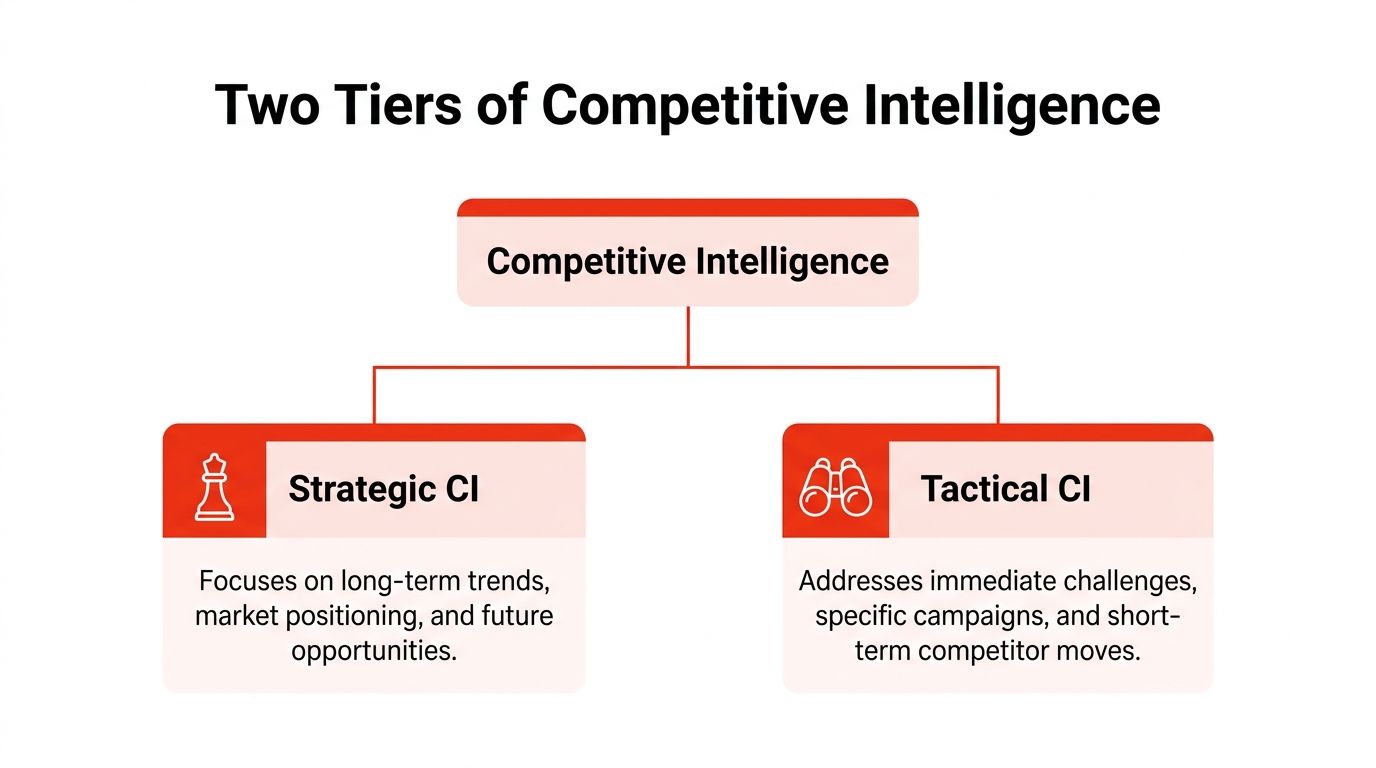
Strategic intelligence
Think like a ship captain with a map.
Strategic competitor intelligence is about direction. It looks at where rivals appear to be heading over time. You aren’t focused on today’s promotion. You’re trying to understand their broader play.
That can include:
- Market positioning: Are they going premium, budget, niche, or broad?
- Audience focus: Are they moving upmarket or chasing smaller customers?
- Category bets: Are they building around speed, service, AI, convenience, or specialization?
- Experience design: Are they simplifying their site, process, and offer in ways that improve conversion, similar to the principles discussed in optimizing user experience?
Strategic intelligence helps you answer a deeper question: what kind of business are they trying to become?
Tactical intelligence
Now switch from the map to the lookout.
Tactical competitor intelligence focuses on immediate signals. These are the moves that affect deals, campaigns, and buyer perception right now.
Examples include:
- Pricing changes
- New service pages
- Fresh ad messaging
- Email offers
- Hiring activity
- Website updates
- Review trends
This is the kind of intelligence your sales and marketing team can use this week.
A simple analogy
A football coach studies an opponent in two ways.
First, the coach studies the rival’s season strategy. Are they a defensive team? Do they rely on possession? That’s strategic.
Then the coach studies recent game tape. Which play did they run in the red zone last week? Which player is injured? That’s tactical.
You need both. If you only study strategy, you’ll miss the immediate threat. If you only watch recent moves, you’ll miss the bigger pattern.
For most SMBs, the easiest place to start is tactical intelligence. It’s closer to daily decisions, and the value shows up faster.
Building Your Competitor Intelligence Toolkit
You don’t need fancy software to begin. You need a sensible mix of sources.
The useful signals usually fall into four buckets: Pricing, Product, Promotion, and People. Those four areas tell you what a competitor sells, how they package it, how they market it, and where they may be investing next.
According to Coresignal’s overview of competitive intelligence, competitor intelligence includes real-time monitoring of signals like pricing, product updates, and hiring trends. The same source notes that outdated information leads to 20-30% lower win rates, and that 74% of enterprises use Big Data analytics in CI, which helps accelerate data-driven decisions by 5x. The lesson for an SMB is simple. Fresh information beats old screenshots and memory.
The four source categories
Some sources are free. Some are paid. Start with what you already have access to.
| Source Type | Examples | What You Get | Best For |
|---|---|---|---|
| Pricing | Public pricing pages, proposal requests, quote forms | Packaging, discount patterns, guarantees, contract structure | Sales positioning and offer design |
| Product | Service pages, feature pages, release notes, demos | What changed, what’s emphasized, what’s missing | Product marketing and roadmap decisions |
| Promotion | Ads, email newsletters, social posts, blog content, landing pages | Messaging themes, campaign timing, target audience clues | Marketing strategy and copywriting |
| People | Job boards, LinkedIn company activity, leadership posts | Hiring focus, team expansion, possible priorities | Early signals about direction |
Free sources that many teams overlook
The cheapest toolkit is often the one sitting in plain sight.
- Your own sales calls: Prospects tell you who they're comparing you to and why.
- Your CRM notes: Lost deal reasons often reveal recurring competitor patterns.
- Competitor websites: Homepages, service pages, and pricing pages change more often than people realize.
- Google search results: Search your core terms and see who appears with what message.
- Public reviews: Complaints reveal gaps. Praise reveals what buyers care about.
If your website is central to lead generation, it's also worth understanding how visitor behavior compares to your assumptions. Tools that support this kind of visibility can complement your CI workflow. For a practical overview, see website visitor tracking tools.
Paid tools when you need more depth
Once your manual process starts producing useful insights, then software becomes worth considering.
Some tools specialize in SEO visibility. Others track website changes, ads, or firmographic signals. If you're comparing options, this roundup of 12 Best Competitive Intelligence Tools is a helpful starting point because it organizes platforms by use case instead of treating them as interchangeable.
Buy tools after you've defined the questions you need answered. Otherwise, you'll pay for noise.
The best toolkit isn't the biggest one. It's the one your team will use every week.
A Lightweight CI Process for Busy Teams
Many SMBs understand the idea of competitor intelligence but never turn it into a routine. That's the primary bottleneck.
Clarity's discussion of competitive intelligence for SMBs highlights the implementation gap well. It cites a 2023 McKinsey report saying only 28% of SMBs systematically use competitive analytics because setup costs and lack of expertise get in the way. That rings true. Small teams don't usually fail because they don't care. They fail because the process feels too heavy.
A lightweight process works better than an ambitious one you abandon.

Step 1: Identify the few competitors that matter
Don't track everyone.
Choose:
- Your direct rival who shows up in deals most often.
- The aspirational rival whose brand or positioning buyers mention.
- The disruptive rival trying a different angle that could reshape expectations.
For many SMBs, that's enough. More than that often creates clutter.
Step 2: Gather information on a schedule
Here, discipline beats intensity.
Use a simple spreadsheet or shared document with columns such as:
- Date noticed
- Competitor name
- What changed
- Where you saw it
- Why it might matter
- Possible response
Gather from a few recurring places: websites, pricing pages, Google search results, review sites, LinkedIn updates, and sales call feedback.
If SEO matters to your lead flow, it helps to monitor how competitors move in search over time. This guide on how to track competitor SERP rankings automatically is useful if you want a lightweight way to add search visibility to your process.
Step 3: Analyze for meaning, not just movement
A list of changes isn't intelligence yet.
Ask:
- Is this a one-off test or part of a pattern
- Does this affect our buyers' expectations
- Are they solving a customer frustration better than we are
- Are they moving toward our niche or away from it
This step matters because raw data creates the illusion of progress. Interpretation is where value appears.
If you can't answer "So what?" after collecting a data point, don't keep collecting that type of data.
Step 4: Act with one clear response
Every review cycle should end with a decision.
Not ten decisions. One.
That action might be:
- Rewrite a headline
- Add a comparison page
- Train sales on a new objection
- Test a revised offer
- Create content around an unanswered buyer question
Small teams win by staying in motion. The cycle is simple: notice, interpret, respond, repeat.
Turning Competitive Insights into Action
A lot of teams collect competitor information and stop there. They build folders, save screenshots, and label documents. Then nothing changes in the business.
That happens because insight isn't yet connected to execution.
Analyzer's article on evaluating competition and unserved demand points to this gap. It notes that 52% of SMB marketers cite siloed data as a barrier to actionable intelligence in real-time sales funnels. That's the practical challenge. The data exists, but it doesn't reach the people shaping copy, conversations, and conversion paths.

Use intelligence to sharpen your message
Suppose three competitors all lead with broad claims like "trusted experts" or "full-service support." That's your cue to get specific.
You might shift your homepage and landing pages toward clearer promises:
- Faster response times
- Specialized expertise for a niche
- Transparent process
- Better after-hours availability
This isn't about sounding louder. It's about sounding more relevant.
Feed insights into your sales funnel
Many SMBs can create quick gains here.
If reviews, sales feedback, or public comments suggest a competitor is weak at after-hours responsiveness, you can use that insight in your lead flow. Your chatbot, forms, or qualification questions can emphasize availability, urgency, and support expectations.
For example, if your rival seems slow to respond outside business hours, your site can ask visitors whether they need help tonight, this weekend, or first thing tomorrow. That turns a competitor weakness into a live qualification advantage.
If customer experience is part of your edge, it helps to measure it deliberately rather than rely on instinct. This guide on measure customer experience is a useful companion for translating that promise into something operational.
Shape content around the gaps competitors leave behind
Competitor intelligence also improves your editorial choices.
Look for:
- Questions they avoid
- Buyer objections they don't address
- Industries they speak to poorly
- Use cases they ignore
- Service concerns hidden in reviews
Those gaps can become blog posts, comparison pages, service FAQs, and lead magnets.
Field note: The best content ideas often come from what competitors leave unclear, not from what they say loudly.
Influence offers and roadmap decisions
Not every insight should trigger a campaign. Some should influence packaging or service design.
If several competitors are adding complexity, your opportunity may be simplification. If they bundle too much, your edge may be a cleaner starter option. If they push automation without reassurance, your edge may be human guidance around the same process.
The important habit is this: every competitive observation should have an owner. Marketing owns some responses. Sales owns others. Leadership owns bigger strategic moves.
That's how competitor intelligence becomes a growth tool instead of a research archive.
Playing Fair and Keeping Score
Competitor intelligence only works if you keep it ethical and useful.
The ethical line is simple. Use publicly available information and customer feedback you've earned legitimately. That includes websites, pricing pages, search results, ads, reviews, public job listings, social posts, and your own sales conversations.
Don't cross into private systems, deception, or confidential material. If you'd be uncomfortable explaining your method to a client, employee, or attorney, don't do it.
The fair-play rules
- Use public sources: Stick to information competitors publish or buyers voluntarily share.
- Document where you found it: This keeps interpretation grounded.
- Separate facts from guesses: "They launched a new pricing page" is a fact. "They must be desperate" is a guess.
- Avoid copycat behavior: Borrow insight, not identity.
How to tell if your effort is working
You don't need a complicated dashboard. Track a few business outcomes tied to decisions you've made.
A simple scorecard can include:
| KPI | What it tells you |
|---|---|
| Win rate against a named competitor | Whether your positioning and sales response are improving |
| Lost deal reasons | Whether the same competitor objections keep appearing |
| Landing page conversion rate after messaging changes | Whether your revised positioning resonates |
| Sales call objections by theme | Whether buyer concerns are shifting |
| Content engagement on gap-focused topics | Whether you chose the right unmet questions |
Keep one more note beside every metric: what changed. That way, when results improve or slide, you can connect performance to a specific action instead of guessing.
Good competitor intelligence doesn't make you paranoid. It makes you more deliberate.
Your First Move in the Intelligence Game
Competitor intelligence sounds bigger than it is.
It's a business habit. You pay attention to what rivals are doing, filter for what matters, and use that knowledge to improve how you sell, market, and serve. That's all. The power comes from consistency, not complexity.
If you're still asking what is competitor intelligence in practical terms, here's the clearest answer: it's the difference between reacting late and responding early.
You don't need to build a formal department. Start smaller than that.
Pick one competitor. Watch them for the next 30 days. Track their homepage changes, offers, content themes, reviews, and sales signals. Keep notes in one place. At the end of the month, answer one question: what should we change because of what we learned?
That single exercise will teach you more than hours of abstract planning.
The biggest risk in a crowded market isn't that competitors exist. It's that you ignore the clues they're leaving in public and keep making decisions in the dark.
If you want to turn more of your website traffic into qualified conversations, LeadBlaze helps you do it around the clock. It gives SMBs and agencies a practical way to engage visitors instantly, ask the right qualification questions, and capture useful lead context without relying on static forms. It's a strong fit for teams that want their sales funnel to respond faster, learn from visitor intent, and stay competitive even when nobody's at the desk.