Imagine walking into a bustling café where the barista greets you by name, knows your favorite brew, and can recommend just the right pastry. That’s exactly what a well-designed marketing chatbot does for your website. It’s a friendly concierge on call 24/7, ready to answer questions and steer visitors toward the content they’re looking for.
The New Face Of Digital Engagement
Back when websites were little more than online brochures, visitors clicked through static pages, hunted for contact forms, and often left feeling detached. Now, companies see that waiting for users to reach out is leaving opportunities on the table—especially if someone drops by late at night or has a quick question right away.
Chatbots change the game by serving as your digital front desk. They’re not some sci-fi gimmick; they’re practical, tireless helpers that can juggle thousands of chats in perfect harmony. Think of them as your best employee—never tired, never distracted, and always delivering consistent responses.
Why Immediate Interaction Matters
The first moments on your site set the tone. In fact, 59% of customers expect an answer within five seconds. Fail to meet that window, and you risk losing their attention for good.
Chatbots close that gap by:
• Reducing Bounce Rates: A quick “Hello, can I help?” invitation keeps visitors engaged, signaling to search engines that your content is worth exploring.
• Capturing After-Hours Leads: Your doors might shut at 5 PM, but your chatbot never clocks out—so no lead slips away when you’re off the clock.
• Improving User Experience: Instead of wandering through menus, users get a direct route to answers, making their journey smoother and more satisfying.
A chatbot’s primary role in marketing is to open a conversation. It turns a one-way information broadcast into a two-way dialogue, building a relationship from the very first click.
At its core, embedding chatbots in your marketing strategy is about honoring modern expectations for speed and convenience. It’s a chance to make your brand feel more approachable and genuinely helpful—even when you’re not there in person. For a deeper dive, check out a comprehensive guide on AI Chat for Marketing. This shift from static pages to active conversations is the cornerstone of effective digital strategy today.
How Marketing Chatbots Actually Work
At their core, marketing chatbots are all about guiding conversations, but they do it in two very different ways. You can think of them as either a highly organized flowchart or a savvy sales assistant.
The first kind, a rule-based chatbot, is like a choose-your-own-adventure story. It follows a strict, pre-written script with decision trees and buttons. It’s fantastic for straightforward tasks where the user’s journey is predictable.
Then you have the AI-powered chatbot. This one feels more like you’re chatting with a real person who understands nuance and context. It doesn’t just follow a script; it listens, learns, and adapts.
Rule-based chatbots follow scripts, while AI chatbots adapt to user intent.
One is a dependable, by-the-book assistant, perfect for simple FAQs. The other is a dynamic problem-solver ready for complex, unscripted conversations.
Understanding Natural Language Processing
So, what’s the magic behind those smarter AI bots? It’s something called Natural Language Processing (NLP).
Essentially, NLP is the technology that lets a machine understand human language—not just the words, but the meaning and intent behind them. It’s how the bot can tell if a visitor is just browsing, has a specific problem, or is ready to make a purchase.
For instance, when a visitor types “What’s your pricing?” or “Can I see a demo?”, the chatbot instantly recognizes these as buying signals. Instead of offering a generic FAQ link, it can pivot the conversation toward scheduling a call or showing a pricing page. It’s all about understanding what the user really wants and delivering the right next step.
Rule-Based Chatbots vs AI-Powered Chatbots
Deciding between a structured, rule-based system and a flexible, AI-driven one is a key first step. Each has its own strengths and is built for different kinds of marketing goals.
This table breaks down the core differences to help you figure out which approach is the right fit for your business.
| Feature | Rule-Based Chatbot | AI-Powered Chatbot |
|---|---|---|
| Conversation Design | Follows predefined scripts and decision trees. | Generates responses dynamically based on user input. |
| Context Awareness | Limited; doesn’t remember past interactions. | High; learns from conversation history for a personal feel. |
| Scalability | Easy for simple, structured flows but hard to scale for complexity. | Learns and improves with more data, scaling effortlessly. |
| Best Use Case | Simple lead capture, appointment booking, and FAQs. | Complex support, personalized recommendations, and dynamic sales. |
Ultimately, a rule-based bot is a great starting point for clear, defined tasks. But if you’re aiming for truly personalized, human-like conversations that build relationships, an AI-powered chatbot is the way to go.
Visualizing Chatbot Engagement
It helps to see how these interactions play out visually. This infographic breaks down the typical journey a user takes with a marketing chatbot.
You can see the three key stages: greeting the visitor, guiding them toward what they need, and finally, capturing their information to turn them into a lead.
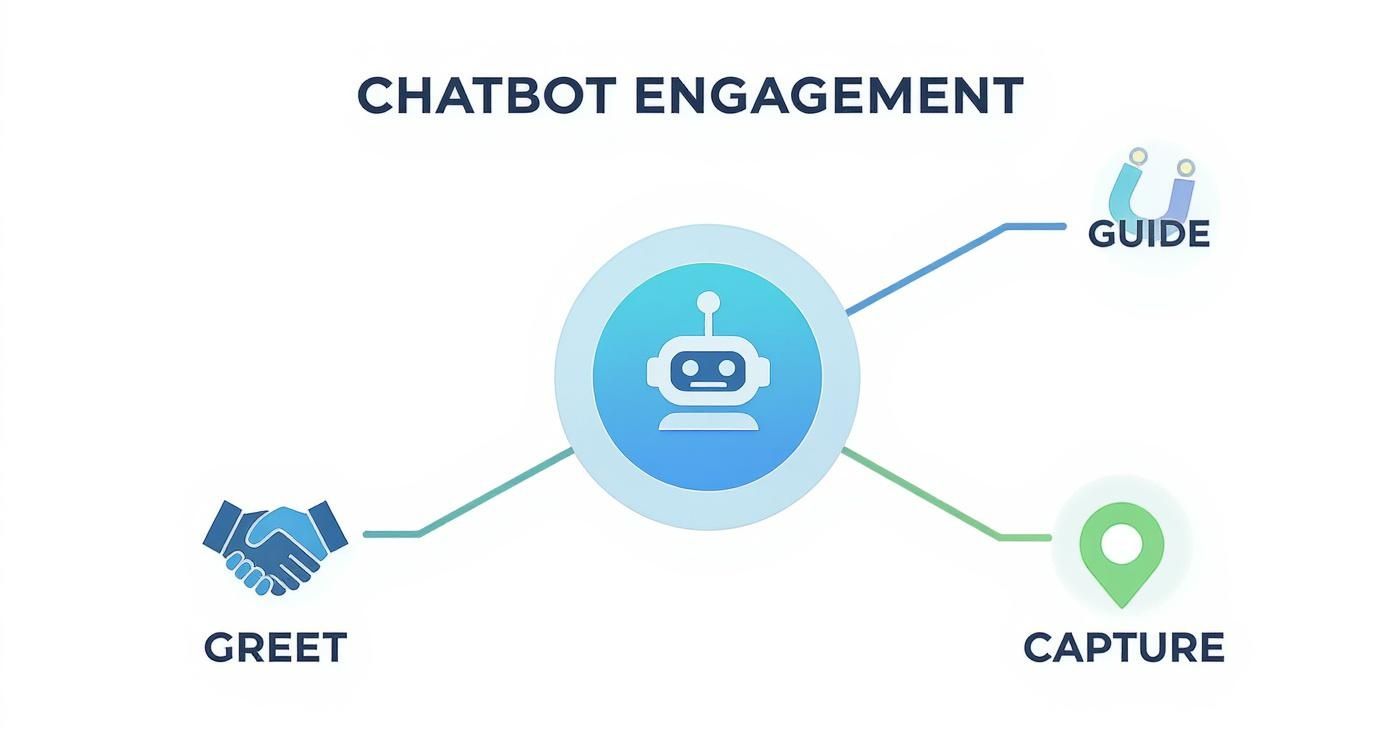
Think of it as a friendly digital concierge for your website—welcoming visitors, answering their questions, and making sure the valuable leads don’t slip away.
Advanced AI Personalization
This is where modern marketing chatbots truly shine. They’ve moved far beyond just answering questions; they’re now masters of personalization.
Using a combination of NLP and machine learning, an AI bot can remember a user’s preferences, past purchases, and even their browsing behavior on your site. Imagine a returning visitor being greeted by name with a message like, “Welcome back, Sarah! Last time you were looking at our enterprise plan. Want to see a new case study about it?”
That’s the kind of data-driven, tailored experience that turns a generic interaction into a memorable one.
This is especially powerful when your chatbot integrates directly with your CRM. A tool like LeadBlaze, for example, can sync this conversation data in real-time, giving your sales team a complete picture of every lead.
The market is taking notice. Projections show the global chatbot market is set to explode, growing from $2.47 billion in 2021 to an expected $46.64 billion by 2029. That’s a compound annual growth rate of 24.5%. You can dig into more of these numbers by reading these chatbot market statistics on ExplodingTopics.
Key Insight: This explosive growth isn’t just a trend; it’s a clear signal that chatbots are becoming a non-negotiable part of modern marketing and customer service.
With an AI-powered tool, you can set custom rules for lead qualification, define a specific brand tone, and decide exactly what information you need to capture. Better yet, platforms like LeadBlaze can learn your website’s content instantly with a simple plugin, slashing setup time so you can start getting value right away.
Selecting Your Chatbot Approach
So, rule-based or AI? The right answer really comes down to your specific marketing goals.
If you just need a simple, no-fuss way to capture leads from your contact page, a rule-based bot will do the job perfectly and won’t break the bank. But if you’re looking to create dynamic, context-aware conversations that can handle anything a visitor throws at them, then an AI-powered solution is what you need.
Here are the key factors to consider:
- Budget and Resources: AI bots are a bigger investment upfront, not just in cost but also in the data needed to train them effectively.
- Conversation Complexity: Are your customer interactions predictable, or do they require navigating open-ended questions?
- Scalability: Do you need a system that gets smarter and more capable as your business and customer base grow?
- Data Integration: How important is it for your chatbot to sync with other tools, like a CRM such as LeadBlaze, to create a single customer view?
By carefully matching the technology to your real-world needs, you’re setting yourself up for success. My advice is always to start small. Pick a clear, measurable goal, launch your bot, and watch the analytics closely.
Pay attention to metrics like response time, conversation completion rates, and, most importantly, the actual feedback from your users. From there, you can iterate and improve. Over time, the sophistication of a well-tuned AI chatbot will unlock a level of engagement and conversion that a static website simply can’t match.
Key Benefits of Using Chatbots in Marketing
Think of a marketing chatbot as the tool that finally bridges the gap between someone just browsing your site and an active, engaged prospect. Instead of letting visitors click around passively, a chatbot starts a conversation, instantly qualifying leads with a few smart questions. This frees up your sales team to stop chasing cold leads and start talking to genuinely interested buyers.
Better Lead Generation, Instantly
Imagine having a friendly digital assistant on your site who greets every visitor, asks what they’re looking for, and recommends the perfect solution. That’s a chatbot in action. They don’t just sit there; they actively guide visitors through a qualification funnel.
- They can gather essential info like names, emails, and specific needs without feeling intrusive.
- If someone abandons a cart, the chatbot can pop up with a helpful message or offer.
- Best of all, this data syncs right into your CRM, so you never lose track of a potential customer.
Key takeaway: A chatbot automates lead capture and qualification, growing your sales pipeline without you having to grow your team.
Deeper, More Meaningful Customer Engagement
A chatbot is your tireless concierge, ready to greet visitors and answer questions 24/7. In an age where 59% of customers expect a response within five seconds, “instant” is the only speed that matters.
This is how it builds real engagement:
- It welcomes new visitors with a personalized greeting, making a great first impression.
- It answers common questions in real-time, which helps slash your bounce rate.
- Based on what a user asks, it can offer tailored content or direct them to the right page.
This constant, helpful interaction builds trust and keeps people on your site much longer.
A Clear Path to Higher Conversion Rates
A well-designed chatbot is like a personal tour guide for your website, leading visitors straight to the finish line. It can handle product questions on the spot, offer to show a quick demo, or even book an appointment directly on your sales team’s calendar.
The difference is night and day.
| Metric | Without Chatbot | With Chatbot |
|---|---|---|
| Conversion Rate | 2.5% | 5.8% |
| Average Response Time | 2 hours | Instant |
| Leads Qualified Per Month | 120 | 420 |
As you can see, a chatbot can easily more than double key conversion metrics.
The Real-World Business Impact
From a financial perspective, the numbers are compelling. For large companies generating $1 billion or more, adding chatbot technology can lead to an average revenue bump of $823 million over three years. And it’s not just about revenue; global customer support costs are expected to drop by 30% thanks to chatbot efficiencies.
You can dive deeper into these figures in SlickText’s chatbot statistics report.
But the impact goes beyond just dollars and cents. Chatbots dramatically improve your team’s productivity by taking all the routine, repetitive questions off their plate.
- Automating FAQs frees up your support agents to focus on complex, high-value customer issues.
- With fewer tickets in the queue, response times can improve by as much as 40%.
- The 24/7 availability means you’re never “closed,” filling a major gap in after-hours support.
Case Study Snapshot: A Quick Win
Here’s a practical example. A mid-sized SaaS company decided to put a chatbot on its pricing page—a spot where visitors often have questions before committing.
The results after just two months were staggering: a 3x increase in demo bookings and a 25% jump in overall lead quality.
| Measure | Month 1 Baseline | Month 3 Outcome |
|---|---|---|
| Demo Bookings | 50 | 150 |
| Lead Quality Score | 65/100 | 81/100 |
This goes to show that you don’t need a massive, complex rollout to see a real return. Smart, targeted deployment can deliver quick wins.
Practical Tips for Success
Getting Started with LeadBlaze
If you’re looking to get a chatbot up and running quickly, a tool like LeadBlaze makes it surprisingly simple. It only takes a few minutes with a one-click WordPress plugin or by dropping a small code snippet onto your site.
- Just install the plugin and pop in your API key.
- Define a few custom rules for what makes a “qualified lead” and set the bot’s tone to match your brand.
- Let the AI learn from your website content so it can answer visitor questions accurately.
- Review the AI-generated chat summaries and push the best leads straight to your sales team.
With an integration like this, every chat becomes an autonomous lead qualification machine.
Writing Chatbot Scripts That Work
The key is to keep your chatbot’s conversations clear and focused. Don’t try to make it do everything at once.
- Write your prompts to sound like a helpful colleague, not a robot.
- Always give users an easy out, like a button that says “Speak to a human.”
- Use simple, everyday language and avoid industry jargon at all costs.
Giving Your Chatbot a Personality
People are more comfortable interacting with a chatbot that has a consistent and appropriate personality. You want its voice to feel like a natural extension of your brand.
- Start with a friendly, inviting greeting.
- Make sure the tone stays consistent, whether it’s answering a question or asking for an email.
- If you have an international audience, consider adapting the language for different regions.
Measuring, Optimizing, and Improving
To prove your chatbot is actually working, you need to track the right metrics. Focus on things like conversation volume, lead qualification rate, and the number of demos booked.
Here’s a simple process:
- Tag every chat with an outcome (e.g., “demo booked,” “info sent,” “unqualified”).
- Analyze weekly reports to see where people are dropping out of the conversation.
- Refine your chatbot scripts and conversation flows based on what you learn.
Think of your chatbot not as a “set it and forget it” tool, but as a living system. By regularly reviewing chat transcripts, A/B testing messages, and collecting user feedback, you can continuously sharpen its performance and drive even better results over time.
Real-World Use Cases for Marketing Chatbots
Theory is great, but let’s talk about what marketing chatbots actually do in the wild. How are real businesses using them to solve frustrating problems and get tangible results?
E-commerce Bot That Recovers Carts
Every e-commerce store owner knows the pain of abandoned carts. Shoppers add items, get to the checkout, and then… vanish. It’s a huge leak in the sales funnel, with some studies showing it can cost businesses up to 27% of their potential revenue.
That’s where a smart chatbot comes in. Imagine a visitor is hesitating on the cart page. Instead of silence, a bot pops up with a friendly, “Hey, need a hand with that?” If the person still seems stuck, the bot can offer a small, time-sensitive discount code to nudge them over the finish line.
- Problem: High cart abandonment rates were tanking conversions.
- Solution: A chatbot proactively engages hesitant shoppers with help and incentives.
- Result: The company recovered 27% of its abandoned carts and saw a 12% lift in average order value.
SaaS Chatbot for Lead Qualification
Now, think about a growing SaaS startup. The sales team is small, but the demo requests are pouring in. They’re drowning in leads, and they can’t tell the hot prospects from the tire-kickers. High-value opportunities are slipping through the cracks.
This is a classic job for a chatbot. It can act as a friendly gatekeeper, asking a few strategic questions upfront: “What’s your company size?” “What’s your budget for this kind of tool?”
Based on the answers, it instantly routes qualified leads straight to the sales team’s calendar to book a demo. Everyone else gets pointed toward helpful blog posts or a webinar, keeping them engaged without bogging down the sales reps.
“Our demo-to-trial rate jumped from 4% to 15% within one quarter using this approach.”
The bot handles the repetitive filtering, so the sales team can focus on what they do best: closing deals.
Real Estate Chatbot to Schedule Viewings
In the fast-paced world of real estate, speed is everything. An inquiry that comes in after hours can easily be a lost lead by morning. Agents simply can’t be available 24/7.
One property site solved this by deploying a chatbot. When a visitor lands on a listing, the bot asks about their preferences—location, budget, number of bedrooms. It then collects their name and number and pulls up the agent’s calendar, letting the prospect book a viewing time right then and there. No phone tag, no waiting.
The impact was immediate and massive.
| Metric | Before Chatbot | After Chatbot |
|---|---|---|
| Leads Captured Monthly | 85 | 220 |
| Viewing Appointments Booked | 40 | 120 |
| Response Time | 3 hours | Instant |
The agency saw a 160% spike in leads, but more importantly, their agents were freed up to build relationships and close deals instead of just scheduling appointments.
If you’re curious about getting a bot like this running, our guide on implementing a chatbot for website breaks down the entire process step-by-step.
What We Can Learn From This
These examples aren’t just hypotheticals; they show how chatbots solve specific, costly business problems. From e-commerce to SaaS to real estate, they turn passive website visitors into actively engaged leads.
- Be laser-focused: Define one clear goal for your bot before you write a single line of script.
- Ask the right questions: Use your bot to qualify leads early, so your human team doesn’t have to.
- Offer value: Give users a reason to engage, whether it’s a discount code or a direct line to book a meeting.
By starting with a clear purpose and measuring what matters, you can turn a simple chatbot into one of your most effective marketing assets. It’s not about replacing humans—it’s about freeing them up to do more valuable work.
Best Practices for Chatbot Implementation
Getting a marketing chatbot up and running is more than just flipping a switch. If you want to avoid common headaches and make a great first impression, you need a smart strategy. Think of it as your roadmap from a simple idea to a powerful marketing tool that actually helps your business grow. The secret? Start small, stay focused, and always, always put the user first.
It’s tempting to build a bot that can do everything—answer any question, solve every problem, close every deal. Resist that urge. A chatbot that does one thing exceptionally well is infinitely more valuable than one that does a dozen things poorly. A narrow focus makes the experience crystal clear for your visitors and much easier for you to manage.
Define One Clear Goal
Before you even think about writing a script, stop and ask the most important question: What is the number one job this chatbot needs to do? A bot built to capture sales leads will have a completely different personality and conversational style than one designed to handle customer support. When you try to cram too many jobs into one bot, you just end up with a confusing mess that frustrates everyone.
Pick a single, high-impact goal to start with. For example, your bot could focus on:
- Booking Demos: Quickly qualify interested visitors and get meetings booked right on your sales team’s calendar.
- Capturing Emails: Offer a valuable download, like a free guide or an ebook, in exchange for an email address.
- Answering FAQs: Automatically handle the top 3-5 questions your team gets over and over, freeing them up for more complex issues.
By zeroing in on one objective, you can craft a clean, efficient conversation that guides users exactly where they need to go. It’s also worth noting that to get the most out of your bot, you’ll want to make sure its answers are discoverable by other AI assistants. This is where concepts like Answer Engine Optimization (AEO) come into play.
Design a Natural Conversation Flow
The best chatbots don’t feel like you’re talking to a machine; they feel like you’re getting help from a capable assistant. The conversation needs to flow logically from one point to the next, almost like it’s anticipating what the user will ask. That means using simple, clear language and steering clear of any internal jargon that might leave a visitor scratching their head.
A great trick is to map out the conversation on paper first. Think of it like a “choose your own adventure” book, where every choice a user makes leads to a helpful and logical next step. And remember, a good conversation isn’t a one-way street. Your bot should be designed to listen just as much as it talks. If you’re looking for more guidance, our post on how to make a chatbot breaks down the process of designing effective dialogue step-by-step.
A great chatbot conversation feels less like an interrogation and more like a helpful consultation. The goal is to guide, not command, making the user feel in control of the interaction.
Give Your Bot a Brand Personality
Your chatbot is often the very first interaction a potential customer has with your brand, so its personality matters—a lot. A generic, robotic tone can feel cold and off-putting. Instead, think about your company’s voice. Are you friendly and casual? Professional and straight-to-the-point? Witty and fun? Whatever it is, that personality should shine through in your bot’s scripts.
Chatbots are becoming standard practice for a reason. 58% of B2B enterprises are already using them, largely because customers are on board. In fact, 62% of customers say they would rather use a bot than wait for a human agent. You can dig into more AI chatbot statistics at BigSur.ai, but the takeaway is clear: people are ready to chat, so make the experience a good one.
Always Provide a Human Escape Hatch
No matter how sophisticated your chatbot is, it won’t have all the answers. Someone will eventually have a complex question, a unique problem, or just a personal preference for talking to a human. Forcing them to stay stuck in a loop with a bot that can’t help is a surefire way to lose a potential customer.
Make sure there is always a clear and easy way to connect with a person. A simple button that says “Talk to a person” or “Chat with our team” can make all the difference. This “escape hatch” is a crucial safety net. It builds trust and ensures that even when your bot hits its limits, your visitor still has a positive experience.
Measuring Your Chatbot’s Marketing Success
Alright, you’ve got a chatbot running on your site. But is it actually working? Throwing a bot on your homepage without a way to measure its impact is like running a race with a blindfold on. You need to know if every interaction is adding real value to your business.
Let’s start with the basics. The first thing to watch is your conversation volume. This is simply the total number of chats people start with your bot. Keeping an eye on this number helps you spot trends, like whether a new campaign is driving more conversations or if there are certain times of the month when people are more talkative.
Of course, just having a lot of conversations isn’t the whole story. You need to know if those chats are leading to something meaningful. That’s where the goal completion rate comes in. This metric tracks how often a chat results in a desired action, like a user signing up for a demo or a new lead being captured.
Here are the core metrics you should have on your dashboard:
- Conversation Volume: How many chats are you getting on a weekly or monthly basis?
- Goal Completion Rate: What percentage of conversations actually hit the goals you’ve set?
- User Satisfaction Score (CSAT): Are people happy with the experience? A quick “rate this chat” survey at the end of a conversation gives you this crucial feedback.
- Human Takeover Rate: How often does a human agent need to jump in and save the day? A high rate might mean your bot’s script needs some work.
Having these numbers front and center on a dashboard makes it easy to see what’s working and what’s not at a glance.
Integrating Chatbot Analytics with Your CRM
To get the full picture, your chatbot data can’t live in a silo. You need to connect it to the tools you already use, especially your CRM.
When you sync a tool like LeadBlaze directly with a CRM like Salesforce, every lead your chatbot generates gets piped straight into your sales team’s workflow. No more manual entry, no more lost leads. It’s seamless.
You should also hook it up to Google Analytics. This lets you see how your chatbot interactions are affecting things like how long people stay on your site, your bounce rate, and their overall journey to becoming a customer.
Here’s a quick-start guide to making that connection happen:
- Map chat events to the right fields in your CRM.
- Tag your chat sessions with UTM parameters to track where users are coming from.
- Use Google Analytics events to track specific actions within the chat, like button clicks.
- Create segments in your analytics reports to isolate traffic that came through the chatbot.
“Without clear metrics, you’re flying blind—chatbot success depends on data you can act on.”
Optimizing Based on Performance Data
Once you have data flowing in, the real fun begins. You can start making informed changes to improve performance.
A/B testing is a great way to do this. For instance, you could try out two different welcome messages to see which one gets more people to engage. A simple tweak like this can often boost engagement by 15% or more.
You can also use heatmaps of your chat conversations to see exactly where people are getting stuck or dropping off. This gives you a clear roadmap for what parts of your script need to be simplified or rewritten.
Regularly reviewing your KPIs is key. A monthly check-in on your dashboard will show you what needs to be iterated on, whether it’s the conversation flow or the questions you’re using to qualify leads.
| Metric | Before Optimization | After Optimization |
|---|---|---|
| Conversation Volume | 450 chats/mo | 520 chats/mo |
| Goal Rate | 12% | 18% |
| CSAT | 3.8/5 | 4.4/5 |
Case Study Snapshot
Let’s look at a real-world example. A mid-sized SaaS company started using a chatbot specifically to book more demos. They focused on tracking their goal completion rate and their CSAT score over three months.
The results were impressive. In just eight weeks, they saw a 30% increase in demo bookings, and their customer satisfaction score jumped from 4.1 to 4.6.
So, how did they do it?
- They A/B tested different opening lines to see which one grabbed the most attention.
- They used the feedback from their CSAT surveys to adjust their follow-up questions.
- They held weekly meetings to review the data and make quick updates to the chatbot scripts.
By keeping a close eye on their KPIs and constantly tweaking their approach based on real data, they were able to clearly prove the chatbot’s ROI to the rest of the company.
Want to dig deeper into evaluating the user journey? Check out our detailed guide on measuring customer experience.
This kind of data-driven approach is what turns a marketing chatbot from a cool new gadget into a powerful, revenue-driving asset.
Got Questions About Chatbots? We’ve Got Answers.
Jumping into the world of marketing chatbots can feel like a big leap, but you’re not alone in your questions. Most of the common concerns have pretty simple answers, and getting them sorted out is the first step toward seeing what this tech can really do for your business.
Let’s walk through some of the most common questions marketers ask before they get started.
Just How Hard Is It to Build and Set Up a Chatbot?
Honestly, it depends on what you want it to do. If you just need a simple, rule-based bot to grab leads on your contact page, you can get one up and running in a few hours. Modern no-code platforms are built with drag-and-drop editors that make it surprisingly easy.
AI-powered bots used to be a heavy technical lift, but that’s changed. Today’s best platforms have made even advanced AI accessible. Most marketing teams can dip their toes in the water with a no-code solution for one specific, high-impact task. It’s a low-risk way to see some immediate results.
Is This Going to Replace My Sales and Marketing Team?
Not a chance. Think of a marketing chatbot as a new team member that augments your crew, not replaces it. It’s brilliant at handling the repetitive, top-of-funnel stuff that eats up so much time—like answering basic questions or qualifying leads after hours.
This frees up your people to focus on what they do best: having meaningful, high-value conversations with prospects who are actually ready to talk. The best setups create a seamless handoff from the bot to a human the second a lead is hot or the conversation gets complex.
What’s This Going to Cost Me?
The price tag can swing wildly, from free or around $50 a month for a basic builder to thousands for a completely custom, enterprise-grade AI solution.
What you’ll end up paying really comes down to three things:
- Conversation Volume: How many chats you expect the bot to handle.
- AI Smarts: How well it needs to understand natural, human language.
- Integrations: How many other business tools it needs to talk to.
For most small and medium-sized businesses, a mid-tier plan from a solid provider usually hits the sweet spot between powerful features and a reasonable price.
Could a Chatbot Actually Hurt My SEO?
It’s actually the other way around—a good chatbot can give your SEO a nice little boost. By engaging visitors right when they land on your site, chatbots can help slash your bounce rate and keep people on your page longer. Both of these are signals that search engines love to see.
A chatbot that provides instant, helpful answers makes for a better user experience, which is exactly what search engines want to reward. The only catch? A clunky, slow-loading, or annoying bot will frustrate users, and that can hurt you. The secret is to keep it fast and genuinely helpful.
Ready to turn your website visitors into qualified leads, 24/7? LeadBlaze offers a powerful AI sales assistant you can set up in minutes. Start engaging every visitor and let our AI handle the qualification so you can focus on closing. Start your 7-day free trial of LeadBlaze today!