Most advice about an AI lead magnet generator starts with the wrong question. It asks, “How do I make a free ebook faster?” That’s useful, but it’s not the core decision.
The main decision is whether a static asset is the right exchange in the first place.
For a lot of small businesses and agencies, the problem isn’t producing a PDF. It’s attracting people who will never buy, never reply, and never move past the download. AI has made lead magnet creation dramatically faster, which is exactly why the strategic choice matters more now. When a draft can be created in minutes instead of becoming a multi-day project, speed stops being the bottleneck. Relevance does.
A smart workflow uses AI to create the asset quickly, then uses judgment to decide what kind of asset should exist, how much friction the form should have, and whether a conversational capture flow would qualify leads better than a download ever could.
Ideating a Lead Magnet Your Audience Actually Wants
The default ebook is often the weakest option.
Not because ebooks never work. They can. But they’re usually the first format people pick when they haven’t thought clearly about buyer intent. If someone needs a quick answer, a checklist beats a long guide. If someone wants to see where they stand, a quiz or diagnostic is stronger. If someone needs a sequence of small wins, a short email course can do more than a PDF that gets ignored after download.
AI tools made this easier to test because creation time dropped sharply. Venngage says its AI lead magnet generator can produce a draft in under 5 minutes via its AI lead magnet generator workflow. That changes the economics for small teams. You’re no longer locked into one big asset because it took too long to make alternatives.

Start with the problem, not the format
The easiest way to choose the right lead magnet is to map the audience’s immediate problem to the smallest useful deliverable.
- Urgent, practical problem: Use a checklist, template, or short resource guide.
- Confused prospect: Use a quiz, self-assessment, or diagnostic.
- Higher-consideration service: Use a framework, mini training, or guided email sequence.
- Complex B2B sale: Use a briefing document, calculator, or problem-specific whitepaper.
Taskade describes lead magnets in the familiar way: ebooks, whitepapers, webinars, and similar assets exchanged for an email address. That’s still true at a basic level. But the bigger opportunity is using the format as a filter.
If you run a dental clinic, “Cosmetic Dentistry Cost Questions to Ask Before You Commit” is better than “The Ultimate Guide to Dental Care.” If you run a local agency, “Homepage Conversion Audit Checklist for Service Businesses” is better than “Digital Marketing Trends.”
Practical rule: The closer the lead magnet sits to the paid service, the better it will pre-frame the sale.
Pick topics that attract buyers, not browsers
A strong topic has three traits:
- It solves a problem the visitor already knows they have.
- It naturally leads to your paid offer.
- It helps you spot fit.
That last part gets overlooked. Good lead magnets don’t just collect emails. They reveal intent.
If you need inspiration beyond the usual generic downloads, these 10 high-converting lead magnet examples are useful because they show how different formats map to different buying situations.
A simple decision filter
Before generating anything with AI, ask:
- Would my ideal client want this today, not someday?
- Does this help them take one concrete next step?
- Will someone who loves this asset be more likely to want my service?
If the answer is no, don’t build it. AI makes it easy to create the wrong thing faster.
Prompting AI to Generate Your First Draft
The fastest way to get bland output is to ask for “a lead magnet about my business.”
AI needs constraints. A useful prompt names the audience, the pain point, the format, the promise, and the next step. Without that, most tools produce something polished-looking and forgettable.
ScoreApp recommends a workflow that starts with AI generation, then adds human structure and pre-qualification before launch. It also notes that a full quiz lead magnet can be generated within minutes, while warning that AI on its own won’t produce high-quality prospects without human refinement in the loop, as outlined in its AI lead magnet generator guidance.
What a good prompt includes
A solid prompt for an AI lead magnet generator usually has five parts:
- Audience: Who the asset is for.
- Problem: The specific pain point or desired outcome.
- Format: Checklist, quiz, mini-course, ebook, worksheet, or guide.
- Brand voice: Direct, expert, local, warm, premium, technical.
- Conversion goal: What should happen after the download or completion.
Here’s the difference in plain terms.
Bad prompt:
“Write an ebook about digital marketing.”
Better prompt:
“Create a concise lead magnet for local roofing companies that want more website leads. Format it as a checklist with a short intro, 12 action items, and a closing CTA that encourages a website review request. Use plain English, practical examples, and a tone that sounds like an experienced marketing consultant, not a software company.”
The prompt should define the outcome for the reader, not just the topic for the AI.
AI Prompt Templates for Lead Magnet Generation
| Lead Magnet Type | Prompt Template |
|---|---|
| Checklist | “Create a practical checklist for [audience] who want to achieve [outcome]. Keep it concise, useful, and specific. Include a short introduction, [number-free] clearly named checklist items, and a closing section that points to [service or next step]. Use a [tone] voice and avoid generic advice.” |
| Quiz | “Create a quiz lead magnet for [audience] to assess their readiness for [goal]. Write a title, short intro, result categories, questions, and suggested follow-up actions for each result. Include pre-qualification questions that help identify whether the lead is a fit for [service]. Tone should be [tone].” |
| Mini email course | “Create an outline for a short email course for [audience] about [problem]. Each lesson should deliver one actionable insight and naturally build toward [paid offer or consultation]. Keep the lessons practical, sequenced, and easy to skim.” |
| Resource guide | “Draft a resource guide for [audience] who need help with [problem]. Structure it with a brief intro, sections grouped by use case, common mistakes, and a CTA for [next step]. Include examples relevant to [industry].” |
| Short ebook | “Write a short ebook for [audience] on [topic], focused on helping them move from [current state] to [desired state]. Use a clear chapter structure, plain language, and strong examples tied to [service area]. End each chapter with an action step.” |
The human layer that makes the draft usable
Once AI gives you the first draft, add what the machine doesn't know:
- Sales context: What signals indicate a serious buyer.
- Audience nuance: What this niche already understands and what it doesn't.
- Commercial fit: Which pain points connect directly to your offer.
- Qualification logic: Which questions separate curious visitors from qualified leads.
This is why an AI lead magnet generator works best as a production assistant, not a strategist. Let the model do the blank-page work. Keep the positioning, filtering, and offer design in human hands.
From Raw AI Output to a Polished Brand Asset
An unedited AI draft costs more than it saves if it makes your business look careless.
That happens all the time. The copy is technically fine, but it sounds interchangeable. The examples feel borrowed. The phrasing is too smooth in the wrong places and too vague where precision matters. Prospects notice that, even if they can't explain why.
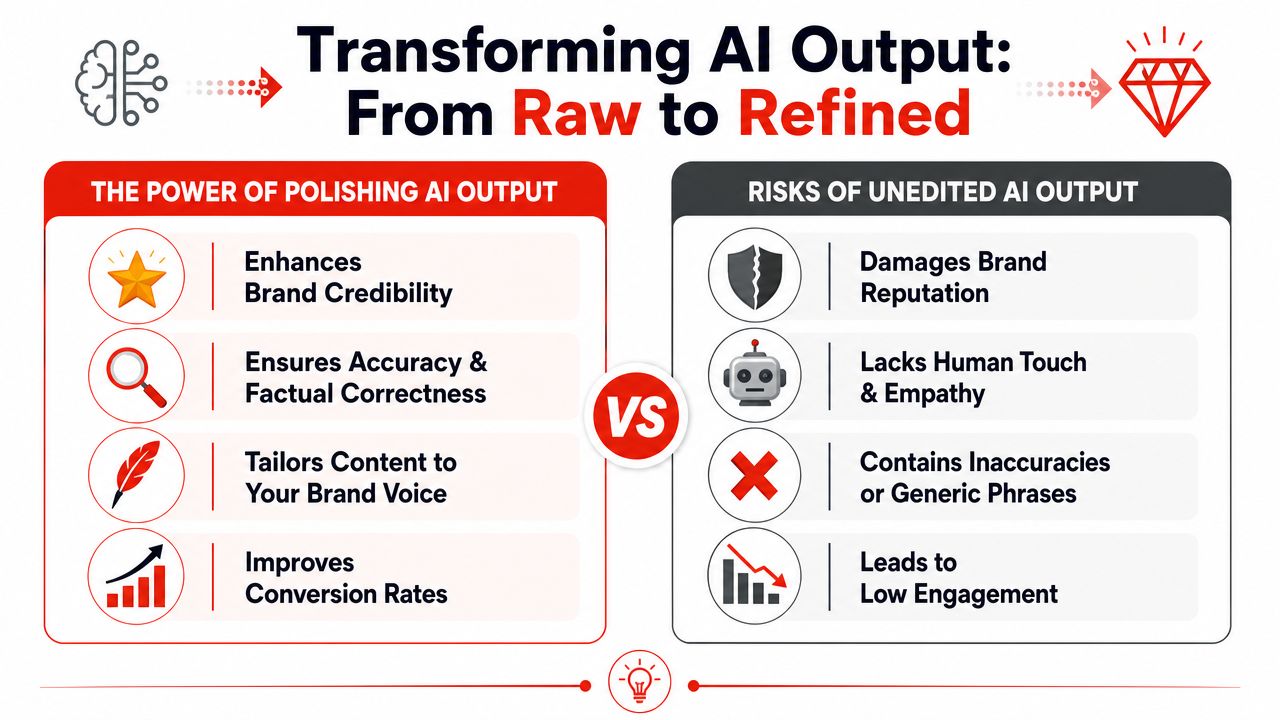
Independent testing of AI lead magnet tools points to the same operational reality. Teams still need human review to catch generic output, verify factual accuracy, and keep assets consistent with the brand. That's the fundamental shift. The work is moving away from one-off generation and toward repeatable quality control systems, as discussed in this testing review of AI lead magnet tools.
What to fix before publishing
The fastest quality upgrade comes from editing in this order:
-
Delete generic filler
Remove lines that could apply to any business in any industry. -
Add your point of view
Insert the practical opinion a client would hear if they hired you. -
Check every claim
If the AI included facts, examples, or numbers you can't verify, remove them. -
Tighten the structure
Shorter sections, stronger subheads, cleaner bullets. -
Design for scanning
Use white space, pull quotes, callout boxes, and simple visual hierarchy.
If you want a stronger ideation process before this editing stage, this guide on how to unlock better ideas with AI is helpful because it focuses on making prompts and outputs less generic.
What polished assets do that raw outputs don't
A polished lead magnet earns trust in small ways:
- Brand voice feels consistent: The reader hears one company, not a stitched-together machine draft.
- Advice feels owned: The content reflects actual judgment.
- The layout supports credibility: Even a simple Canva or Google Docs design can look professional when spacing and hierarchy are handled well.
- The CTA feels earned: It connects naturally to the problem the asset just helped solve.
A quick visual breakdown helps here:
Raw AI is fast. Edited AI is publishable.
The businesses getting value from an AI lead magnet generator aren't the ones publishing the first draft. They're the ones building a small review system that keeps quality high every time.
Deploying Your Lead Magnet for Conversion
Most lead magnets don't fail because the asset is bad. They fail because the page is weak, the form asks for the wrong thing, or the follow-up stops after delivery.
That's an execution problem.
TailoredRead recommends matching friction to funnel stage. Use email only for top-of-funnel offers, add qualification questions for mid-funnel assets, and pair the magnet with a 5–7 email nurture sequence that references specific sections of the asset. It also notes that the core asset can be AI-generated in about 10 minutes, and that landing pages should present 3–5 benefit bullets plus social proof before the opt-in in its lead magnet deployment guide.
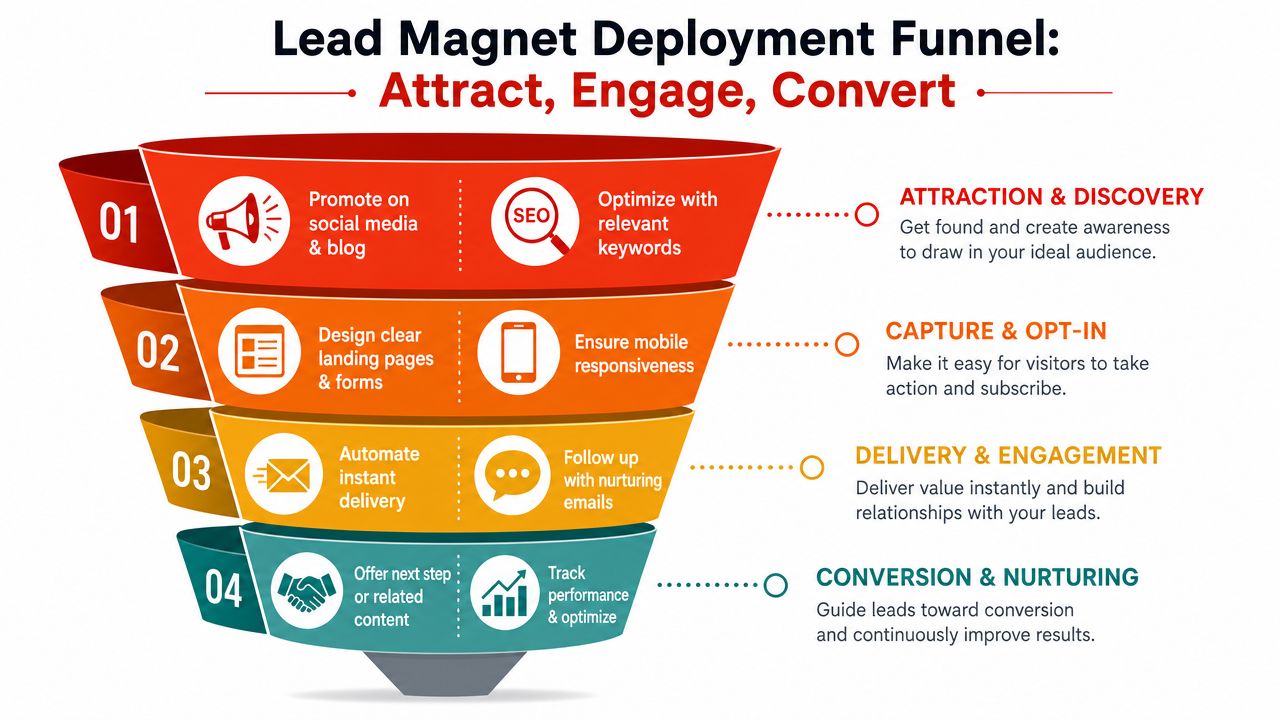
Build the page around benefits, not the file
The visitor doesn't care that your PDF is beautifully formatted. They care what changes after reading it.
A landing page should answer:
- What is this?
- Who is it for?
- What problem does it solve?
- Why should I trust it?
- What happens after I opt in?
Keep the hero copy tight. Then add a short set of benefit bullets.
- Immediate value: What they'll understand, fix, avoid, or decide faster.
- Specific relevance: Why it's suited to their role, industry, or situation.
- Practical usability: Show that they can act on it quickly.
- Logical next step: Frame the offer as a useful step, not a pitch trap.
For teams working on page structure and forms, these B2B conversion rate optimization best practices are a solid reference point.
Ask for less unless you've earned more
At this juncture, many businesses overreach.
If the offer is a lightweight top-of-funnel download, only ask for an email. If the offer sits closer to the sale, then add one or two qualification fields. That trade-off matters. More form fields can improve lead quality, but they can also suppress response if the perceived value isn't high enough.
Field rule: The deeper the funnel value, the more information you can reasonably request.
If you're trying to improve this handoff from visitor to lead, this practical guide on how to increase website conversion rate is worth reading because it focuses on the whole conversion path, not just the form itself.
Write the nurture around the asset, not around yourself
The follow-up sequence is where the conversion starts.
A useful nurture sequence does three things:
- Delivers the promised asset immediately.
- References specific parts of the asset in follow-up emails.
- Moves the reader toward a clear next action.
A simple sequence might look like this:
- Email 1: Delivery and a short explanation of how to use the asset
- Email 2: Highlight one key section they may skip
- Email 3: Share a common mistake related to the topic
- Email 4: Add a practical example or short success scenario
- Email 5: Invite the next step, such as a consultation, demo, or audit
- Optional emails: Handle objections or segment by interest
That sequence turns a static download into an active sales asset.
The Next Step From Static Downloads to Live Conversations
Static lead magnets still have a place. They're useful when the visitor wants a self-serve resource and the business needs a clean top-of-funnel entry point.
But they also have a built-in limitation. They usually capture only one thing well: an email address.
That's not enough when you need to know urgency, fit, location, service need, budget context, or buying timeline. In those cases, the stronger move isn't a better PDF. It's a live conversational experience that gives the visitor value immediately while collecting richer context.
Coachvox AI frames the category shift clearly in its AI lead magnet overview. The market is moving from one-off ebooks toward dynamic homepage tools that provide real-time value. In that model, AI doesn't just create content. It combines content, personalization, qualification, and follow-up in one system.
When a static lead magnet is enough
A traditional lead magnet is usually still a good fit when:
- The offer is educational: Guides, frameworks, and checklists work well here.
- The sales cycle is longer: You're building awareness before qualification.
- The audience prefers self-paced research: Many B2B buyers still do.
- You need content portability: A PDF can be shared internally more easily than a chat transcript.
When conversation wins
A conversational flow is stronger when:
- The business needs richer lead context
- Visitors have pre-purchase questions
- The service varies by customer need
- Speed to response affects conversion
- The website already gets relevant traffic but loses visitors before contact
This is especially relevant for agencies, consultants, clinics, local service providers, and businesses with consultative sales. In those cases, the highest-value first touch often isn't “download this.” It's “tell me what you need, and I'll help you now.”
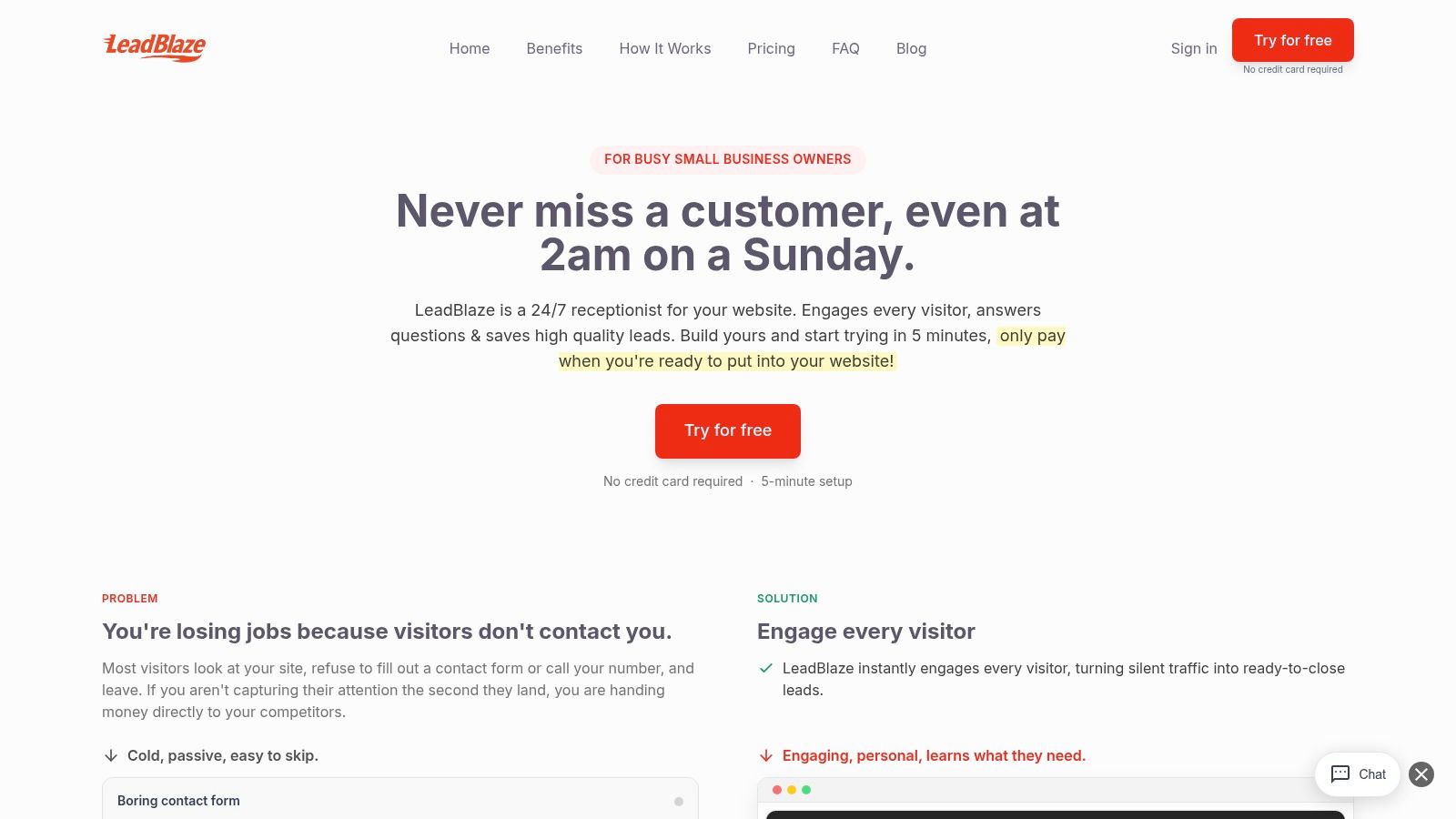
One practical option in that category is a chatbot for website lead capture. Used well, it can answer questions, collect useful qualification details, and keep the conversation moving without waiting for a form submission and a later email reply.
A static asset captures contact information. A conversational flow can capture intent.
That's the strategic pivot many businesses miss when evaluating an AI lead magnet generator. The question isn't only how fast AI can produce a lead magnet. It's whether the lead magnet should stay static at all.
Measuring Success and Optimizing Your Funnel
Download volume can be misleading.
A lead magnet that attracts lots of weak-fit subscribers can look healthy in a dashboard and still produce very little revenue. The true test is whether the asset pulls the right people into the right next step.
Metrics that matter more than downloads
Start with a simple performance stack:
- Landing page conversion rate: Does the offer and page earn the opt-in?
- Email engagement: Are people opening, clicking, and replying to the nurture?
- Lead quality: Do the leads match your target customer profile?
- Sales progression: Are leads booking calls, requesting quotes, or moving into pipeline?
Many small businesses often require greater visibility. If you can't see which visitors engaged, what pages they viewed, or which paths produced actual inquiries, optimization becomes guesswork. Tools in the category of website visitor tracking tools can help connect top-of-funnel activity to downstream lead quality.
What to test first
Don't test everything at once. Change one lever at a time.
Good first tests include:
-
Headline angle
Problem-focused versus outcome-focused. -
Offer format
Checklist versus quiz versus short guide. -
Form friction
Email only versus email plus one qualifier. -
CTA wording
“Get the guide” versus “Send my checklist” versus “See my score.” -
Nurture sequencing
More educational follow-up versus a faster move to consultation.
How to read the results
Some patterns are common.
If page conversion is low, the offer likely lacks relevance or clarity. If the page converts but email engagement is weak, the promise may be misaligned with what the asset delivers. If leads engage but don't move toward sales, the content may be attracting researchers instead of buyers.
That's also why static lead magnets and conversational capture should be evaluated differently. A static asset may produce more raw contacts. A conversational flow may produce fewer, but better-informed, leads. The right choice depends on your sales model and how much context your team needs before outreach.
A good funnel doesn't just generate leads. It reduces wasted follow-up and gives sales or service teams a better starting point.
If you want a practical way to move beyond static forms and basic downloads, LeadBlaze is built for that shift. It acts as a 24/7 AI sales assistant on your website, answers visitor questions, applies qualification rules you control, and captures richer lead details than a simple form typically can. For businesses that still want to use lead magnets, that conversational layer can sit alongside them and turn more anonymous traffic into usable sales conversations.