Your website’s welcome message is your first, and often only, shot at grabbing a visitor’s attention. Think of it as your digital handshake. It’s the single best chance you have to turn a passive browser into an engaged user, guiding them where you want them to go instead of letting them click away.
A good greeting is the difference between an empty, silent storefront and having a friendly, helpful assistant ready to point people in the right direction.
Why Your First “Hello” is a Conversion Goldmine
Imagine walking into a coffee shop. That immediate “Welcome in!” from the barista makes you feel noticed and valued, right? A well-timed, relevant welcome message on your website does the exact same thing. It instantly turns a static, impersonal webpage into a dynamic, helpful space that reassures visitors they’ve found what they’re looking for.
This isn’t just about being polite; it’s smart business. That initial interaction is your best tool for slashing bounce rates by hooking visitors within the first few crucial seconds they’re on your site. Understanding how these initial messages perform is key. For a deeper dive into the numbers, it’s worth exploring resources on optimizing pages to boost conversions, because even tiny adjustments here can produce massive results.
The Financial Impact of a Warm Welcome
Not greeting your website visitors is like leaving cash on the table. We see this principle proven constantly in email marketing, and it’s just as true for on-site messages. For example, welcome emails typically generate 4x more opens and 5x more clicks than regular campaigns.
Even more telling, newly welcomed subscribers show 33% more engagement with a brand. And when you add an offer into that first touchpoint? You’re looking at a potential revenue boost of 30% per message, on average. The data doesn’t lie: a timely, personal welcome is one of the highest-impact marketing plays you can make.
Turning Visitors into Qualified Leads
A smart welcome message does more than just keep people from leaving—it actively starts the qualification process for you. Instead of letting visitors wander around your site hoping they find what they need, you can proactively guide them with targeted questions and point them toward the right resources.
This simple first step accomplishes three critical things:
- Immediate Engagement: It signals that you’re present and ready to help, which builds trust right off the bat.
- Lead Qualification: You get to understand what a visitor needs from the moment they arrive.
- Friction Reduction: It gives users a clear, easy next step, making their path to conversion much smoother.
When you put a thoughtful welcome strategy in place, you’re not just being friendly. You’re essentially installing a 24/7 sales assistant that works tirelessly to improve your site’s performance. For more practical advice on this, check out our guide on how to increase website conversion rates.
Breaking Down a Welcome Message That Actually Works
A great website welcome message is more than just a friendly “Hello!” It’s a strategic conversation starter. To get it right, you need to think beyond a simple greeting and focus on combining a clear goal, the right tone, sharp copy, and a dead-simple call to action. When all these pieces work together, you turn a passive pop-up into an active engagement tool.
First things first, every message needs a single, well-defined purpose. Are you trying to point a lost visitor in the right direction? Qualify a hot lead? Maybe you just want to push them toward a special offer. If you try to do everything at once, you’ll just end up confusing people. Before you even think about writing, decide on the one job you need your message to do.
A local plumber, for example, probably wants to get visitors to book an emergency service call. A SaaS company, on the other hand, is likely aiming for free trial sign-ups. Nail down this primary goal, and every other element of your message will fall into place.
This is the moment where a visitor decides to stick around or bounce. Your welcome message is the bridge between their arrival and their next action.
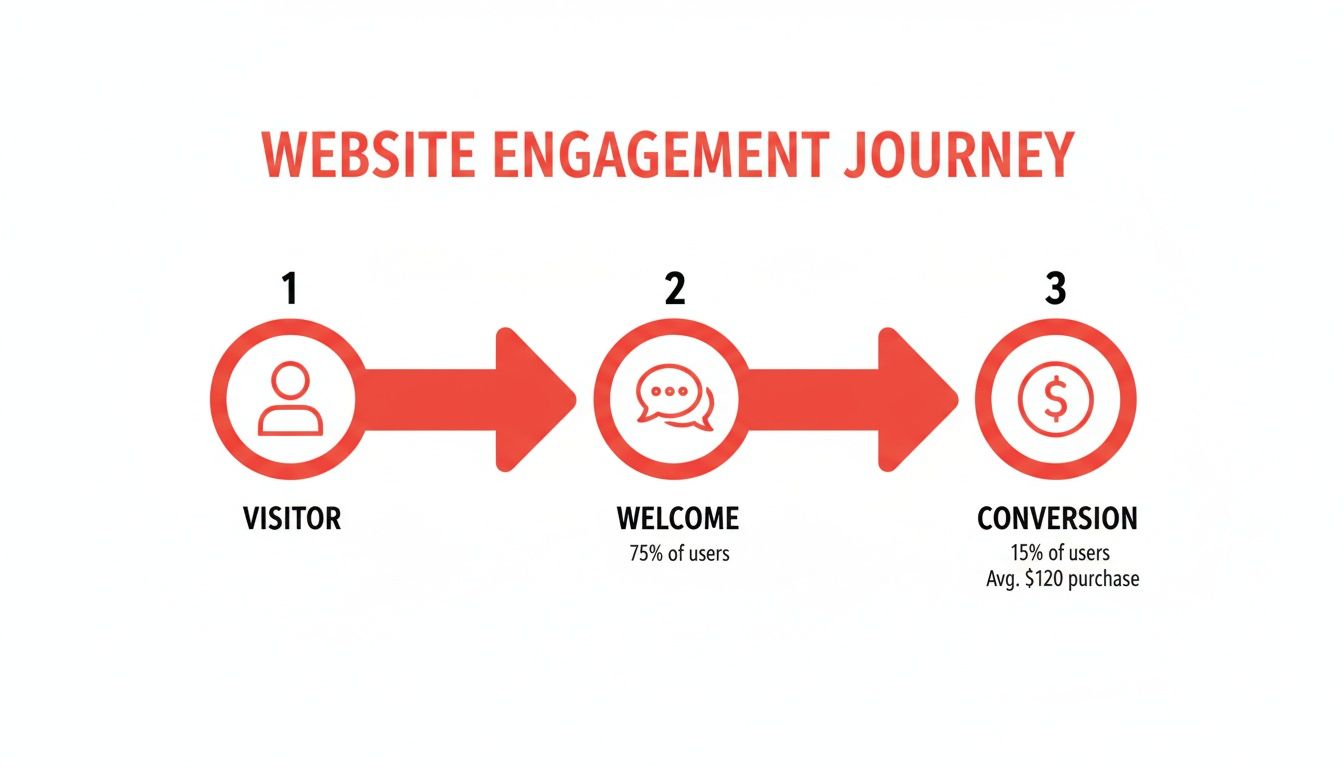
As you can see, that initial touchpoint is what kicks off the entire conversion journey. It’s your one shot to make a great first impression.
H3: Nailing Your Tone of Voice
Your tone is essentially your brand’s personality, boiled down into a few words. It has to match what your audience expects to hear from you. If you’re a B2B tech firm, a helpful and professional tone is probably your best bet. But if you run a quirky local gift shop, something more casual and fun will feel much more natural.
Authenticity is everything here. A bubbly, emoji-packed welcome message on a serious corporate law firm’s website is just going to feel weird and out of place. Consistency is what builds trust. It’s like the greeting you get at your favorite local cafe—it’s familiar, it sets the mood, and it makes you feel right at home.
My Two Cents: The goal isn’t just to sound “friendly.” It’s to be appropriately friendly. Your tone needs to be a direct reflection of the customer experience you’re trying to create, striking that perfect balance between being warm and being credible.
H3: Writing Copy That Clicks With Your Visitors
Once you’ve locked in your goal and tone, it’s time to write the actual message. The best welcome copy is always short, packed with value, and focused entirely on the user.
- Hook them with a strong opener. Ditch the generic “How can I help you?” and try something that shows you understand their situation. Something like, “Welcome! Looking for a faster way to manage projects?” immediately speaks to a potential pain point.
- Make it all about them. Flip the script from what you do to what they need. Instead of, “We sell the best accounting software,” ask, “Ready to simplify your bookkeeping?”
- Keep it short and sweet. No one is going to read a novel in a chat pop-up. Use short sentences and simple questions to make it feel like a real conversation.
Finally, every welcome message needs a clear, compelling call to action (CTA). This is the part where you tell them what to do next. Keep it specific and make it feel like a low-effort next step. “Book a Demo” can feel like a big commitment for a first-time visitor, but “See Pricing” or “Ask a Quick Question” is much easier to say yes to. Your CTA should be the obvious next move that perfectly aligns with the goal you set from the start.
Using Personalization And Timing To Your Advantage
A generic message that pops up at the wrong moment isn’t just ignored—it’s digital noise. But a personal greeting that arrives at the perfect time? That’s a powerful conversation starter that makes your visitors feel seen from the very first click.
The secret is to stop thinking in terms of a one-size-fits-all welcome mat. Instead, you need to use the data you have to inform your greeting.
Think about who’s visiting. Is this their first time on your site, or are they a loyal customer back for more? Maybe they clicked through from a specific LinkedIn ad or found you after Googling one of your services. Acknowledging that context right away makes your message feel relevant and immediately starts building trust.
Triggering Messages Based On Behavior
When you deliver your message is just as important as what you say. Blasting every visitor with the same pop-up the second your page loads is a rookie mistake. A much smarter approach is to set up triggers based on what your visitors are actually doing.
Here are a few ways to put this into practice:
- Time on Page: See someone lingering on your pricing page for more than 30 seconds? That’s the perfect moment for a chatbot to ask, “Have any questions about our plans?” It’s timely and incredibly helpful.
- Scroll Depth: If a visitor has scrolled 75% of the way down a deep-dive blog post, you know they’re engaged. Trigger a message offering a related guide or a chance to subscribe for more content just like it.
- Referral Source: Greet visitors from a specific campaign with a message that connects the dots. For example: “Glad you found our LinkedIn post helpful! What can we show you first?”
The goal is to make your welcome feel less like an interruption and more like a helpful tap on the shoulder from an expert who knows exactly what you’re looking for.
The Power of an Instant, Personal Hello
The impact of getting this right is staggering. We all know a great welcome email can pull in a mind-blowing 91.43% open rate, and that same principle applies to real-time interactions on your website.
In fact, studies show that welcome messages triggered instantly can hit 4.01% conversion rates—a massive 4.3x improvement over generic, delayed pop-ups. This matters because 74% of people expect an immediate response when they reach out, but less than 58% of brands actually provide one. That’s a huge opportunity for you to stand out. You can see more data on this at MailMend’s welcome email performance report.
This data makes it crystal clear: timing and relevance aren’t just nice-to-haves. They’re the core of a high-converting welcome strategy. When you meet visitor expectations for speed and personalization, you dramatically increase the odds of turning a casual browser into a qualified lead.
If you’re looking to go deeper, check out our guide on what website personalization truly means.
Real-World Welcome Message Examples And Templates
Theory is one thing, but seeing welcoming messages on websites in action is where the real learning happens. Let’s get out of the clouds and into the trenches with some practical, proven templates you can steal and adapt for your own site.
The secret I’ve learned is that the best messages are always short, have one clear goal, and feel like the start of a genuine conversation.
Here are a few examples broken down by business type. Pay close attention to how each one has a single, laser-focused objective and uses plain English to nudge the visitor toward that next step.
For Local Service Businesses
If you’re a plumber, electrician, or roofer, your lifeblood is quote requests and booked appointments. Your welcome message needs to cut straight to the chase, be helpful, and focus on solving the visitor’s immediate problem.
Real-World Scenario: A homeowner is frantically searching online for a local roofer right after a big storm. They land on your website, stressed and in a hurry.
Welcome Message Template:
“Welcome! Looks like you’re checking out our roofing services. Are you looking for a quick repair or a full roof replacement?”
Why This Works:
- It’s Direct & Empathetic: The message immediately shows you understand why they’re there.
- It Qualifies Instantly: The simple question immediately segments their need, so you know how to help.
- It’s Low-Friction: Tapping an option is way easier than filling out a form, especially for someone in a panic.
This approach is so much better than a generic “How can I help you?” It demonstrates you get their situation and are ready with a specific solution, turning a desperate search into a scheduled job.
For Marketing Agencies
For an agency, the main goal is usually booking that initial discovery call with a solid prospect. Your welcome message should act as a friendly bouncer, filtering for the right kind of clients and smoothly guiding them onto your calendar.
Real-World Scenario: A B2B marketing manager is browsing your agency’s site, kicking the tires on your SEO and PPC services.
Welcome Message Template:
“Hi there! Glad you found us. To help point you in the right direction, are you looking to improve your SEO or PPC results?”
And the follow-up after they choose:
“Great! We’ve helped companies like yours increase their organic traffic by over 200%. Would you be open to a quick 15-minute chat to see if we’re a good fit?”
Why This Works:
- Instant Segmentation: Asking about SEO vs. PPC lets you tailor the rest of the conversation immediately.
- Credibility Boost: The follow-up hits them with a powerful stat that builds instant trust.
- A “Softer” CTA: “15-minute chat to see if we’re a good fit” sounds much less intimidating than a pushy “Book a Sales Call.”
For Software (SaaS) Companies
A software company’s welcome message is all about ushering people toward the most valuable actions: starting a trial or seeing a demo. The entire game is about removing friction and showing them the path to value as quickly as possible.
My Two Cents: For SaaS, your welcome message is the very first step of the user onboarding experience. It needs to be just as clean and intuitive as the product itself.
Real-World Scenario: A potential customer lands on the homepage of your project management tool, curious but not yet committed.
Welcome Message Template:
“Welcome! Ready to see how you can manage projects more efficiently? You can start a free 14-day trial instantly (no credit card needed) or see a quick 2-minute product tour.”
Why This Works:
- It’s Benefit-Driven: The message opens with the desired outcome (“manage projects more efficiently”).
- It Kills Anxiety: Explicitly saying “no credit card needed” is a classic move because it removes one of the biggest barriers to signing up.
- It Offers a Choice: This empowers the user. Some people want to jump right in and play around, while others would rather watch from the sidelines first. This message caters to both types perfectly.
How AI Can Supercharge Your Welcome Strategy
The old one-size-fits-all welcome pop-up is on its way out. These days, smart businesses are using AI assistants to transform a simple greeting into a dynamic, 24/7 conversation. It’s no longer just about welcoming visitors—it’s about actively qualifying them from the moment they land on your site.
Think about it: instead of a static message, you could have an intelligent assistant that knows your website inside and out. When a visitor shows up with a question, it doesn’t just say hello. It gives them an immediate, accurate answer pulled directly from your content. This shift turns a passive welcome into a productive sales discussion in a matter of seconds.
Ultimately, this is all about creating an experience that feels both personal and incredibly efficient. The real magic happens when you turn every single visitor interaction into a genuine opportunity.
Deploying Your AI Assistant
Getting started with an AI-powered welcome is probably easier than you think. The best way to approach it is to treat your AI like a new team member. First, you need to define its role, its personality, and what you want it to accomplish.
You’ll want to start by setting the brand tone. Are you professional and direct, or more casual and conversational? An AI tool like LeadBlaze lets you customize its voice, making sure every interaction feels like it’s truly coming from your brand.
Next, you need to set up custom rules for qualifying leads. This is where you tell the AI exactly what to ask to spot high-intent visitors. For example, you could create a rule that asks anyone landing on your pricing page about their company size or project timeline. This simple step instantly separates the warm leads from the casual browsers. Our guide to chatbot best practices has a lot more advice on how to fine-tune these conversations.
From Long Chats to Actionable Summaries
One of the biggest wins of using AI for your welcome messages is pure efficiency. Let’s be honest, nobody has time to read through endless chat transcripts to find the golden nuggets. Modern AI assistants solve this problem by sending you concise, AI-generated lead summaries.
Instead of a full transcript, you get a clean summary with the key insights: who the visitor is, what they need, and how qualified they are. This frees up your team to focus their energy on closing deals with the best prospects, not chasing dead ends.
This kind of speed is crucial for capturing a visitor’s interest right away. In fact, research shows that landing pages with a single clear CTA see 13.5% better conversion rates. On top of that, a well-optimized welcome series can hit 3% conversion rates, which beats out many other marketing channels. AI helps you get there by creating an instant, focused path forward for every single person who visits your site. You can dig into more of these website conversion statistics to see the full picture.
Measuring Success And Optimizing Your Messages
Crafting the perfect welcome message isn’t a “set it and forget it” kind of deal. If you’re not looking at the data, you’re essentially just guessing what your visitors want. The only way to turn a friendly greeting into a real lead-generating machine is to adopt a data-driven approach.
This whole process kicks off with zeroing in on the key performance indicators (KPIs) that actually matter. It’s easy to get sidetracked by vanity metrics, but you need to focus on the numbers that tell you exactly how your messages are engaging people and pushing them toward a conversion.
Key Metrics To Track
To really get a feel for how your message is performing, you need to track a few core metrics. Think of these numbers as telling a story—from the first impression to the final click.
Here are the big three I always keep an eye on:
- Engagement Rate: What percentage of people who see your message actually interact with it? A low number here is a red flag. It could mean your opening hook is falling flat or the message is popping up at the wrong moment.
- Lead Qualification Rate: Of the people who engage, how many are actually a good fit? This metric tells you if you’re pulling in the right crowd or just getting a lot of clicks from window shoppers.
- Conversion Rate: This is the bottom line. It’s the number of interactions that turn into the action you want, whether that’s a booked demo, a free trial sign-up, or a quote request.
And if your welcome message is designed to capture emails, your job isn’t done once you get the subscription. Knowing how to optimize Mailchimp open rates is crucial for making sure that initial handshake on your site turns into a real conversation in their inbox.
A Simple Framework for A/B Testing
Once you’ve got your baseline numbers, it’s time to start tinkering. A/B testing is your best friend here. The trick is to change only one thing at a time—the headline, the CTA, the timing—so you know for sure what’s making a difference.
My Two Cents: Go for the big wins first. I’ve seen teams spend weeks debating button colors when a simple headline change could double their engagement rate. Test your core message and offer before you start sweating the small stuff.
To help you get started, let’s look at the essential KPIs for measuring your welcome message performance. This table breaks down what each metric means and, more importantly, gives you actionable ideas for how to improve it.
Key Metrics For Welcome Message Performance
A guide to understanding the essential KPIs for measuring the effectiveness of your website’s welcome messages and what each metric tells you.
| Metric | What It Measures | How To Improve It |
|---|---|---|
| Engagement Rate | The percentage of viewers who interact with the message. | A/B test different headlines and opening questions. Adjust the timing trigger (e.g., from 3 seconds to 10 seconds). |
| Drop-Off Rate | Where users abandon the conversation. | Simplify questions or reduce the number of steps. Make the "ask" clearer and less demanding. |
| Conversion Rate | The percentage of interactions that result in a goal. | Test different calls to action (CTAs). Experiment with the offer or the perceived value of the next step. |
By consistently testing these elements, you'll start to build a real, data-backed understanding of what your audience actually responds to. This isn't just about tweaking for the sake of it; it's about creating a continuous feedback loop that transforms a simple greeting into a powerful and predictable conversion engine.
Ready to stop guessing and start converting? LeadBlaze is the 24/7 AI sales assistant that turns your website traffic into qualified leads. Get started with a 7-day free trial and see the difference an intelligent welcome can make. Learn more at https://leadblaze.ai.