Ever walked into your favorite coffee shop and the barista already knows your usual order? That’s the exact feeling website personalization brings to the digital world. It stops your website from being a static, one-size-fits-all billboard and turns it into a living, breathing space that feels uniquely relevant to every single visitor.
Instead of shouting the same message to everyone, personalization uses data—things like a visitor’s location, browsing history, or even the device they’re on—to adjust the content they see in real time. The whole point is to shift from a monologue to a meaningful one-on-one conversation.
The Core Idea Behind Personalization
At its core, personalization is about one simple truth: every visitor is different. A first-time visitor from a marketing agency has completely different needs than a loyal customer looking for a support article. When you acknowledge and act on these differences, you create a far more engaging and effective user experience.
This entire strategy is built on three fundamental pillars: collecting data, having a variety of content ready, and using the right tech to connect the two.
To really nail this, you have to master the interplay between data, content, and the technology that brings it all together. This table breaks down these core components so you can see how they work in harmony.
The Three Pillars of Website Personalization
| Pillar | What It Means | Example |
|---|---|---|
| Data | Collecting information about who your visitors are and how they interact with your site. | Tracking which pages a user has viewed or identifying their geographic location. |
| Content | Having a library of different messages, offers, and visuals ready to deploy. | Creating unique hero banners for different industries or special discounts for returning customers. |
| Delivery | Using technology to match the right content with the right person at the right moment. | An e-commerce site showing a “Welcome Back!” message and a personalized coupon to a returning shopper. |
Understanding these pillars is the first step. When they’re all working together, you stop just having a website and start creating genuine experiences.
Consumers have come to expect this level of attention. A massive 76% of shoppers get frustrated when they land on a generic site that doesn’t feel tailored to them. And while 85% of businesses think they’re delivering personalized experiences, only 60% of their customers agree. That’s a huge gap—and a massive opportunity for businesses that get it right.
The ultimate purpose of website personalization is to make every visitor feel like the site was designed specifically for them. This fosters a deeper connection, making them more likely to convert and return.
A truly personalized experience is so much more than just sticking a first name in a headline. It’s about anticipating needs, solving problems before they’re even fully formed, and building a foundation of trust. By focusing on relevance, you can dramatically improve your customer engagement best practices and guide users more smoothly on their journey.
This approach gives you a powerful edge, turning your website from a simple source of information into a helpful, intelligent partner for your audience.
Exploring the Four Core Types of Personalization
Knowing what personalization is gets you in the door, but knowing how to use it is where the real magic happens. Think of it like a master chef who doesn’t just use one spice for every dish. Instead, they have a whole rack of them, each suited for a different purpose. In the world of websites, we have four primary methods for tailoring an experience.
These approaches aren’t mutually exclusive; they actually build on one another. You can start with simple adjustments and work your way up to experiences that feel almost psychic, anticipating what your visitors need before they even realize it themselves.
But before we dive in, it’s crucial to understand that any great personalization strategy stands on three core pillars: data, content, and delivery. They have to work together.
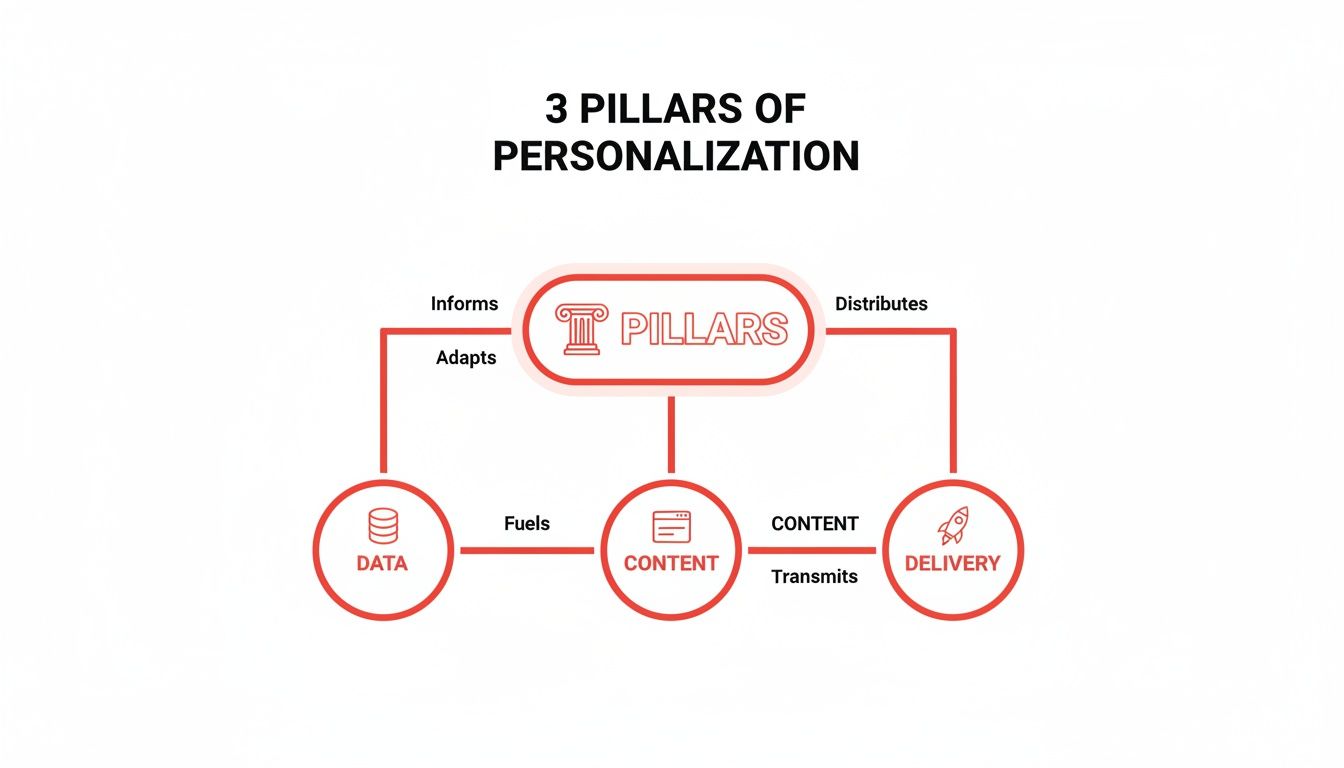
Without good data, you’re just guessing. Without compelling content, your data is useless. And without a solid delivery system, even the most perfect message never lands.
Behavioral Personalization
This is your website’s short-term memory. Behavioral personalization watches what a visitor does on your site—the pages they browse, the buttons they click, the products they add to their cart—and uses that activity to shape what they see next. It’s the most common and intuitive starting point.
A classic example is an e-commerce store. If someone keeps looking at hiking boots, the site should remember that. The next time they visit, the homepage banner might feature a sale on outdoor gear, and the product recommendations will be filled with similar boots and hiking socks. It’s not a random guess; it’s a direct response to their actions.
This works so well because it’s based on clear intent. In fact, research shows that calls-to-action personalized based on user behavior can convert over 200% better than their generic counterparts.
Demographic Personalization
While behavioral personalization focuses on what people do, demographic personalization is all about who they are. This method uses known attributes—like their location, company, or job title—to serve up more relevant content.
Here’s how it often plays out:
- Location: Showing a local store finder or promotions specific to their country.
- Company: For B2B sites, this is huge. You can display case studies from a visitor’s specific industry (e.g., healthcare, finance).
- Job Title: A CEO visiting a software site should see content about ROI and scalability, while a developer might see technical documentation.
- Age or Gender: A clothing retailer might adjust its hero images and messaging to resonate with different age groups.
Imagine a SaaS company that detects a visitor is from a 5-person startup. Instead of showing them an overwhelming enterprise plan, the site wisely presents a “Startup Friendly” pricing package right away. It’s a simple shift that makes the visitor feel understood.
Contextual Personalization
This one is all about the here and now. Contextual personalization adapts the experience based on the visitor’s immediate situation, not their past history. It’s about reacting to their current environment.
The triggers for this are all happening in real-time:
- Device Type: A user on a phone gets a streamlined, thumb-friendly layout, while a desktop user sees the full-featured version.
- Time of Day: A restaurant’s website might cleverly show its lunch menu from 11 AM to 2 PM, then automatically switch to the dinner menu.
- Weather: A home goods store could promote cozy blankets and space heaters to visitors in a city where the temperature just dropped.
- Traffic Source: Someone clicking from a Facebook ad about a 20% discount should land on a page that immediately reflects that same offer.
Contextual tweaks make your site feel incredibly smart and responsive, showing that you’re paying attention to the visitor’s world right now.
Predictive Personalization
This is the big leap—moving from reacting to visitor data to proactively anticipating what they’ll want next. Predictive personalization uses AI and machine learning to analyze massive datasets, identify hidden patterns, and forecast future behavior with surprising accuracy.
It’s the difference between a website that remembers your favorite coffee order and a barista who sees you walking down the street and has it waiting on the counter before you even ask.
Amazon’s legendary “Customers who bought this also bought…” is the poster child for this approach. The system isn’t just looking at your personal history; it’s crunching data from millions of transactions to make an incredibly educated guess about what you might like.
This forward-looking method powers hyper-relevant product recommendations, can predict which customers are about to churn, and even adjusts pricing on the fly. It requires more data and sophisticated tools, for sure, but the payoff is an experience that feels uniquely personal and builds incredible loyalty.
Why Personalization Is a Business Growth Engine
So we’ve covered the “how,” but let’s get into the part that really matters: the “why.” Website personalization isn’t just a clever marketing trick; it’s a legitimate, reliable engine for growing your business. When you stop treating your visitors like a faceless crowd and start acknowledging them as individuals, you completely change their relationship with your brand.
That shift from a generic, one-size-fits-all website to a tailored one isn’t a luxury anymore—it’s what customers flat-out expect. Not meeting that expectation means you’re just leaving money on the table for competitors who get it right. Think of it as a strategic investment that pays off again and again, all the way through the customer journey.
Boosting Conversions and Driving Sales
The first place you’ll see the impact of a smart personalization strategy is your conversion rates. When someone lands on a page that speaks directly to their needs, their industry, or what they’ve looked at before, the path to making a purchase gets a whole lot shorter and clearer.
Let’s take a B2B software company. A visitor from the healthcare sector lands on the homepage and sees a headline that says, “The #1 Project Management Tool for Medical Clinics,” with a relevant case study right below it. That immediately builds trust and makes them far more likely to book a demo than if they’d seen a generic, all-purpose message.
This isn’t just a hunch; the numbers back it up. A massive 40% of consumers say they’ve bought more because of personalization, and 59% agree it makes shopping easier. In the retail world, 74% of eCommerce businesses have personalization programs, and a staggering 98% of them report higher average order values. You can dive deeper into these personalization statistics and their impact to get the full picture.
Increasing Customer Loyalty and Lifetime Value
Personalization creates a kind of “stickiness” that keeps customers coming back. When your site remembers someone’s preferences and shows them content that’s actually useful, you stop being just another vendor and become a trusted partner.
Personalization transforms transactions into relationships. It’s the digital equivalent of a shopkeeper knowing your name and preferences, which fosters loyalty that competitors find difficult to break.
This feeling of being understood is what strengthens the bond with your customers. A loyal customer doesn’t just buy again; they become an advocate for your brand. This directly leads to a higher Customer Lifetime Value (CLV), which is one of the most critical metrics for long-term, sustainable growth.
Enhancing Average Order Value
Getting the first sale is great, but personalization is also a key tool for increasing the value of every single transaction. By using data to make smart suggestions, you can cross-sell and upsell in a way that feels helpful, not pushy.
This is where tactics like these come into play:
- “Frequently Bought Together” prompts: These show logical product pairings based on what thousands of similar customers have purchased.
- “Complete the Look” suggestions: A fashion retailer can suggest accessories that perfectly match an item sitting in the user’s cart.
- Tiered upgrade offers: A SaaS business can show a user who is constantly hitting their plan’s limits a timely and relevant offer to upgrade.
These small, helpful nudges really add up. Fast-growing companies see 40% more revenue from personalization than their slower competitors. The ability to bump up your Average Order Value (AOV) turns every sale into a bigger win, fueling revenue growth without needing a massive spike in traffic. It’s about working smarter, not just harder.
Building Your First Personalization Strategy
It’s one thing to understand the what and why of website personalization; it’s another thing entirely to actually make it happen. The jump from theory to practice can feel massive, but you don’t need a Silicon Valley budget or a team of data scientists to get started. A great strategy always begins with clear goals and a smart plan.
Everything you do in personalization hinges on data. Without it, you’re just making educated guesses about what your audience truly wants. This means you absolutely need a reliable way to understand who is visiting your site and what they’re doing while they’re there.
Getting this first step right sets the stage for everything that follows. Quality data is what allows you to build meaningful audience segments and deliver experiences that actually connect with people.
Setting Clear Goals and Identifying KPIs
Before you even glance at a new tool or tactic, you have to define what winning looks like for you. Vague goals like “improve engagement” just won’t cut it. You need to get specific and measurable, tying every objective directly to a real business outcome.
Start by asking the right questions:
- Are we trying to get more qualified leads from our demo request form?
- Do we want to slash the cart abandonment rate for first-time shoppers?
- Is our main goal to bump up the average order value with smarter product recommendations?
See the difference? Each of these goals points to a clear Key Performance Indicator (KPI). If you’re focused on lead generation, your KPI is the conversion rate on that form. This kind of clarity is what will steer your entire strategy.
A personalization strategy without clear KPIs is like a road trip without a map. You might feel like you’re making progress, but you have no idea if you’re actually heading in the right direction.
Once you know your destination, start small. Pick one or two high-impact areas to focus on first. Trying to personalize every corner of your website at once is a surefire way to get overwhelmed and see mediocre results.
Ethical Data Collection and Privacy Compliance
You can’t talk about data today without talking about privacy. Earning and keeping your audience’s trust is non-negotiable, and that means being transparent and compliant with regulations like GDPR and CCPA.
Your approach to data has to be ethical from the get-go. This means clearly explaining what information you collect and how it’s used in your privacy policy. It also means giving people real control over their own data.
Ignoring privacy doesn’t just open you up to hefty fines; it destroys the very customer trust that personalization is supposed to build. You can use various tools to help with this; in fact, our guide on website visitor tracking tools discusses options that put user privacy first.
Choosing the Right Technology Stack
With your goals set and your data strategy in place, it’s time to pick your tools. The market is flooded with options, from simple analytics platforms to sophisticated Customer Data Platforms (CDPs). Your choice should always come back to your goals, your budget, and the technical resources you have on hand.
As you build out your strategy, finding the right tools is critical. There’s a great guide to ecommerce personalization software that can give you a deeper look into the specific platforms out there.
For most businesses, the tech stack grows over time. You might start with a simple setup and add more powerful tools as your strategy matures and you start seeing a return on your investment. Here’s a quick look at how the different levels stack up.
Choosing Your Personalization Tech Stack
The technology you choose should be a direct reflection of your current needs and future ambitions. This table breaks down what you might consider at each stage of your journey.
| Technology Level | Tools & Platforms | Best For | Complexity |
|---|---|---|---|
| Entry-Level | Google Analytics, WordPress Plugins | Businesses new to personalization, focusing on simple segmentation. | Low |
| Mid-Tier | Opt-in Tools, A/B Testing Software | Companies ready to test different messages and offers for specific segments. | Medium |
| Advanced | Customer Data Platforms (CDPs), AI-Powered Engines | Organizations scaling personalization across multiple channels with complex data. | High |
The main takeaway here is to choose technology that helps you hit your goals without adding a ton of complexity. Don’t invest in an enterprise-level CDP if a simple WordPress plugin can get the job done for now.
The smartest path forward is almost always to start small, test your assumptions, and scale up based on what’s actually working. This methodical approach keeps your efforts both effective and efficient.
Website Personalization Examples in Action
It’s one thing to talk about the theory, but seeing personalization out in the wild is where its power really clicks. The best way to understand what website personalization truly is, is to look at how top brands are using it to connect with customers and get incredible results. They aren’t just deploying fancy tech; they’re genuinely solving problems for their users.
Whether it’s an e-commerce giant, a streaming service, or a B2B software company, personalization is often the quiet engine driving their success. Each example that follows shows how a real understanding of the user gets turned into a website that’s more intuitive, more helpful, and ultimately, more profitable.
E-commerce Giants: The Personal Shopping Assistant
Amazon is the classic case study for a reason. Its recommendation engine is a masterclass in predictive personalization, analyzing your past purchases, browsing habits, and even what you’ve abandoned in your cart to build a homepage that feels like it was made just for you.
Those “Frequently bought together” and “Customers who viewed this item also viewed” sections aren’t just random guesses. They’re smart suggestions powered by mountains of data from millions of shoppers. This strategy doesn’t just push products—it anticipates what you’ll need next, making shopping faster, more satisfying, and boosting the average order value in the process.
This kind of thinking isn’t just for the big players. To see how other businesses are getting it right, check out these effective e-commerce personalization examples for ideas you can adapt.
Media Companies: Curating Your Digital World
Ever notice how your Netflix homepage looks nothing like your friend’s? That’s a perfect blend of contextual and behavioral personalization at work. Netflix takes it a step further than just recommending shows; it actually personalizes the artwork for each title based on what it thinks will catch your eye.
If you’re a fan of comedies, you might see a thumbnail for a new series highlighting its comedic stars. A thriller enthusiast, on the other hand, might see the same show advertised with a darker, more mysterious image. This incredible attention to detail—driven by your viewing history, the time of day, and even the device you’re on—is what keeps you hooked.
Personalization is the art of making a user feel seen and understood. For media companies, it’s the difference between a user endlessly scrolling and one who clicks ‘play’ in seconds.
B2B SaaS: Customizing the Buyer Journey
Personalization is a game-changer in the B2B world, too, where buying cycles are longer and the decisions are bigger. A SaaS company can use demographic and firmographic data to instantly adjust its website for visitors from different industries or company sizes.
Imagine a project management tool detecting a visitor from a construction firm. Instead of a generic headline, the homepage immediately displays, “The #1 Project Management Platform for Construction Crews,” and features a relevant case study. Right away, that visitor knows they’re in the right place.
The goal is to answer the visitor’s unspoken question: “Is this for me?” By tailoring calls-to-action, content, and social proof, B2B companies can shorten the path from prospect to qualified lead.
Luxury retailer Saks Fifth Avenue proved this by launching a personalized homepage that uses AI to act like an in-store stylist. The impact was immediate: engagement shot up, revenue per visitor grew by 7%, and conversion rates climbed by nearly 10%. It’s a powerful demonstration of how a finely tuned digital experience translates directly to the bottom line. You can explore the full story of AI’s impact on website personalization to see more on this trend.
Avoiding Common Pitfalls for Better Results
A great personalization strategy is built on trust, not just tech. For all the incredible upside, a few common mistakes can completely derail your efforts and turn off the very people you’re trying to help. Getting this right is about navigating the human side of the equation.
The biggest mistake I see? Crossing the line from helpful to just plain creepy. There’s a world of difference between showing a visitor a product they might actually love and making them feel like they’re being spied on. When you get too specific with personal details, it feels invasive and instantly breaks that trust.
The best way to stay on the right side of that line is with total transparency. Be upfront about the data you collect and how you use it. A clear, readable privacy policy isn’t just a legal box to tick; it’s a sign of respect for your audience.
The Dangers of Bad Data and Stagnation
Another classic pitfall is building your entire strategy on a shaky foundation of bad data. If your information is wrong or incomplete, your personalized experiences will be, too. That means you’ll be serving up irrelevant offers and confusing messages that just annoy your visitors.
The whole point of personalization is to create clarity and add value, not sow confusion. Bad data guarantees you’ll deliver the wrong message to the right person, effectively torpedoing all your hard work.
Finally, you can’t just “set it and forget it.” This isn’t a slow cooker. What resonates with your audience today might fall flat tomorrow. This is where continuous A/B testing becomes your best friend. You have to constantly test your assumptions, dig into the results, and tweak your approach based on how people are actually behaving.
To keep you on the right path, here are a few best practices to live by:
- Start with a Clear Hypothesis: Don’t just personalize for the sake of it. Have a specific goal in mind, like, “I bet showing returning visitors a ‘welcome back’ discount will boost conversions by 5%.”
- Segment Audiences Thoughtfully: Move past the basics. Create groups based on what people are trying to do, how engaged they are, or where they are in their buying journey.
- Tie Everything to Business Goals: Make sure every personalized element—from a custom headline to a product suggestion—is there to support a key business objective.
Following these practices helps you build a strategy that’s not only effective but also ethical and sustainable. When visitors get real value from a site that understands them, it does wonders for engagement and is a great way to learn how to reduce bounce rate on your website.
Frequently Asked Questions About Website Personalization
Even with a solid game plan, you’re bound to have some questions when you start putting website personalization into practice. Let’s tackle some of the most common ones so you can move forward with confidence.
How Much Data Do I Need to Get Started?
You probably need a lot less than you think. You don’t need a mountain of data to make a real impact. Many businesses see fantastic results just by starting small and focusing on simple, accessible data points.
Things like a visitor’s location, how they found your site (e.g., from a specific ad), or whether they’ve been there before are all you need for your first few wins. Start with a clear goal—like welcoming users from a specific email campaign—and build from there. You can always get more sophisticated as you gather more data.
Can Website Personalization Hurt My SEO?
This is a totally valid concern, but the short answer is no, as long as you do it right. The fear comes from an old, shady SEO tactic called “cloaking,” where a website would intentionally show search engine crawlers something completely different from what a human visitor would see. Search engines rightly penalize this because it’s deceptive.
But that’s not what modern personalization is about. Good personalization is all about making the experience better for the user, not trying to fool search engines. Google and other search engines actually see positive user experience signals—like lower bounce rates and longer time on site—as a good thing.
What’s the Difference Between Personalization and Customization?
People often use these terms interchangeably, but they’re actually two different sides of the same coin. It all boils down to who’s calling the shots: the user or the website.
- Customization is when the user is in the driver’s seat. Think about choosing your interests on a news app or rearranging the widgets on your iGoogle homepage. You are explicitly telling the platform what you want.
- Personalization is when the website takes the wheel. It uses data to automatically adjust the experience for you, without you having to lift a finger. The Netflix homepage, which serves up shows it thinks you’ll like, is the perfect example.
In short, customization is explicit—the user makes a choice. Personalization is implicit—the system anticipates what you want and delivers it proactively.
How Do I Actually Measure the ROI of Personalization?
You absolutely have to measure your return on investment (ROI); otherwise, you’re just guessing. The key is to tie specific metrics directly to the goal of each personalization campaign you run.
Here are the big ones to watch:
- Conversion Rate: Are more people signing up or buying when they see a personalized call-to-action?
- Average Order Value (AOV): Are your tailored product recommendations actually getting people to add more to their cart?
- Customer Lifetime Value (CLV): Are personalized journeys creating loyal customers who come back again and again?
- Bounce Rate: Is your content now relevant enough to make visitors stick around instead of leaving immediately?
The best way to get clean data is by running A/B tests. Pit your personalized version against the standard, one-size-fits-all experience. This lets you directly attribute any lift in these numbers to your personalization efforts, proving its financial impact loud and clear.
Ready to turn every website visitor into a qualified lead? LeadBlaze acts as your 24/7 AI sales assistant, engaging visitors with personalized, real-time conversations the moment they land on your site. Stop losing leads to static forms and start converting traffic with intelligent, automated engagement. See how it works at https://leadblaze.ai.