Text message ads get seen in a way most channels can’t match. They reach about 98% to 99% open rates, and 97% are read within 15 minutes according to Infobip’s SMS marketing statistics. That single fact changes the conversation for a small business owner. The challenge usually isn’t getting attention. It’s using that attention without wasting it.
That’s where most first campaigns go wrong. The message gets opened, the click comes through, and then the visitor hits a slow mobile page or a clunky form and disappears. Good text message ads don’t stop at the send. They carry intent all the way through to a qualified lead, booked job, sale, or conversation.
Why Text Message Ads Are a Must Have Channel
SMS earns attention fast. For a small business, that matters because wasted spend usually comes from delay, not just bad creative.
A key advantage is not that a text gets opened. It is that a text can move a prospect from interest to action while intent is still high. Email often helps later in the buying process. Paid social can create awareness. Search captures active demand. Text message ads fill the gap between those channels by prompting an immediate next step.
That next step is where many campaigns lose money.
A prospect taps your link, lands on a generic page, sees a long form, and leaves. You paid for attention and got a click, but not a lead. In practice, SMS performs best when the post-click experience is built for mobile speed, clear intent, and low-friction qualification. That is why I treat SMS as both a traffic channel and a conversion system.
Why SMS cuts through
Text messages arrive in a space people check throughout the day, and they usually get reviewed faster than email. That makes SMS a strong fit for time-sensitive offers, appointment availability, restocks, quote follow-up, and abandoned cart recovery.
Used well, it also reduces lag in your sales process. A roofing company can text a prospect right after an estimate request. A med spa can fill last-minute openings. A retailer can push repeat buyers back to a product page while interest is still fresh. Those are practical revenue cases, not vanity metrics.
Here is the channel role in simple terms:
| Channel trait | Text message ads | Traditional email |
|---|---|---|
| Speed of attention | Fast | Often slower |
| Inbox competition | Lower | Heavy |
| Best use | Urgent offers, reminders, follow-up | Longer nurture, newsletters |
Why this channel earns a place in the budget
SMS should not replace every other channel. It should get budget when timing and intent matter more than message length.
That is especially true for smaller teams that cannot afford loose handoffs between ad click and lead capture. If a customer is ready to ask for pricing, book a service, or respond to a limited offer, a text can create action faster than channels built around passive browsing. The trade-off is equally important. You have less room for storytelling, less tolerance for irrelevant sends, and less forgiveness if the landing experience is weak.
That is why the best-performing SMS campaigns do not send traffic to static forms and hope for the best. They use short mobile pages, clear calls to action, and AI tools that can qualify visitors in real time. Tools like LeadBlaze help reduce the SMS-to-website drop-off by turning a dead-end form into a live qualification flow, so more clicks become usable leads instead of anonymous bounces.
If you are mapping your broader paid strategy, this guide to online ad types for SaaS is useful because it shows how different channels support different stages of intent. The same planning applies to local businesses and ecommerce brands. Search captures demand. Social creates interest. Email nurtures. Text message ads create fast action and work best when the website experience is built to capture that momentum.
Navigating Compliance for Text Message Ads
The Federal Communications Commission has proposed fines in the millions for unlawful marketing texts, and small businesses do not need many complaints to create an expensive problem. Compliance protects more than legal risk. It protects response rates, list health, and the return you get from every click.
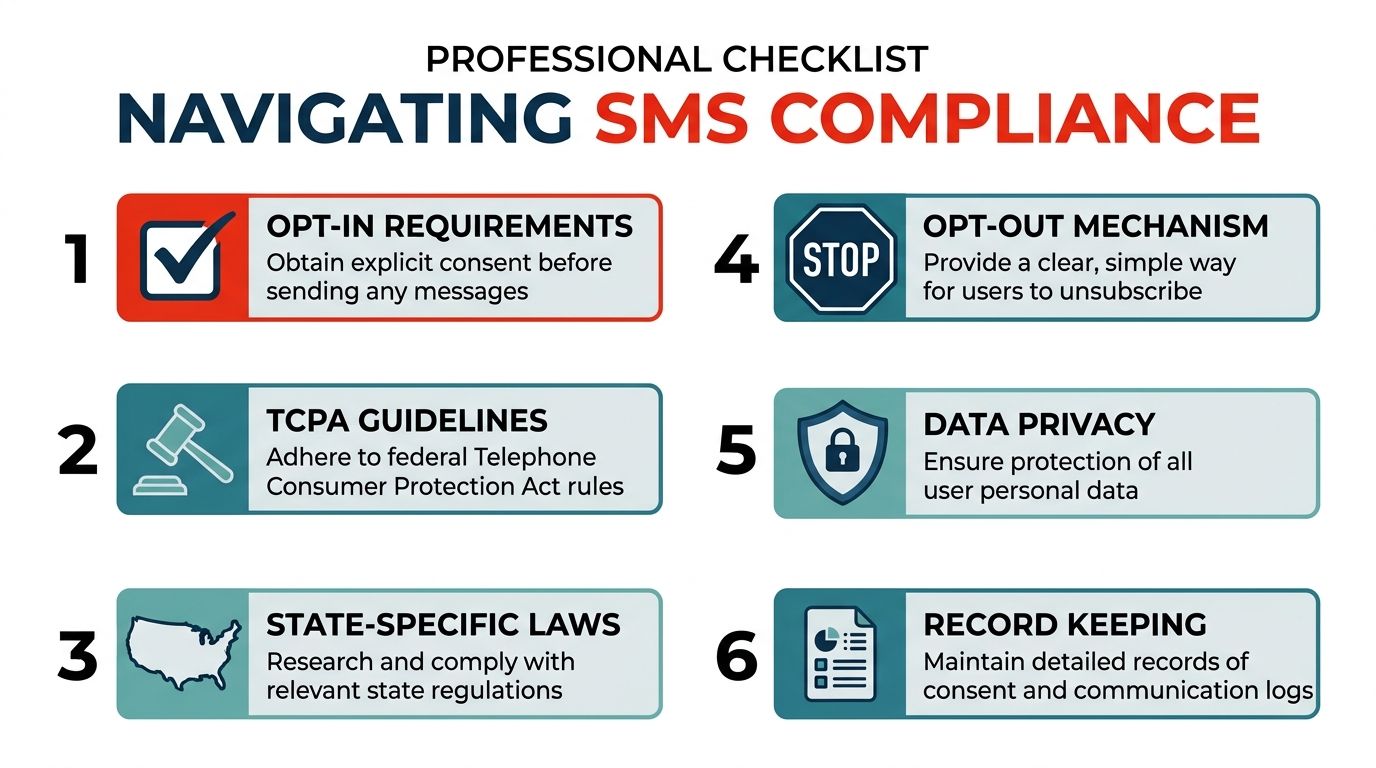
A lot of owners treat compliance like paperwork. In SMS, it directly affects performance. If someone did not clearly ask for your texts, they are less likely to click, more likely to opt out, and far less likely to trust the page they land on. That matters even more if your goal is lead generation, because weak consent often sends low-intent traffic to your site, where static forms already lose people.
What your business must do before sending
Start with consent that you can prove.
That means the customer knowingly agreed to receive text messages from your business, and the language matched what you plan to send. A phone number collected for receipts, shipping alerts, or a customer service callback does not automatically cover promotions. If your opt-in wording is vague, fix that before the first campaign.
Keep these controls in place from day one:
- Get explicit consent: Ask clearly for SMS permission at signup, checkout, booking, or lead capture.
- Store proof of consent: Keep the form version, timestamp, source, and opt-in language.
- Describe the message type: Say whether subscribers will get promotions, reminders, updates, or support messages.
- Set reasonable send times: Timing rules vary, so check federal and state requirements and use the subscriber's local time when possible.
- Make opt-out easy: Reply STOP should work every time.
- Limit access to your list: One careless import by a staff member can create a compliance issue fast.
The opt-in promise also needs to match the landing experience after the click. If the text offers a quote, the page should help the visitor request a quote quickly. If it sends them to a generic page with a long form, drop-off rises and the campaign gets more expensive than it looks on the dashboard. Businesses comparing tools should look for platforms with consent controls, audit trails, and website integrations, not just bulk sending. This guide to business messaging platforms for SMS workflows is a useful reference for that evaluation.
Broken opt-outs create legal and revenue risk
An unsubscribe path is part of the product, not a footer detail.
The FCC has stated that consumers can revoke consent by replying to a text message, and sellers need to honor that request through reasonable methods, including common opt-out keywords such as STOP, QUIT, END, REVOKE, OPT OUT, CANCEL, and UNSUBSCRIBE, as outlined in the agency's rules on revocation of consent under the TCPA. If your system misses those replies, the risk is not theoretical. The person who wanted to leave can become the person who files the complaint.
I tell clients to test opt-out handling the same way they test checkout or booking. Use a real phone. Send STOP. Confirm the number is suppressed. Then try to message that number again and make sure the platform blocks it.
A simple compliance checklist for small teams
Use this before every campaign:
-
Confirm the list source
Every contact should come from a documented opt-in path. -
Match the message to the permission
Promotional texts go only to people who agreed to promotional texts. -
Test opt-out handling
Reply STOP from a real device and verify suppression works. -
Check send timing
Review time zones and local sending rules before launch. -
Review the landing path
The website should match the text offer and capture intent quickly. -
Keep records
Save consent details, campaign copy, and suppression logs in case a complaint comes in.
Good compliance improves lead quality. People who expect your text are more likely to click with real intent, and that gives you a better shot at turning the visit into a qualified conversation instead of another abandoned form.
Choosing Your SMS Marketing Platform
Your platform choice shapes everything that comes next. Segmentation, opt-in handling, reporting, automation, and website handoff all depend on it.
A lot of small businesses pick an SMS tool the same way they pick cheap email software. They look at the monthly price first and deal with the consequences later. That usually leads to weak list management, poor integrations, and limited reporting.
What matters more than the homepage demo
A solid platform should make five jobs easier:
| What to evaluate | Why it matters |
|---|---|
| Consent management | You need clean opt-in records and reliable opt-out handling |
| Segmentation | Sending one blast to everyone lowers relevance |
| Integrations | SMS should connect to your CRM, booking tool, store, or lead system |
| Automation | Follow-ups and triggered messages save time and improve response speed |
| Analytics | You need to see clicks, replies, opt-outs, and downstream outcomes |
If you run appointments, make sure the tool can trigger reminders and post-visit requests. If you sell online, look for cart, order, and customer segment integrations. If you generate leads, the platform should pass data cleanly into the place where your team works.
Short code, long code, and practical fit
You don't need to obsess over technical labels at first. What matters is how the sending setup fits your use case.
Short codes are often associated with larger-scale programs and recognizable brand messaging. Long codes or similar business messaging setups can work well for conversational outreach, service updates, and smaller-volume campaigns. The right choice depends on your send volume, your need for two-way conversation, and the markets you serve.
Selection shortcut: If the platform makes compliance awkward, segmentation shallow, or reporting vague, keep looking.
Choose for the next year, not just the next month
Before you commit, ask one practical question: can this platform support your workflow once SMS starts working?
That means checking whether it can connect with the rest of your stack. If you want a broader view of the software side, this overview of business messaging platforms is a helpful reference point. It's easier to choose well now than to migrate your list, automations, and records later.
Planning Your First High Impact Campaign
The best first campaign is narrow, relevant, and easy to act on. It's not a mass blast.
Start with one audience, one offer, and one desired action. If you try to announce everything at once, the message gets muddy and performance drops. SMS rewards clarity more than cleverness.

Segment before you write
A restaurant, clinic, agency, or home service company usually has multiple audience groups already. Recent buyers behave differently from inactive leads. New subscribers need a different message than loyal customers.
Useful segments include:
- Recent customers: Send follow-up offers, refill reminders, or review requests.
- Warm leads: Send a booking link, consultation slot, or limited-time incentive.
- Inactive contacts: Reintroduce value with a concise reason to re-engage.
- VIP customers: Offer early access, priority booking, or exclusive updates.
If your data is thin, improve that before you scale. Tools with enrichment and prospecting features can help teams understand available contact details and list quality. For example, these Icypeas contact data capabilities show the kind of phone number discovery workflows some businesses use when building outbound or hybrid campaigns. The key point is this: only message people you're allowed to message, and only after your data is organized enough to support targeting.
Keep the message tight
A strong SMS ad usually contains four parts:
-
Who it's from
The brand name should be obvious. -
Why it matters now
The offer, reminder, or update needs a clear reason. -
What to do next
One action. Click, reply, book, confirm, or shop. -
How to opt out
Keep it simple and visible.
Example structure:
[Brand]: Your spring AC tune-up slot is open this week. Book today to secure your preferred time [link]. Reply STOP to opt out.
That works because it's direct. No fluff. No mystery. No second CTA.
Control frequency before frequency controls you
A lot of first-time advertisers over-send because SMS gets attention quickly. That's exactly how lists get damaged.
Textus notes that for small businesses, sending more than 3 promotional texts per week can cause opt-out rates to rise above the 5% safety benchmark in its discussion of SMS marketing benefits. For most SMBs, precision beats volume.
Use a simple send rhythm:
- Promotions: Keep them selective and tied to a clear offer.
- Service messages: Send when the customer expects them.
- Follow-ups: Trigger based on behavior, not guesswork.
If you want to reduce manual work, automation helps a lot. This guide on automated direct messages is useful for thinking through trigger-based outreach rather than one-size-fits-all blasts.
Creative Examples and Proven Templates
Most weak text message ads fail for one of three reasons. They sound generic, they ask for too much, or they don't give the recipient a good reason to act now.
The fix is simple. Write the message for a specific moment in the customer journey.
Ecommerce flash sale
Template
[Brand]: VIP early access is live. Shop the new drop before it opens to everyone else [link]. Reply STOP to opt out.
Why it works: it gives status, urgency, and one clean action. It also fits how people use SMS. Fast scan, fast decision.
A weaker version would add too much detail about the collection, shipping, brand story, and categories. Save that for the landing page.
Local service reminder
Template
[Brand]: Your dental cleaning is due. Tap here to book a time that works for you [link]. Reply STOP to opt out.
This format is practical. It matches a known need and reduces friction. Service businesses do well when the text acts like a shortcut, not a sales pitch.
Short messages win when the offer is already understood. The text doesn't need to educate. It needs to move.
B2B lead follow-up
Template
[Brand]: Thanks for requesting pricing. Want a quick walkthrough or a custom quote? Reply DEMO or QUOTE.
Why it works: it invites a reply instead of forcing a form click. That often feels easier for a prospect who's still deciding.
Win-back message
Template
[Brand]: It's been a while. We saved a returning-customer offer for you. Use it before it expires [link]. Reply STOP to opt out.
A win-back text should feel relevant, not needy. Keep the tone respectful. If the business has no clear reason to contact the person again, don't send it.
Two mistakes to avoid in every template
- Too many actions: Don't ask people to click, call, follow, review, and reply in one text.
- Cute but vague copy: Clever lines waste space when the recipient can't tell what's being offered.
If you're unsure, write the message and cut a third of it. Then check whether the customer still understands the offer immediately. Usually, the trimmed version performs better because it respects the medium.
Connecting SMS Clicks to Qualified Leads
At this point, text message ads either produce revenue or leak it.
A lot of businesses get the hard part right. They earn the opt-in, send a relevant message, and generate the click. Then they send that traffic to a standard website page with a slow load, a small button, and a form that asks for too much. The visitor drops, and the business blames the ad instead of the handoff.
The hidden friction after the click
CallHub points out that SMS traffic has a 45%+ higher bounce rate on non-optimized mobile forms than email traffic, and that SMS users are 3x more likely to abandon a multi-field form in its article on text message advertising. That's the lead quality paradox. High intent arrives, then static forms kill momentum.
The behavior makes sense. A person coming from a text message expects speed. They don't want to pinch-zoom, fill six fields, and wait for a follow-up tomorrow. They want an answer now, or at least a clear next step.
What works better than static forms
The best SMS landing experiences do three things well:
- Load fast on mobile
- Continue the conversation from the text
- Capture information progressively instead of all at once
That's why conversational lead capture performs better than old contact forms in many SMS journeys. A chat-based or AI-assisted flow can greet the visitor, ask one question at a time, qualify intent, and route the lead based on the answers. It feels like a continuation of the text, not a jarring context switch.
When someone clicks from SMS, don't make them restart the conversation from zero.
How to think about qualification
A good post-click experience doesn't just collect contact details. It filters.
For a local service business, that might mean asking about service type, timing, and location before handoff. For an agency, it might mean budget, need, and timeline. For a clinic, it could be visit type and preferred contact method. The point isn't to interrogate the lead. It's to reduce junk submissions and give your team enough context to respond well.
Attribution matters here too. If you want to understand how SMS contributes across the funnel, not just at the click level, tools in the category of marketing attribution software can help frame what happened before and after the message. For teams that also want lead data flowing into customer records, this guide on how to integrate WhatsApp with CRM is useful because the same operational principle applies to SMS. The faster conversation data reaches your system, the easier it is to qualify and follow up well.
Tracking Performance and Optimizing for ROI
SMS ROI usually breaks in one of two places. The message fails to earn the click, or the website wastes the click after it arrives.
For small businesses, the second problem is often more expensive. You already paid for attention. If the visitor hits a slow page, a generic landing page, or a long mobile form, the campaign can look fine at the click level and still produce weak results.
Track the full path from send to qualified lead to sale.
Metrics that matter
Use a simple scorecard for each campaign:
| Metric | What it tells you |
|---|---|
| Click-through rate | Whether the message and offer created action |
| Conversion rate | Whether the landing experience finished the job |
| Opt-out rate | Whether the campaign felt irrelevant, excessive, or mistimed |
| Reply quality | Whether responses came from the right audience |
| Revenue or pipeline outcome | Whether the campaign actually paid off |
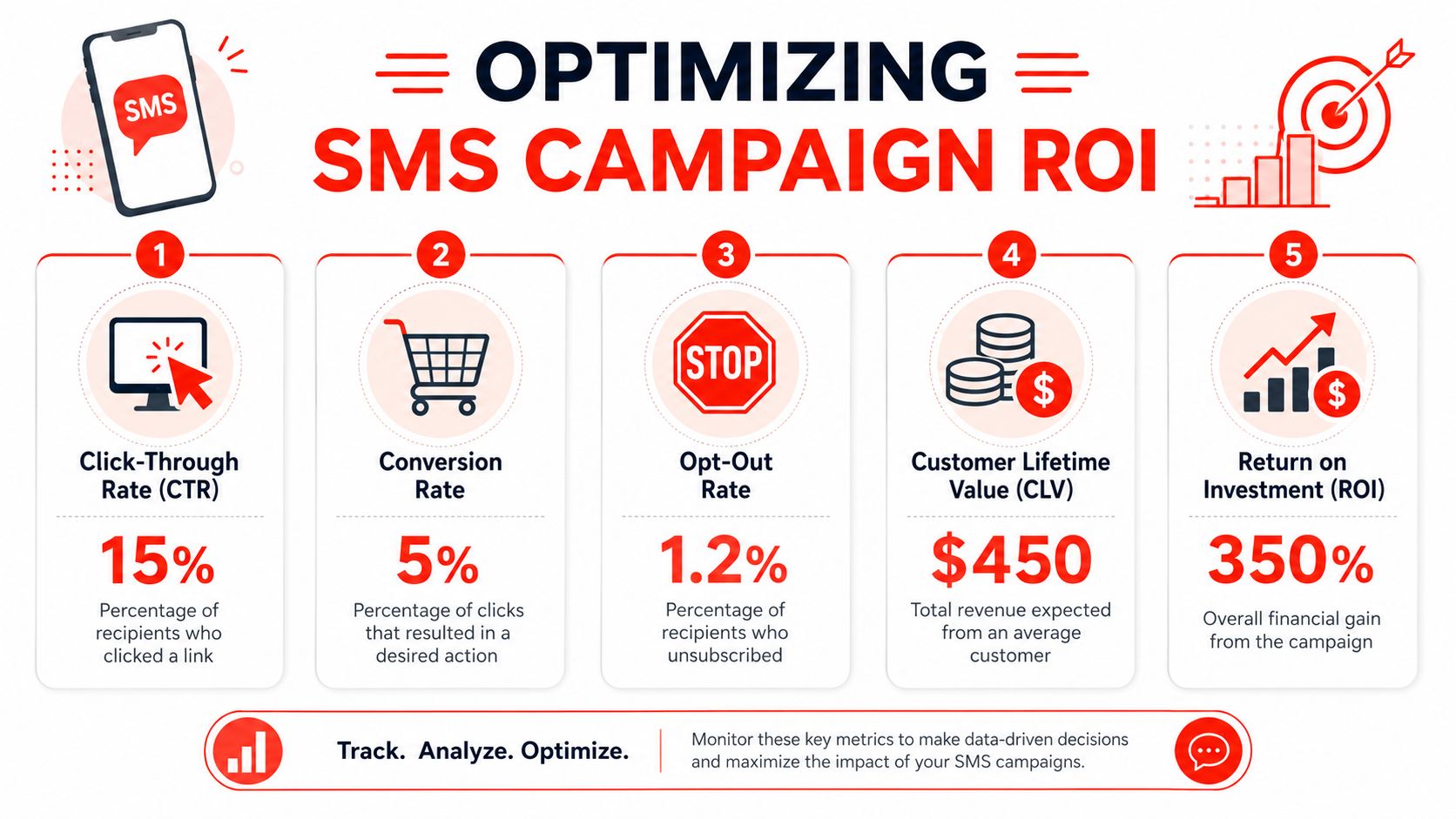
Those metrics matter together, not in isolation. A campaign with a strong click rate and poor lead quality is not working. A campaign with fewer clicks but better booked calls, stronger close rates, and lower opt-outs is often the better investment.
What to change first
Interactive post-click experiences usually outperform passive ones because they keep the conversation going. That matters a lot in SMS, where the user started with a short, personal message and expects the next step to feel just as direct.
Start diagnosis in this order:
If clicks are low, fix the offer, timing, or CTA.
If clicks are healthy but form completion is weak, the website is the problem. Shorten the page, speed it up, and remove fields that your team does not need on first contact.
If submissions are coming in but leads are poor, improve qualification. Ask better questions after the click instead of collecting every lead the same way.
If opt-outs rise, reduce frequency, tighten segmentation, and review whether the message matched the original consent.
That last point matters for compliance and ROI. Sending more texts to the wrong segment raises costs, increases opt-outs, and can put your list quality at risk.
A practical testing rhythm
Change one meaningful variable per send. That gives you a cleaner read on what improved results.
- CTA: Book now vs. get a quote
- Offer framing: Price savings vs. speed or convenience
- Audience segment: Recent buyers vs. older leads
- Timing: Mid-morning vs. late afternoon
- Destination: Standard landing page vs. conversational lead capture
I usually tell owners to test the destination sooner than they expect. Copy tweaks help, but a better post-click experience often has a larger impact on revenue. If SMS traffic is landing on a static form, you are forcing high-intent visitors into the weakest part of the funnel.
The best-performing programs treat SMS and lead capture as one system. The text gets the click. The website has to qualify the lead without adding friction. Tools like LeadBlaze help by greeting visitors instantly, answering basic questions, and collecting useful qualification details in a conversational flow instead of a cold form.
That is how SMS starts producing better ROI, not just more traffic.