Picture this: you have a sales assistant on your website who never sleeps. They’re there 24/7 to greet every single visitor, patiently answer their questions, and pinpoint your most promising prospects. That, in essence, is a lead generation chatbot. These are smart, automated tools that use conversational AI to engage people on your site, figure out if they’re a good fit, and grab their contact details.
They turn casual browsers into real, actionable leads.
The Modern Alternative to Static Forms
For years, the go-to tool for capturing website leads was the humble contact form. They get the job done, sure, but they’re also impersonal and can feel like a chore to fill out. A lead generation chatbot completely changes the game by starting a dynamic, two-way conversation. It feels less like filling out paperwork and more like having a helpful chat.
Instead of hitting visitors with a wall of empty boxes, a chatbot asks questions one at a time, guiding them through the process naturally. This conversational flow makes the whole experience smoother and keeps people engaged, which means they’re far more likely to share their information. It’s the difference between being handed a long questionnaire on a clipboard and having a friendly chat with someone who wants to help.
This move toward conversational marketing is more than just a passing trend. The chatbot market is booming, valued at USD 7.76 billion in 2024 and expected to skyrocket to USD 27.29 billion by 2030. This explosive growth is a clear signal that businesses are ditching passive lead collection for more proactive, engaging methods. You can dive deeper into the numbers with this detailed chatbot market analysis.
Chatbots vs Traditional Lead Capture Methods
When you put a lead generation chatbot side-by-side with old-school methods like static forms and pop-ups, the advantages are crystal clear. Chatbots provide a much more interactive and efficient way to qualify and capture leads right when they come in.
A great lead generation chatbot filters out low-intent visitors by asking the right questions—like budget, needs, or timeline—so your sales team only spends time on the most promising prospects.
Let’s break down how they really compare.
| Feature | Lead Generation Chatbot | Traditional Forms & Pop-ups |
|---|---|---|
| Engagement | Dynamic and interactive, feels like a real conversation. | Static and one-way, often feels like a chore. |
| Response Speed | Instant, 24/7 availability to answer questions and capture info. | Delayed, relies on manual follow-up from your team. |
| Qualification Depth | Asks a series of qualifying questions to gauge lead quality in real-time. | Gathers basic contact information with limited context. |
| User Experience | Personal and helpful, guides the visitor through the process. | Impersonal and can be intrusive, leading to high abandonment rates. |
Ultimately, the chatbot’s conversational approach isn’t just a gimmick; it delivers a better user experience that translates directly into more, higher-quality leads for your business.
Why Chatbots Are a Game-Changer for Capturing Leads
Think about the old way of getting leads from your website. Someone shows up, clicks around a bit, and maybe—if you’re lucky—they’ll fill out your contact form. Then they wait. And you hope they don’t lose interest while they’re waiting. This whole passive setup means you’re leaving money on the table every single day.
A lead generation chatbot completely flips that script. It’s not just a static form; it’s an active, conversational sales assistant that’s on the clock 24/7. Instead of waiting for a visitor to take action, the chatbot proactively starts a helpful conversation, ready to capture their interest the moment it sparks.
Imagine a potential customer lands on your site at 3 AM from a different time zone. Without a chatbot, that lead is gone. But with one, they can get their questions answered right away, you can collect their details, and they feel like you’ve paid attention to them. This 24/7 availability means you never miss a beat, no matter what time it is.
From Casual Browsers to Qualified Prospects
One of the most valuable things a lead generation chatbot does is qualify leads in real-time. It acts like a friendly bouncer, gently guiding the serious buyers forward while politely engaging with those who are just looking around.
How does it do this? By asking a few smart, targeted questions. A chatbot can ask about a visitor’s budget, what they’re looking for, or their project timeline. Based on how they respond, it can figure out instantly if they’re a great fit for your business.
This single function saves your sales team an unbelievable amount of time. They stop wasting hours sifting through a pile of so-so contacts from a generic form and instead get a clean, pre-vetted list of people who are actually ready to have a conversation.
Let’s look at a real-world example. A small digital marketing agency was getting decent traffic, but their leads were unpredictable. People would land on their “Request a Quote” page and just… leave. After they added a chatbot, the game changed.
The bot started conversations with a simple, direct question: “What’s your biggest marketing challenge right now?” This one change led to a 40% increase in lead captures in the first month. The bot then qualified them by asking about their industry and monthly ad spend, and automatically booked demos right on the sales team’s calendar. The team was finally free to focus on closing deals instead of chasing ghosts.
Making the Experience Better for Everyone
Let’s face it: nobody likes filling out long, boring forms. In fact, research shows that over 80% of people will ditch a form before they finish it. It’s just too much work. A lead generation chatbot gets rid of that friction by turning the whole process into a simple, easy conversation.
Asking for information one question at a time feels more like a chat and less like a chore. This keeps people engaged and dramatically cuts down on how many people give up halfway through. Plus, the bot provides instant answers, building trust and showing that your brand is responsive and helpful. You can dive deeper into the wider impact of chatbots in marketing in our detailed guide.
A single chatbot can juggle thousands of these conversations at once without breaking a sweat, giving you a level of scale you could never match with a human team. For any business that’s serious about getting the most out of its website traffic, it’s a total game-changer.
How to Use Chatbots for Inbound Lead Generation
Think of your website as a digital storefront. Is it just a passive brochure, or is it an active, engaging space that turns casual browsers into real customers? A lead generation chatbot is the single best tool to make that transformation happen. It acts as a friendly, helpful guide, bridging the gap between a visitor’s initial curiosity and a genuine sales opportunity.
Instead of making people hunt for a contact form and then waiting for them to fill it out, you can start the conversation right away. It’s all about blending smart tech with a bit of human psychology—being genuinely helpful the moment someone needs it, offering real value upfront, and making the path from visitor to qualified lead completely smooth.
The infographic below really nails this flow, showing how a chatbot can grab a visitor’s attention and turn them into a valuable lead.
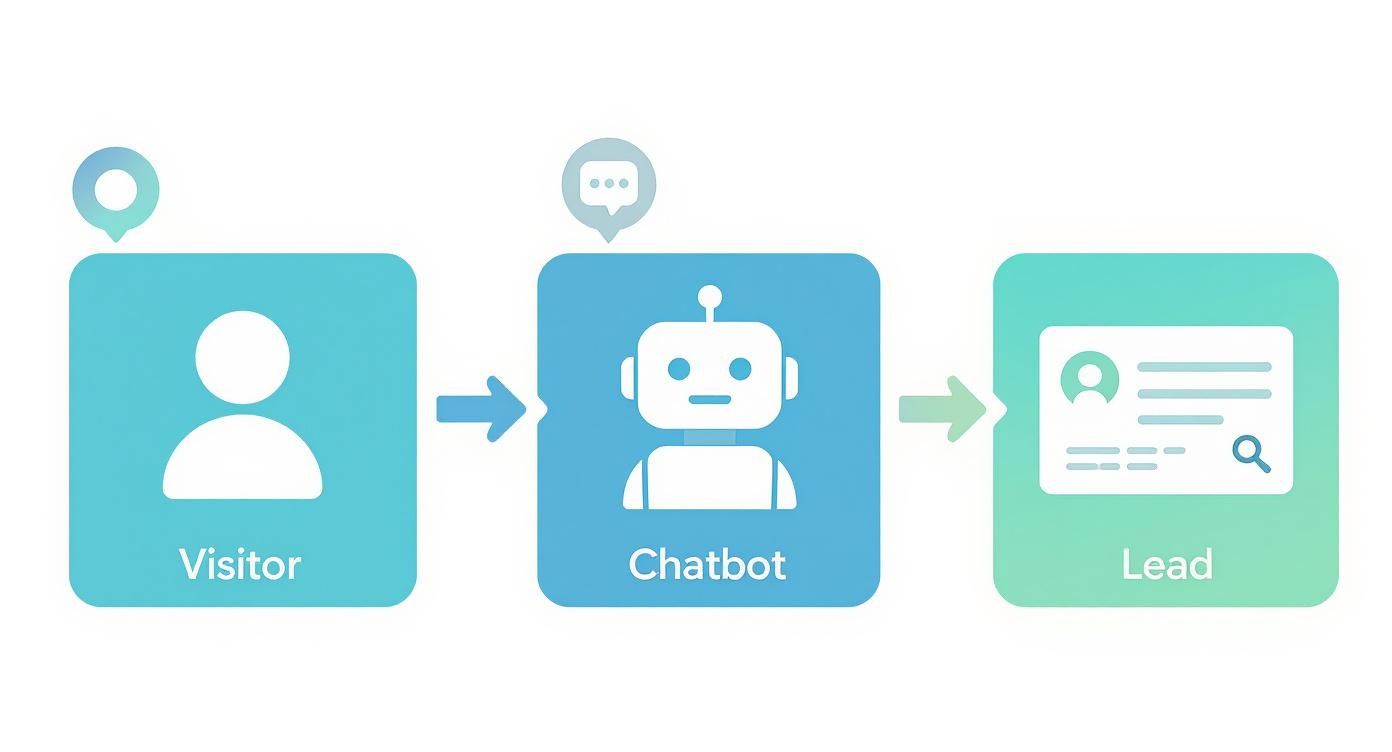
As you can see, the process is simple but powerful. A chatbot intercepts a visitor, starts a meaningful conversation, and captures their information, turning anonymous traffic into a real business contact.
1. Engage Visitors at the Perfect Moment with Intelligent Triggers
The core of inbound marketing is being helpful and relevant, not intrusive. The first step to using a lead generation chatbot effectively is to stop waiting passively. You must be proactive, but in a smart way. This is where intelligent triggers come in—they allow your chatbot to initiate a conversation at the perfect moment based on a visitor’s behavior.
It’s like a great retail assistant who notices you’ve been looking at the same item for a minute. They don’t pounce on you the second you walk in the door, but they don’t ignore you either. They step in at just the right time to offer assistance.
Here are a few of the most effective intelligent triggers for inbound lead generation:
- Time on Page: Someone spending more than 30 seconds on your pricing page is clearly interested. That’s your cue for the chatbot to pop up with, “Have any questions about our plans? I can help.”
- Exit-Intent: When a visitor’s mouse moves toward the “close tab” button, the chatbot can appear with a final, value-packed offer. For example, “Before you go, would you like our free guide to [solving their problem]?”
- Specific Page Visit: If someone is browsing your case studies or a deep-dive blog post, they’re likely in the consideration stage. This is the perfect time for a chatbot to ask, “Interested in seeing how we could get results like this for your business?”
Using these triggers lets you meet prospects where they are, providing help that feels timely and relevant, not pushy. This proactive mindset is a cornerstone of any good inbound strategy. For more ideas on how to attract prospects, check out our guide on how to generate inbound leads.
2. Provide Value Before You Ask for Anything
Here’s the golden rule of inbound: give before you get. People are protective of their contact information. They won’t hand over their email address just because you asked nicely. You have to earn it by offering something of tangible value first.
This is where your chatbot becomes a powerful delivery mechanism for your best content and offers.
- Offer Exclusive Content: Instead of a generic “sign up for our newsletter,” use the chatbot to offer a valuable resource. A simple, “Want our free 10-point SEO checklist? Just let me know where to send it,” is highly effective.
- Provide Instant Quotes or Assessments: If you’re a service business, a chatbot can ask a few quick qualifying questions and give a ballpark estimate or a mini-assessment on the spot. This instant gratification is a powerful motivator.
- Schedule a Free Consultation: Remove all friction from booking a meeting. The chatbot can connect to a sales rep’s calendar, find a time that works for the prospect, and lock it in automatically.
When you lead with value, the exchange feels helpful, not transactional. This doesn’t just get you more leads—it starts the entire customer relationship off on the right foot.
3. Design Conversations That Feel Human
Once you have their attention, the quality of the conversation will determine if they engage or leave. Nobody wants to interact with a clunky, robotic script. The key is to design a conversational flow that feels natural, empathetic, and genuinely helpful.
Your chatbot needs a personality that aligns with your brand. Are you formal and authoritative? Or are you friendly and casual? Your chatbot’s script should reflect that tone. Ditch corporate jargon and write like you speak.
The goal isn’t to trick people into thinking they’re talking to a human. It’s to provide an experience so smooth and helpful that they don’t care that it’s a bot.
Start by mapping out the conversation. What is the primary goal? Booking a demo? Capturing an email for your newsletter? Answering a common question? Every question the bot asks should gently guide the user toward that goal. Use a mix of multiple-choice options (for speed and ease) and open-ended questions to keep the interaction feeling like a real back-and-forth.
4. Qualify and Segment Leads Automatically
Not all leads are created equal. A student doing research is very different from a decision-maker who has visited your pricing page three times this week. A smart lead generation chatbot can tell the difference for you, automatically.
It accomplishes this through lead scoring and segmentation. As the chatbot asks questions—about their role, company size, budget, or timeline—it can assign points behind the scenes.
For example:
- Role: Director or C-level? +10 points.
- Company Size: Over 100 employees? +5 points.
- Timeline: Looking to buy this quarter? +15 points.
Once a lead hits a certain score, you can flag them as “hot” and route them directly to your sales team. This ensures your sales reps stop wasting time on low-intent contacts and focus only on the most qualified prospects.
5. Ensure a Seamless Handoff
This final step is critical. A clunky handoff can negate all the great work the chatbot has done. A smooth transition from the bot to the next step in your sales process is non-negotiable.
There are two primary handoff scenarios:
- Handoff to a Live Agent: For high-intent leads who are ready to talk now, the chatbot must be able to transfer them to a live person instantly. A key part of this is leveraging live chat integrations. The sales agent must receive the full chat transcript for context, so the prospect doesn’t have to repeat themselves.
- Handoff to a Calendar or CRM: If no one is available or the lead prefers to schedule a call, the chatbot should integrate directly with a tool like Calendly. The lead picks a time, the meeting is booked, and all the information captured by the bot is sent straight to your CRM to create a new, enriched contact.
This seamless integration ensures no leads fall through the cracks and makes the entire experience feel professional from start to finish. And it works. Websites that add AI chatbots see an average 23% increase in conversion rates. Even better, chatbot-generated leads are known to convert at three times the rate of leads from old-school sign-up forms.
Essential Features for Your Chatbot Platform
Picking the right chatbot platform is the bedrock of your whole lead generation strategy. The market is crowded, sure, but a handful of core features really separate the truly effective tools from the ones that just cause headaches. These are the non-negotiables you’ll need to turn your chatbot into a lead-generating powerhouse.
Think of it like stocking a workshop. You wouldn’t try to build a custom cabinet with just a hammer. Having the right tools makes the job faster, easier, and yields a far better result. Your chatbot platform is no different.
Intuitive No-Code Conversation Builder
Let’s be real: your marketing team shouldn’t need to file a ticket with engineering just to tweak a chatbot’s greeting. This is why a visual, drag-and-drop conversation builder is at the absolute top of the must-have list. It lets you map out, build, and edit your chatbot’s dialogue without writing a single line of code.
With a good no-code builder, you can:
- Get going fast: You can build and launch your first bot in a matter of hours, not weeks.
- Tinker and improve: Easily test new questions, adjust your messaging, and fine-tune conversation flows based on what real users are doing.
- Stay nimble: Quickly adapt your bot to support a new marketing campaign or a change in your sales process.
A user-friendly builder basically hands the keys to the people who know your customers best—your marketing and sales teams. If you want to see what this looks like in practice, our guide on how to make a chatbot walks you through the entire process.
Seamless CRM and App Integrations
A lead generation chatbot shouldn’t be a silo. Its real value is unlocked when it talks to the other tools you’re already using. Seamless CRM integration is absolutely crucial for automating your workflow and making sure no lead ever slips through the cracks.
When your bot captures a lead’s info, it should automatically zap that data over to your CRM, whether it’s HubSpot, Salesforce, or Pipedrive. This simple action can create a new contact, log the entire conversation history, and even kick off an automated follow-up sequence. It makes the handoff from bot to human totally seamless.
Live Chat Handoff for High-Intent Leads
Automation is great, but sometimes a hot prospect wants to talk to a person right now. That’s where a live chat handoff feature becomes invaluable. When the bot flags a user as a high-intent lead—maybe based on their answers to a few key questions—it needs to be able to instantly transfer them to an available sales rep.
The magic is in the details. The best platforms pass the entire chat transcript to the human agent. This avoids that classic, frustrating moment where a customer has to repeat everything they just told the bot.
This hybrid model gives you the best of both worlds: the 24/7 efficiency of a bot to capture and qualify, plus the personal touch of a human expert to close your most valuable leads.
Customization and Brand Alignment
Your chatbot is often the very first “voice” a potential customer hears from your company. It has to look and sound like it belongs. A top-tier platform will give you robust customization options to make the bot a true extension of your brand.
Look for the ability to control:
- Visual Branding: You should be able to change colors, fonts, and logos to perfectly match your website’s design.
- Tone of Voice: The platform should make it easy to write scripts that reflect your brand’s personality—whether that’s buttoned-up and professional, witty and fun, or anything in between.
A chatbot that’s on-brand builds trust and creates a cohesive experience. It feels less like a clunky add-on and more like a helpful, integrated part of your website.
To help you prioritize, we’ve broken down the features you’ll encounter into two main categories: the essentials you need from day one, and the advanced capabilities that become more important as you scale.
Essential vs Advanced Chatbot Features
This table breaks down the must-have features for getting started versus the more advanced capabilities you might look for as your lead generation efforts mature.
| Feature Category | Essential (Must-Have) | Advanced (Nice-to-Have) |
|---|---|---|
| Conversation Design | Visual drag-and-drop builder, pre-built templates for common use cases. | AI-powered suggestions for conversation paths, A/B testing for different scripts. |
| Integrations | Native integration with your primary CRM (e.g., HubSpot, Salesforce) and email marketing platform (e.g., Mailchimp). | Integration with analytics platforms (Google Analytics), webinar software (Zoom), and data enrichment tools (Clearbit). |
| Human Handoff | Ability to transfer a chat to a live agent, with email/Slack notifications. | Intelligent routing to specific departments (sales, support), agent availability status, co-browsing capabilities. |
| Customization | Ability to change chatbot widget colors, avatar, and greeting messages. | Full CSS control over the widget’s appearance, custom branding removal, multi-language support. |
| Analytics | Basic metrics: number of conversations, leads captured, and conversion rates. | Detailed conversation flow analysis, drop-off point identification, sentiment analysis, and individual user journey tracking. |
Starting with the “Essential” column ensures you have a solid foundation. As your strategy evolves, the “Advanced” features will empower you to optimize performance, personalize interactions, and get even more value from your chatbot.
Real-World Examples of High-Performing Chatbots
Theory is one thing, but seeing how a lead generation chatbot actually performs is where the lightbulb really goes on. Let’s step away from the concepts and look at how real businesses are using chatbots to turn their website traffic into qualified leads, day in and day out.
These examples prove that no matter what you sell, a well-thought-out chatbot can become your most tireless sales and marketing team member. The secret is putting it right where your most motivated visitors are making their decisions.
B2B SaaS Pricing Page Powerhouse
If you run a B2B software company, you know the pricing page is where the magic happens. It’s where serious buyers go to compare plans and make a choice. But it’s also where a flood of questions can derail a sale. One SaaS company transformed this high-stakes page into a lead-gen engine by putting a chatbot exactly where people needed it.
Instead of forcing a potential customer to fill out a “Contact Us” form and wait, their chatbot pops up for anyone lingering on the page. It asks a simple, direct question: “Have questions about our plans? I can help clarify the features.” Just like that, a helpful conversation begins.
The bot is built to:
- Answer common questions about what features come with each tier.
- Ask smart qualifying questions about the user’s company size and what they need to accomplish.
- For the best-fit prospects, it can book a demo directly on a sales rep’s calendar, all without leaving the page.
Key Takeaway: A chatbot on your pricing page can intercept high-intent buyers right at the moment of decision, answer their last-minute questions, and convert them while their interest is at its peak. It’s a game-changer for booking more demos.
Real Estate Client Qualifier
The real estate world moves at lightning speed. Agents simply don’t have time to chase down leads who are just “window shopping.” One clever real estate agency put a chatbot on its homepage and property listings to handle the initial screening process, which used to eat up hours of their team’s day.
The bot kicks things off by asking visitors what they’re looking for—property type, number of bedrooms, ideal neighborhood. Then, it goes a little deeper, asking about their budget and whether they’re already pre-approved for a mortgage. Based on the replies, it can instantly tell who’s a hot lead and who’s just browsing. For the serious buyers, it automatically offers to schedule a viewing.
This conversational flow filters out all the noise, freeing up agents to focus their energy on people who are actually ready to buy.
E-commerce Personalized Shopping Assistant
An online clothing brand wanted to do more than just move inventory. Their goal was to grow their subscriber list while giving customers a more personal, boutique-like experience. They set up a chatbot to act less like a support tool and more like a proactive stylist.
When someone lands on a category page, the chatbot offers to help them find the perfect outfit. It asks a few quick questions about their style and what they’re shopping for, then gets ready to suggest specific products—just like a helpful associate in a physical store. But right before showing the final recommendations, it makes an offer: “Get a 15% off coupon and see your personalized picks by signing up for our newsletter.”
This strategy is brilliant because it does two things at once: it delivers immediate value with tailored suggestions and captures an email for future marketing. It’s a perfect example of a growing trend in automation. In fact, 59.17% of organizations are now using chatbots for lead generation and marketing support. You can learn more about how businesses are driving ROI with chatbots.
Launching Your First Lead Generation Chatbot
So, you’re ready to dive in? Good. Getting your first lead generation chatbot up and running doesn’t have to be some monumental, month-long project. It’s actually pretty straightforward if you follow a simple roadmap.
The big secret is to aim for progress, not perfection. This simple 3-step plan will get your bot live and working for you, minus the usual headaches.
Nail Down One Clear Goal
First things first: fight the urge to build a chatbot that can do everything for everyone. That’s a recipe for disaster. Instead, pick one specific, measurable goal.
A great place to start is by looking at a high-traffic, high-intent page on your website—think a pricing or a core service page. Your goal could be as direct as, “book 10% more demos from our main service page this month.” Having a single, sharp focus makes designing the conversation a breeze and gives you a concrete way to measure success.
Pick the Right Tool and Launch a Simple Bot
Next up, you need a platform. When you’re comparing tools, just focus on the essentials we’ve talked about, like a user-friendly no-code builder and the ability to connect to your CRM. Most of the best platforms have free trials, so you can play around without pulling out your credit card.
As you build your bot, it’s really important to find ways to automate your sales process without sounding robotic. You want helpful, not clunky.
Once you’ve picked your tool, just build the absolute simplest version of the bot that can achieve your goal. This is your MVP (minimum viable product). Don’t get bogged down in creating complex, branching conversations. Just build a straight path to the action you want users to take.
The whole point is to get your chatbot live quickly so it can start interacting with real people and gathering data. You can’t optimize something that doesn’t exist.
Watch, Tweak, and Improve
Once your bot is live, the real fun begins. Now you get to be a detective. Dive into the analytics and see how people are actually using it. Where in the conversation are they bailing? Are they asking questions you never even thought of?
Use what you learn to make small, steady improvements. This cycle of launching, watching, and tweaking is how you turn a basic bot into an automated lead-generating machine. So, take a look at your own site—what’s the single best spot to put your new chatbot to work?
Frequently Asked Questions
Diving into lead generation chatbots for the first time? It’s natural to have a few questions. Let’s clear up some of the most common ones so you know exactly what to expect.
How Much Does a Lead Generation Chatbot Cost?
Chatbot pricing is all over the map, but most services use a simple subscription model. You can definitely find free plans with basic features, which are perfect for just dipping your toes in the water.
For most small and medium-sized businesses, you’re likely looking at something in the $40 to $100 per month range. This usually gets you the important stuff like CRM integrations and more control over the bot’s look and feel. Of course, enterprise plans can run into the hundreds per month, but they come with heavy-duty analytics and a dedicated support team.
Do I Need to Know How to Code to Build a Chatbot?
Not at all. This is probably the biggest misconception out there. Today’s chatbot platforms are designed for the people who actually use them—marketers and business owners, not programmers.
The best tools have simple drag-and-drop builders and visual interfaces. If you can sketch out a conversation flow on a piece of paper, you have all the technical skills you need to build a powerful lead generation chatbot. No code required.
The whole point of modern chatbot builders is to empower the people who know the customer best. They give you the keys to create automated conversations without needing a developer on speed dial.
How Do I Measure the Success of My Chatbot?
Figuring out if your chatbot is working means tracking the right numbers. It’s easy to get lost in vanity metrics like “total conversations,” but you need to focus on the KPIs that actually impact your bottom line.
Here are the big ones to watch:
- Leads Generated: This is the most straightforward one. How many actual, qualified contacts did the bot capture?
- Conversion Rate: What percentage of people who interacted with the bot ended up becoming a lead?
- Cost-Per-Lead (CPL): Simple math here—divide your monthly subscription cost by the number of leads it brought in.
- Booking Rate: If you’re a service business, this is huge. How many appointments or demos did the bot schedule for your team?
Keeping an eye on these metrics will tell you in black and white whether your chatbot is delivering a solid return on your investment.
Will a Chatbot Replace My Sales Team?
Think of a chatbot as a hyper-efficient assistant, not a replacement. Its real job is to take care of the time-consuming, repetitive tasks at the very top of the sales funnel.
It’s your 24/7 front-line qualifier. It engages website visitors the second they arrive, answers their basic questions, and gently filters out anyone who isn’t a good fit. By the time a lead gets handed off to a real person, they’re already warmed up and confirmed to be interested. This frees up your sales team to do what humans do best: build relationships and close deals.
Ready to turn your website traffic into qualified leads around the clock? LeadBlaze is a 24/7 AI sales assistant that engages every visitor, answers their questions, and captures the details that matter. Start your 7-day free trial and see the difference for yourself at https://leadblaze.ai.