Your website gets visits. People read a service page, check pricing, maybe open your contact page, then disappear.
That’s the frustrating part for many SMB owners. You’ve already done the expensive work. You built the site, wrote the copy, ran ads, posted on LinkedIn, or invested in SEO. But your lead flow still depends on a static form and a vague hope that someone will fill it out.
A good B2B lead generation software tool changes that. It turns your site from a brochure into an active part of your sales process. Instead of waiting, you start identifying interest, qualifying visitors, and sending useful context into your CRM while that interest is still fresh.
The big strategic mistake is assuming all lead gen tools solve the same problem. They don’t. Some help you find people to contact. Others help you convert the people already showing intent. For most SMBs, that second category deserves more attention than it gets.
Stop Wasting Website Traffic Start Capturing Leads
Most SMBs don’t have a traffic problem first. They have a capture problem.
A visitor lands on your website, has a question, can’t find a fast answer, and hits back. Another visitor is interested but doesn’t want to fill out a long contact form just to ask one simple thing. A third visits after hours, when nobody on your team is available. All three were possible leads. None became a conversation.
That gap is exactly why this category has become so important. The B2B lead generation software market is projected to grow from USD 6.78 billion in 2025 to USD 15.0 billion by 2035, with an 8.3% CAGR over 2026 to 2035, according to Wise Guy Reports market projections. That kind of growth tells you something practical. Revenue teams aren’t treating lead capture as a side tool anymore. They’re treating it as core infrastructure.
Why this matters for a small business
If you’re running a smaller company, every missed lead hurts more. You don’t have a giant pipeline to absorb waste. You also probably don’t have time for manual follow-up on every weak inquiry.
A solid lead generation setup helps you do three things better:
- Respond faster: Visitors get engagement while they’re still interested.
- Filter earlier: Your team spends less time on poor-fit inquiries.
- Route smarter: Sales gets context, not just a name and email.
Practical rule: If your website’s main conversion path is still “fill out this form and wait,” you’re creating friction at the exact moment a buyer wants momentum.
The real shift
The old model was passive. Build pages, add a contact form, wait.
The newer model is active. Greet the visitor, answer basic questions, collect the right details, and hand off a qualified lead with context. That shift has direct business impact because it reduces wasted traffic and wasted staff time at the same time.
For many SMBs, the most impactful move isn’t buying a bigger database. It’s making the traffic they already have far more likely to convert.
What Is B2B Lead Generation Software
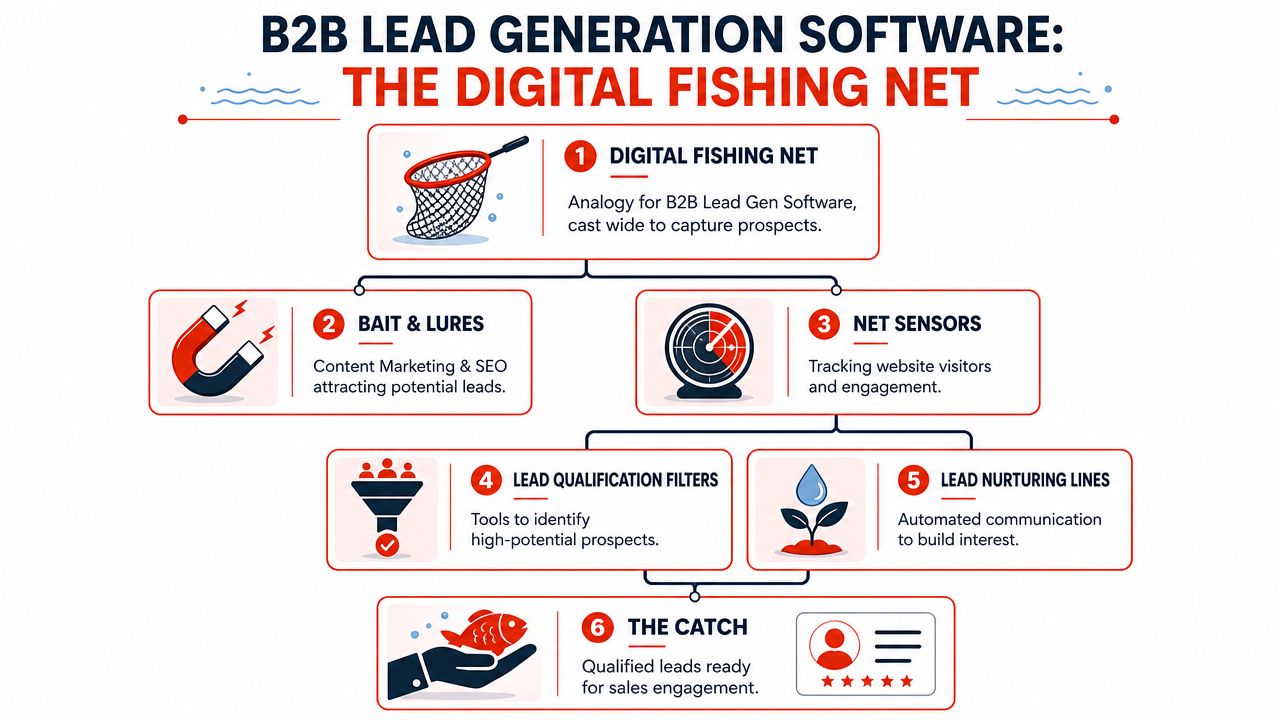
Think of B2B lead generation software as a digital receptionist for your pipeline.
A strong system doesn’t just collect contact details. It greets visitors, figures out what they need, asks qualifying questions, records useful context, and sends the conversation to the right place. In outbound use cases, it can also help your team find accounts that match your ideal customer profile. In inbound use cases, it captures intent from the traffic already reaching your website.
That distinction matters because “lead gen software” sounds like one product category, but it isn’t. It’s a set of tools that solve different parts of the same revenue problem.
The six categories that shape the market
The most effective stacks usually combine multiple layers. Apollo’s overview of lead generation tool categories describes six core categories: sales intelligence, engagement, enrichment, ABM and intent, content and SEO, and CRM integration. That’s useful because it gives you a map instead of a messy list.
Here’s what each category does:
- Sales intelligence: Tools like LinkedIn Sales Navigator, Apollo, or ZoomInfo help you identify companies and contacts you may want to approach.
- Engagement: These tools support outreach, follow-up, or real-time conversations. That can include email sequencing or website chat.
- Enrichment: They add business context to a lead record so your team doesn’t work with incomplete information.
- ABM and intent: These tools help teams spot which accounts appear to be actively researching a problem.
- Content and SEO tools: They bring in traffic that may eventually become leads.
- CRM integration: This is the connective tissue. Without it, information gets stuck in silos.
Why people get confused
Many buyers compare tools that sit in totally different parts of the funnel.
A prospecting database and a website conversation tool can both be called a B2B lead generation software tool, but they solve different problems. One helps you start conversations from the outside. The other helps you capture demand already happening on your site.
That’s why it helps to ask one simple question first: where is your lead leakage happening?
If you need a way to define target accounts before outreach, a lead research platform can help structure your prospecting work. But if people are already reaching your site and not converting, research alone won’t fix the bottleneck.
The smartest buyers don’t ask, “Which platform has the most features?” They ask, “Which stage of my funnel is currently wasting money?”
That one question usually makes the shortlist much clearer.
Core Capabilities and Their Business Impact
Software features are easy to overvalue. Business outcomes are what matter.
A useful evaluation lens is this: does this capability increase revenue, reduce labor, or improve lead quality? If the answer is unclear, the feature probably isn’t a priority for your business yet.
What modern tools need to do
According to ZoomInfo’s explanation of modern lead generation software, the strongest systems combine verified contact data, intent signals, enrichment, and workflow activation so teams can find and qualify prospects who match an ICP before sending them into sales workflows.
For an SMB owner, that translates into very practical benefits:
- Verified contact data: Your team spends less time chasing bad records or incomplete submissions.
- Intent signals: Sales can prioritize people showing active interest instead of treating every lead the same.
- Enrichment: Reps see context quickly, which makes follow-up more relevant.
- Workflow activation: Leads move into CRM, alerts, or nurture sequences without manual copying and pasting.
Feature to outcome translation
Here’s a simple way to think about ROI.
| Capability | What it changes in the business |
|---|---|
| Automated qualification | Your team stops wasting effort on poor-fit inquiries |
| Real-time conversation capture | Visitors can convert while interest is fresh |
| CRM sync | Sales sees context immediately instead of chasing missing details |
| Enrichment | Reps spend less time researching before follow-up |
| Intent-based routing | Better leads get faster attention |
This is also where many SMBs underinvest. They buy a tool that stores contacts, but not one that improves the handoff.
The hidden cost of weak qualification
A form that asks for “name, email, message” looks simple. Operationally, it creates work.
Somebody on your team has to read the message, interpret what the person wants, decide if they fit, route the inquiry, and reply. If the inquiry is vague, that process gets slower. If it happens after hours, momentum drops further.
A conversational capture system changes the shape of that work. It can ask follow-up questions in the moment, collect structured information, and summarize what matters before a human steps in. If you want a practical overview of how automation supports nurture and handoff, ReachLabs.ai automation insights are a helpful complement to this topic.
You can also see how this thinking applies specifically to on-site qualification in this guide to a lead generation chatbot for website conversion workflows.
Bottom line: Don't buy software because it “captures leads.” Buy software that reduces manual qualification and improves the quality of the lead your team actually receives.
That's where the ROI shows up first.
Typical Workflows and Critical Integrations
A lead gen process only works when the handoffs work.
Plenty of businesses have some lead capture. The bigger issue is that the process breaks between the website, inbox, CRM, and sales follow-up. The result is familiar: incomplete records, delayed responses, and no clean view of where leads came from or what they asked.
A practical lead flow from click to CRM
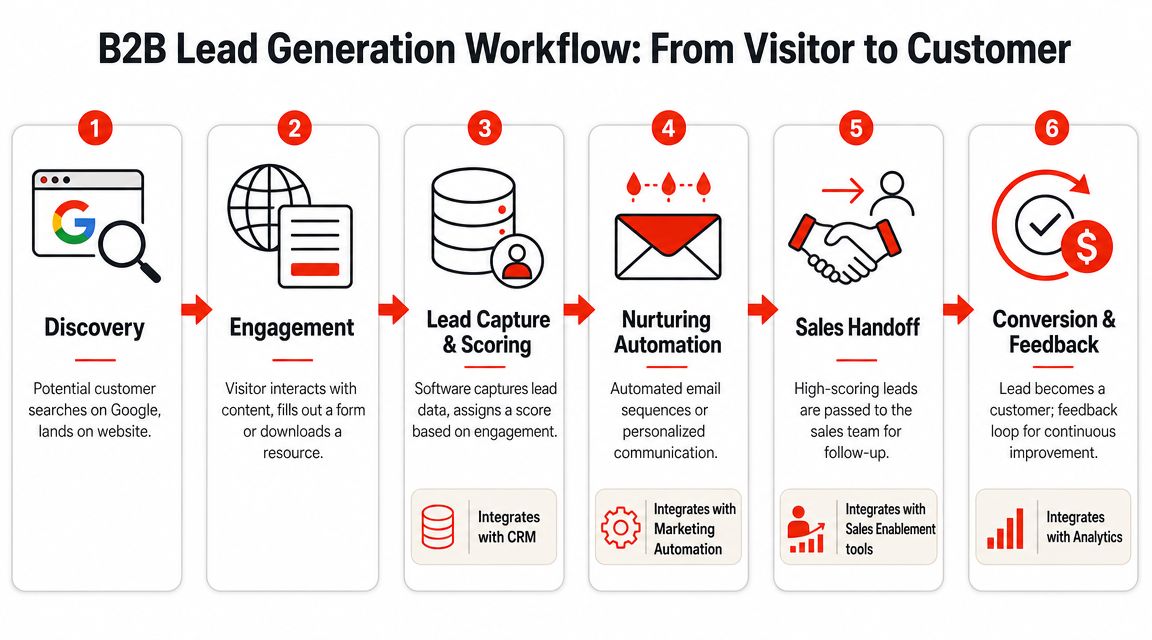
A typical modern workflow looks like this:
- A visitor discovers you through search, referral traffic, or LinkedIn.
- They engage on-site by reading a service page, pricing page, or case-study page.
- Your capture layer responds with chat, a guided conversation, or a targeted form experience.
- The tool qualifies the lead by asking relevant questions and collecting structured details.
- The CRM receives the record with conversation notes, source details, and routing tags.
- Sales or automation takes over with follow-up, booking, or nurture.
The traffic mix matters here. Warmly's 2026 lead-generation statistics roundup notes that 16% of MQLs come from organic and referral traffic, 94% of B2B marketers use LinkedIn for sales and lead generation, and LinkedIn accounts for 80% of all B2B social media leads. The practical takeaway isn't just “use LinkedIn.” It's that your lead capture system needs to support both website intent and multi-channel demand.
Integrations that actually matter
A lot of software checklists get too long. For most SMBs, the must-have integrations are simpler than vendors suggest.
- CRM integration: If lead data doesn't sync cleanly, your sales process slows down immediately.
- Email or nurture automation: Useful for non-urgent leads that aren't ready for direct outreach.
- Scheduling tools: Helpful when a qualified lead is ready to book.
- Analytics and attribution: Needed so you can tell which channels are producing useful conversations.
If you're comparing options, this overview of website visitor tracking tools for lead capture and attribution can help clarify where visitor insight fits into the larger workflow.
A quick visual helps if your team needs to align on process before buying:
A lead isn't just a form fill. It's a chain of events. If one handoff fails, the value of the whole system drops.
Where SMB workflows usually break
The biggest failure points are usually boring ones:
- No context: Sales gets a contact record with almost no useful detail.
- Slow response: The inquiry sits in an inbox until someone notices.
- Manual routing: Staff decide by hand who should reply.
- Disconnected tools: Marketing sees one system, sales sees another.
The best workflow doesn't just collect a lead. It preserves intent all the way through the handoff.
How to Choose the Right Software Tool for Your Business
Most buying guides push you toward the biggest list of contacts, the widest feature matrix, or the most recognizable brand.
That's often the wrong starting point for an SMB.
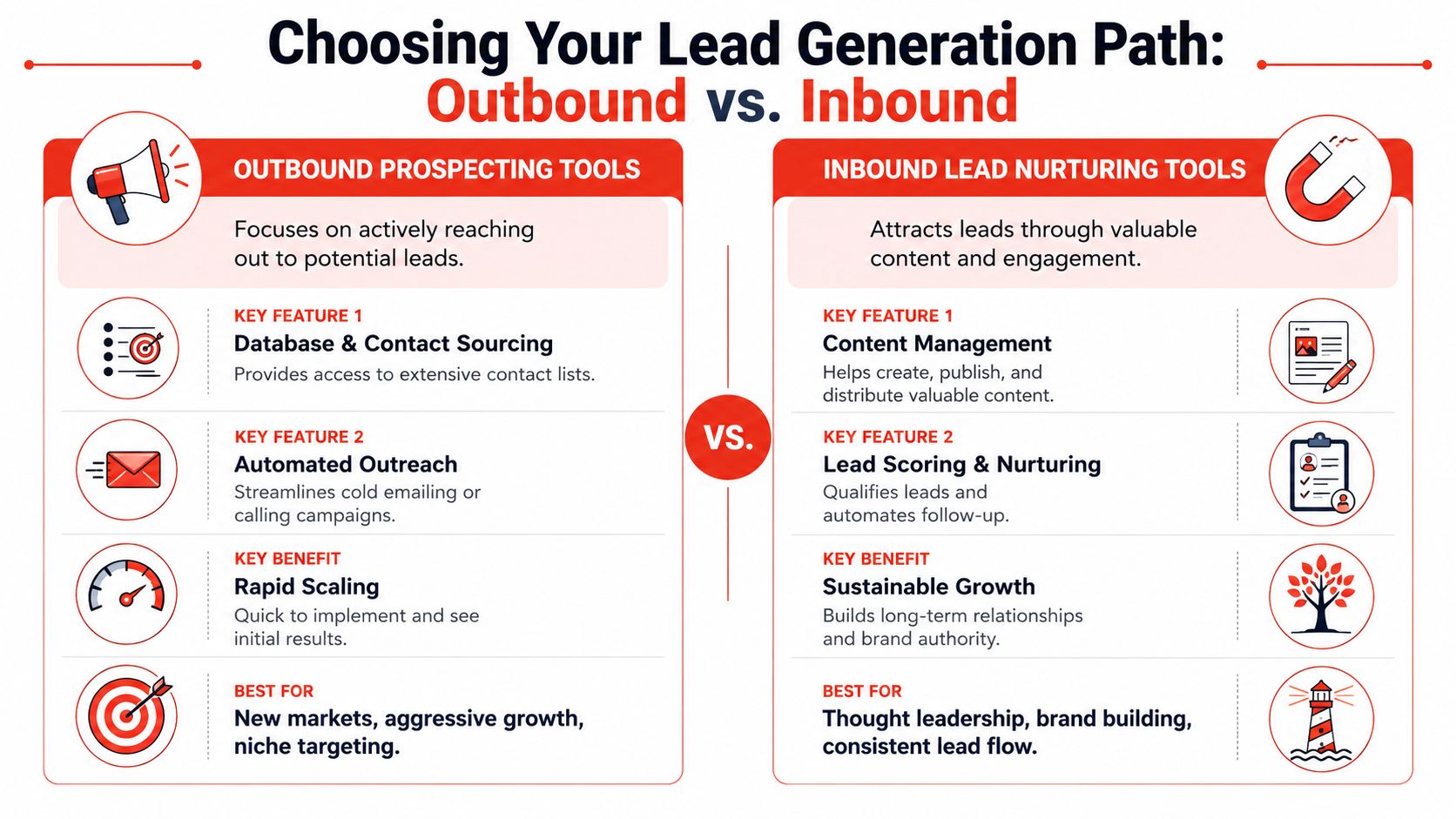
The choice is typically between two paths. Prospecting tools help you go find buyers. Conversion tools help you turn existing website interest into qualified conversations. Both can matter. But they shouldn't be treated as equal first purchases for every business.
Prospecting versus conversion
Here's the blunt version.
If your pipeline problem is “we have nobody to target,” a prospecting platform may be the right first move.
If your pipeline problem is “people visit our site but rarely convert,” a conversion-focused tool is usually the smarter place to start.
That second scenario is more common than many owners realize. Perspective's analysis of lead capture friction points to an important pattern: high-intent traffic converts better when it moves through a frictionless, interactive funnel that qualifies visitors before a sales handoff, rather than through a static form.
A buyer checklist that gets to the point
Use these questions before you compare vendors:
- Where is the bottleneck? Do you lack prospect lists, or are you failing to convert people already showing intent?
- How much friction do you force onto visitors? If your main path is a long form, you're likely losing people who would have engaged in a lighter conversation.
- What data do sales need? More fields aren't always better. Better questions are better.
- How important is first-party intent? In a privacy-first environment, the value of website-native capture goes up.
- Can your stack pass data cleanly into CRM? If not, the tool adds activity without adding usable pipeline.
Why conversion often wins first
For many SMBs, outbound sounds appealing because it feels controllable. Buy data, build lists, send messages.
But outbound also adds operational load. Someone has to define the audience, manage list quality, write sequences, monitor replies, and keep outreach compliant and relevant. That can work well, especially for targeted account-based selling. It just isn't always the fastest path to useful ROI for a small team.
A conversion tool starts with a simpler truth. You already have some demand. Visitors are already arriving. Some have intent right now. If your site fails to capture them, spending more on traffic or more on databases often just increases waste.
Decision lens: If your website already attracts relevant visitors, improving on-site conversion is usually a higher-leverage first investment than buying a larger outbound engine.
That doesn't mean prospecting tools are bad. It means sequencing matters. Many SMBs should fix website conversion before they scale outbound acquisition.
Lead Generation Software in Action for SMBs and Agencies
The easiest way to judge this category is to picture daily operations, not vendor demos.
A local service business after hours
A clinic, contractor, or legal office often has the same problem. The site gets traffic in the evening and on weekends, but no one is there to answer questions. The visitor may be ready to book, but the only option is a contact form that promises a reply later.
With an on-site conversational tool, the website can answer common questions, ask what service the person needs, collect contact details, and summarize the inquiry for the team the next morning. The business owner doesn't need a huge outbound machine. They need to stop missing qualified interest that already exists.
An agency managing multiple client sites
An agency has a different problem. It isn't just trying to get more leads. It has to prove that the website is generating useful business outcomes for clients.
A conversion-focused setup helps by replacing generic contact forms with guided qualification flows. Instead of sending clients a spreadsheet of vague inquiries, the agency can send structured lead context, cleaner handoff notes, and better routing. That makes the agency look more strategic because it isn't only delivering traffic. It's improving lead quality and response readiness.
One example of the conversion-tool approach
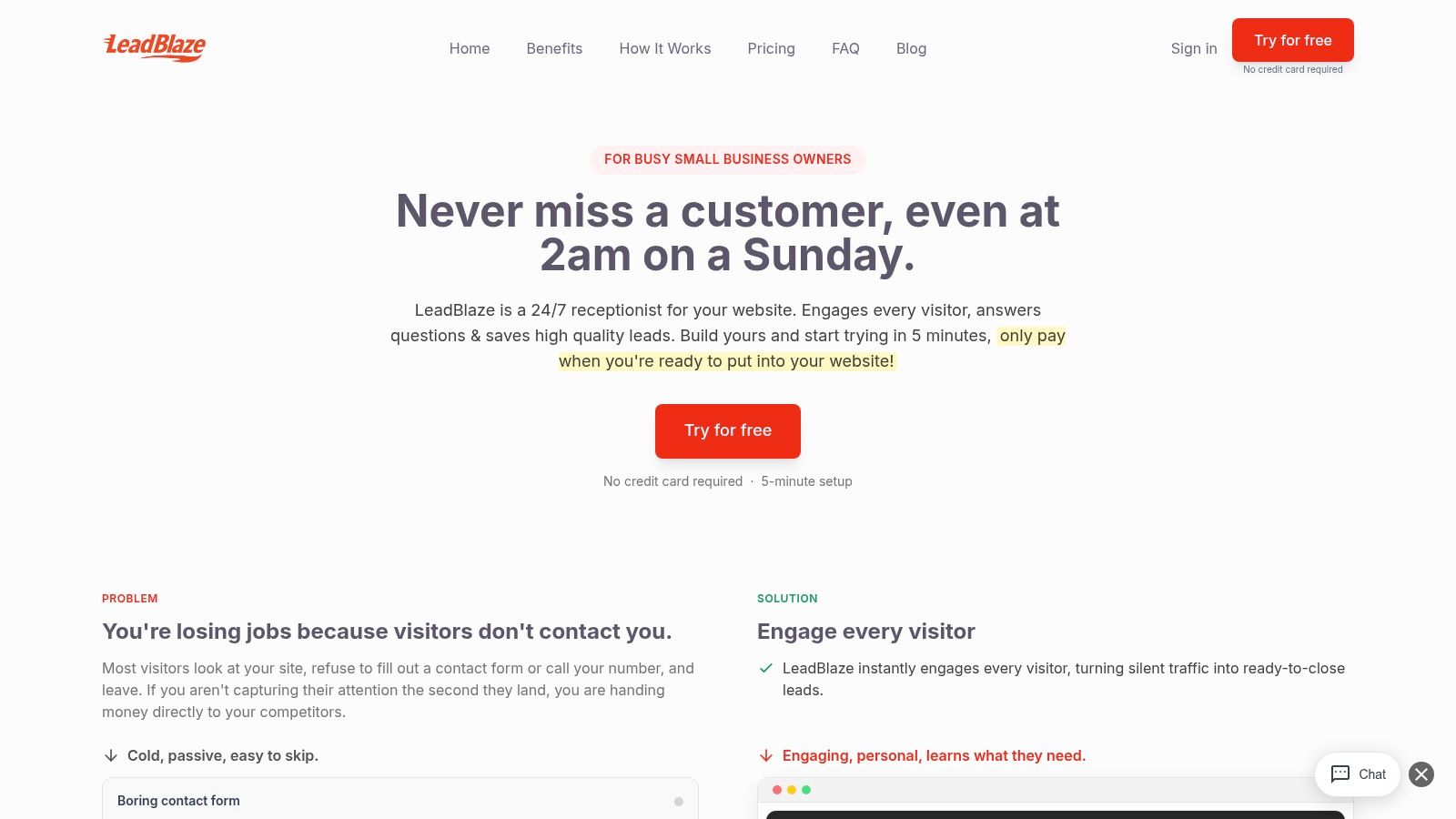
LeadBlaze fits this on-site conversion category. It acts as a 24/7 AI sales assistant on a website, answers visitor questions, applies custom qualification rules, and provides concise lead summaries in a central dashboard. For SMBs and agencies, the practical appeal is that it focuses on capturing and qualifying website intent rather than functioning as a large prospect database.
For teams comparing broader automation setups, this guide to marketing automation tools for small business workflows is a useful next read because it shows how lead capture fits into a larger follow-up system.
The clearest sign that a tool fits your business is simple: it removes work from your team while improving the quality of conversations that reach them.
That's what SMB owners usually care about in practice.
Getting Started and Measuring Your Success
Implementation doesn't need to become a tech project.
Most SMBs should start small. Put the tool on your highest-intent pages first. Usually that means service pages, pricing pages, and contact pages. Then define a short set of qualification questions your team uses in real sales conversations.
What to measure first
Skip vanity metrics. Track the metrics that connect to revenue operations:
- Lead conversion rate: Are more visitors becoming leads?
- Lead quality: Are the inquiries a better fit for your services?
- Cost efficiency: Are you getting more from the traffic you already pay for?
- Time to response or handoff: Is the team acting faster on inbound demand?
For teams building better reporting around those questions, these marketing dashboard best practices are useful for turning activity into something decision-ready.
A good B2B lead generation software tool should make your business simpler, not noisier. If setup is easy, data flows into the right places, and your team gets clearer, better-qualified leads, you're on the right track.
If your website already gets relevant traffic, the next logical step is turning more of that traffic into qualified conversations. LeadBlaze is built for that on-site conversion job, using an AI assistant to engage visitors, qualify them, and hand your team cleaner lead context without relying on static contact forms.