Improving your sales conversion rate isn’t about some secret marketing trick. It’s about one powerful idea: turning more of your website visitors into happy, paying customers.
This means we need to systematically find and fix the “leaks” in your customer journey, engage people the moment they show interest, and make it incredibly easy for them to take the next step with you.
Find The Hidden Gaps Costing You Sales
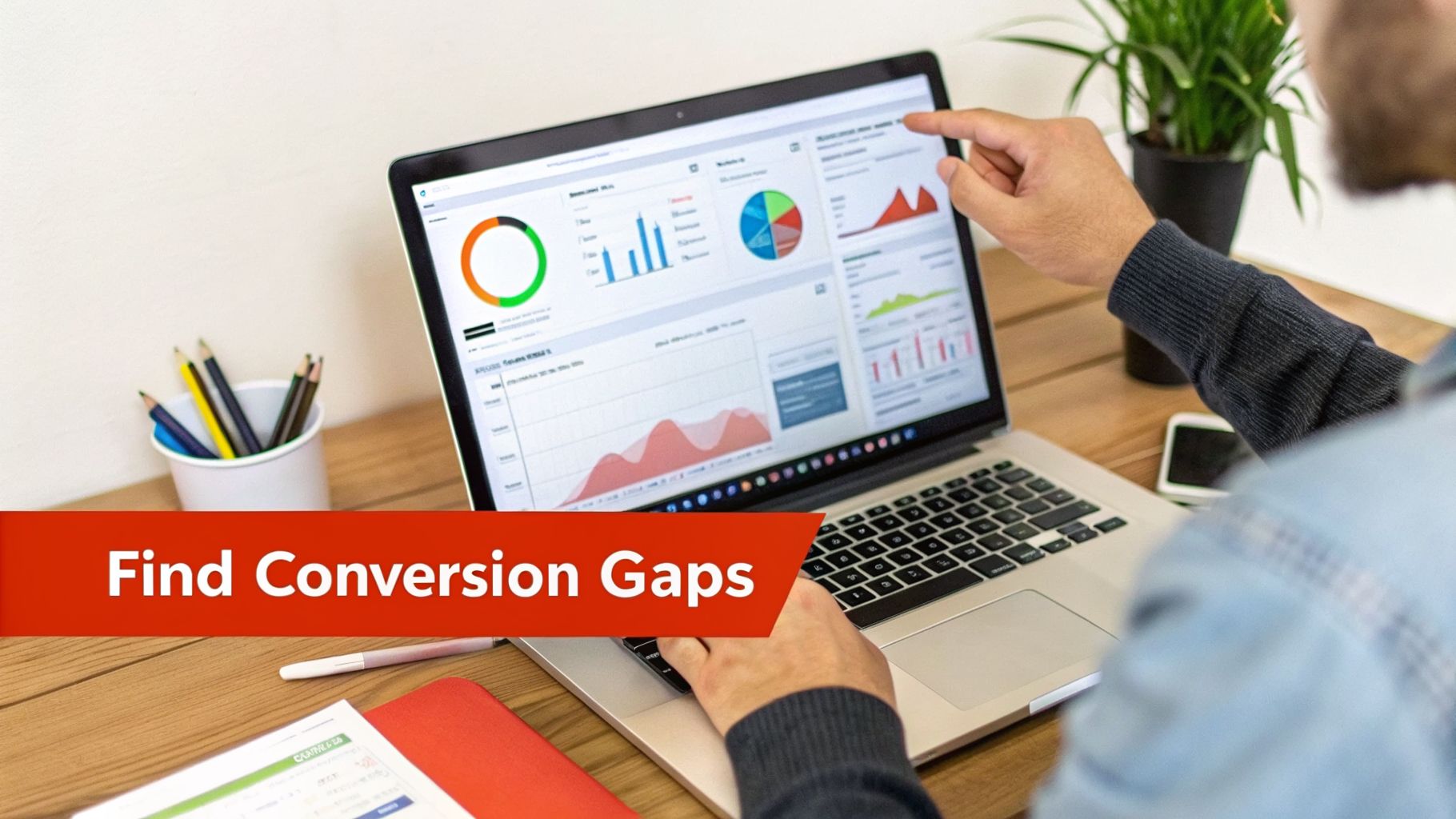
Your website might be bringing in a ton of traffic, but how many of those visitors actually convert? The very first thing we have to do is put on our detective hats and diagnose the silent issues that are pushing potential customers away. Think of it as a much-needed ‘conversion health check’ for your digital storefront.
So many businesses I see are still relying on outdated tools like static “contact us” forms. These create a massive gap between a visitor’s interest and any real sales action. In a world that runs on instant answers, making someone wait is a direct hit to your bottom line. Every single person who leaves your site without a conversation is a missed opportunity.
Symptoms Of A Low Conversion Rate
How can you tell if your website is underperforming? Start by looking for these all-too-common red flags in your analytics:
- High bounce rates on key pages: People are landing and leaving almost immediately, without clicking a thing.
- Major drop-offs in the sales funnel: You see a huge percentage of users vanish at a specific stage, like your pricing or demo request page.
- High shopping cart abandonment: This is a classic sign of friction right at the moment of truth for e-commerce sites.
- Low engagement with your calls-to-action (CTAs): People see your “Request a Demo” or “Buy Now” buttons but just aren’t clicking.
Shifting From Passive To Active Engagement
Finding these problems requires a real shift in how you think. Stop seeing your website as a passive digital brochure and start treating it like your number one salesperson—someone who should be actively greeting and helping every person who walks through the door.
The gap between traditional, passive websites and those built for instant engagement is significant. The table below illustrates just how wide that performance gap can be.
Conversion Rate Potential Traditional vs Optimized
| Metric | Traditional Website (Static Forms) | Optimized Website (AI Assistant) |
|---|---|---|
| Visitor Engagement | Low (passive browsing) | High (proactive conversation) |
| Lead Capture Rate | 1-2% | 5-10%+ |
| Time to First Contact | Hours or days | Instant (0 seconds) |
| Qualification Process | Manual, slow | Automated, instant |
| Sales Conversion Rate | 1.65% (Average) | 4.7%+ (Top Performers) |
As you can see, the difference isn't just incremental; it's a fundamental change in performance. Moving from a passive model to an active one completely changes what's possible.
The reality is, even small tweaks can lead to incredible results. The global average e-commerce conversion rate might hover around a modest 1.65%, but top-performing sites are hitting 4.7% or more. That proves smart changes can more than double your revenue.
In fact, recent benchmarks showed that traffic coming from AI-driven recommendations saw conversion rates jump +55% year-over-year. It was the only channel that actually grew while others declined. You can learn more about these e-commerce conversion rate statistics and see what they could mean for your own business.
Build Instant Trust the Moment They Arrive
So you've found the leaky spots in your sales funnel. Now for the real work: patching those holes right at the source—your website. When a visitor lands on your page, you have just a few seconds to earn their trust. If they feel even a hint of uncertainty, they're gone.
It all starts with your value proposition. Can a first-time visitor understand exactly what you offer, who it's for, and why you’re the best choice within five seconds? If they have to dig for it, you’ve already lost them. Make it bold, clear, and unmissable.
Weave Credibility into Every Page
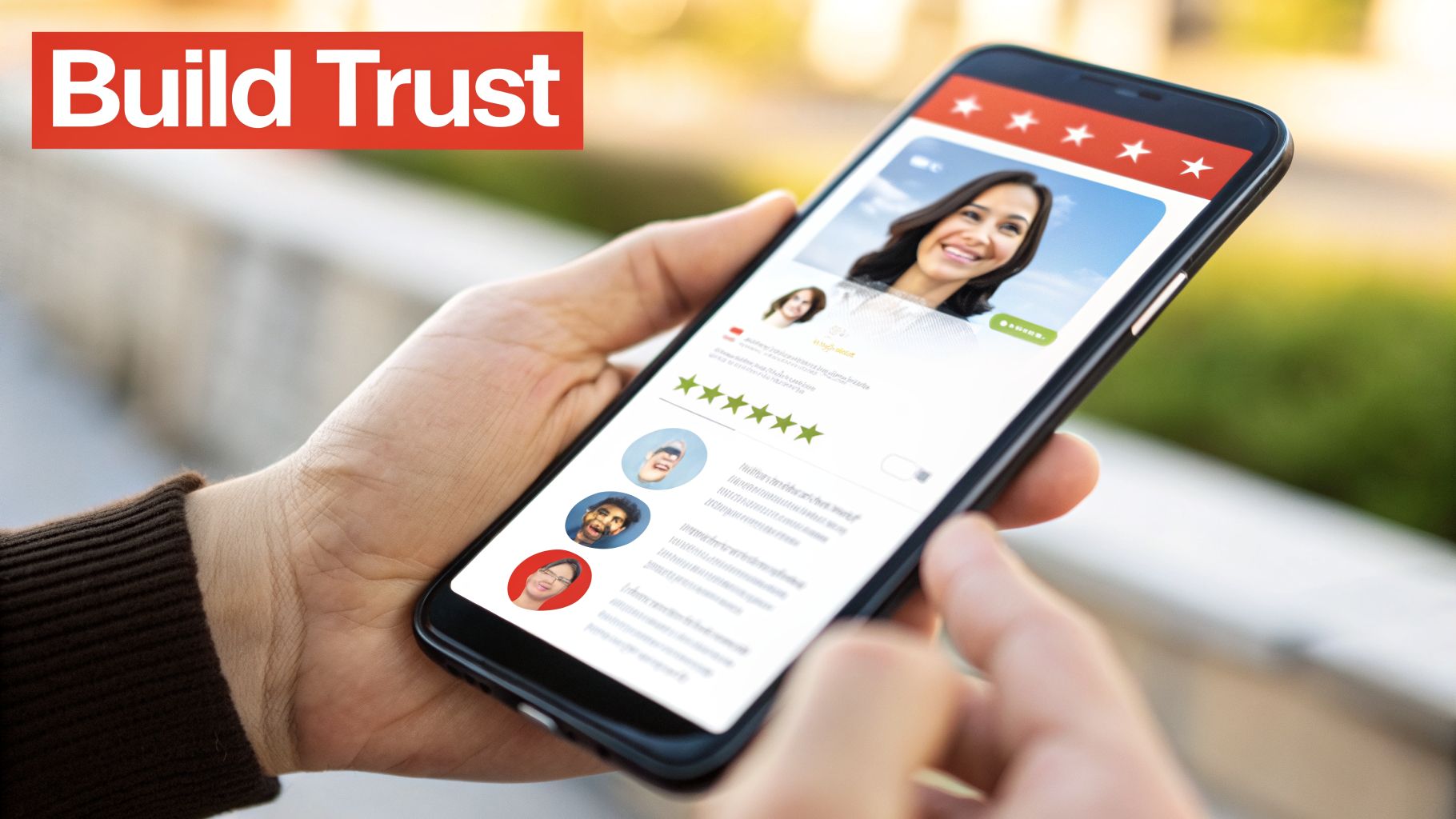
Next, you have to back up your claims. This is where social proof becomes your secret weapon, but a dusty testimonials page just won’t cut it. You need to strategically place these trust signals where they'll have the most impact.
Think about the user's journey and place proof right at their decision points:
- Beside your CTAs: A powerful customer quote right next to your "Request a Demo" button can be the final nudge someone needs.
- On product pages: Display star ratings and snippets of reviews directly under the product name. This instantly validates their interest.
- In detailed case studies: Go beyond vague praise. Show real-world results with hard numbers. A B2B buyer doesn’t want to hear "they were great"—they want to see how you helped a company just like theirs increase revenue or slash costs.
For instance, an agency saying, "Our client's qualified leads shot up by 150% in three months," is infinitely more powerful than a generic "We loved working with them!"
The goal is to make saying "yes" to you feel like the safest, smartest decision they could possibly make. When a visitor sees that people like them have already won with you, their own hesitation just melts away.
Master the Multi-Device Experience
Your website has to be flawless everywhere, period. But great design goes deeper than just looking good on a phone. It's about understanding that people use devices differently. While mobile might bring in the masses, it's often not where the final handshake happens.
The data tells a fascinating story. Mobile traffic might account for nearly 70% of all website visits, but desktop conversion rates can be a staggering 74% higher. That gap isn't a problem; it's a golden opportunity. I've seen businesses boost their revenue by 23% simply by fixing their user experience (UX) friction. You can see how your own industry stacks up by exploring digital experience benchmarks.
Turn Your Site into a Conversation
Finally, let’s stop thinking of your website as a static brochure and start treating it like a dynamic, helpful salesperson. Conversational commerce is about being there with an answer the second a question pops into your visitor's head.
Imagine someone is looking at your pricing page, trying to figure out which tier fits their needs. Instead of making them hunt for a contact form, a proactive chat assistant can pop up and ask if they need help.
This kind of instant, on-demand support is a massive trust-builder. Answering questions in real-time not only prevents people from bouncing but actively guides them toward becoming qualified leads. We cover this in-depth in our guide to implementing effective live chat support. It’s about being there 24/7, turning curiosity into conversion.
Automate Your Lead Qualification with an AI Assistant
Let’s be honest: your sales team's time is far too valuable to be wasted on leads that are going nowhere. One of the single most impactful changes you can make is to stop qualifying leads by hand and start automating the process.
Picture this: every visitor who lands on your website is greeted instantly, asked the right questions, and qualified based on your specific criteria. It doesn't matter if it's 2 PM on a Tuesday or 2 AM on a Sunday. This isn't science fiction; it's what a modern AI sales assistant can do for you right now.
These tools do more than just scrape your website for answers. They're programmed to engage visitors in a real conversation, capturing the critical details that turn a random visitor into a red-hot lead. Your website transforms from a passive brochure into an active, 24/7 sales development rep.
This simple flow shows you exactly how an AI assistant can turn a casual browser into a sales-ready lead.
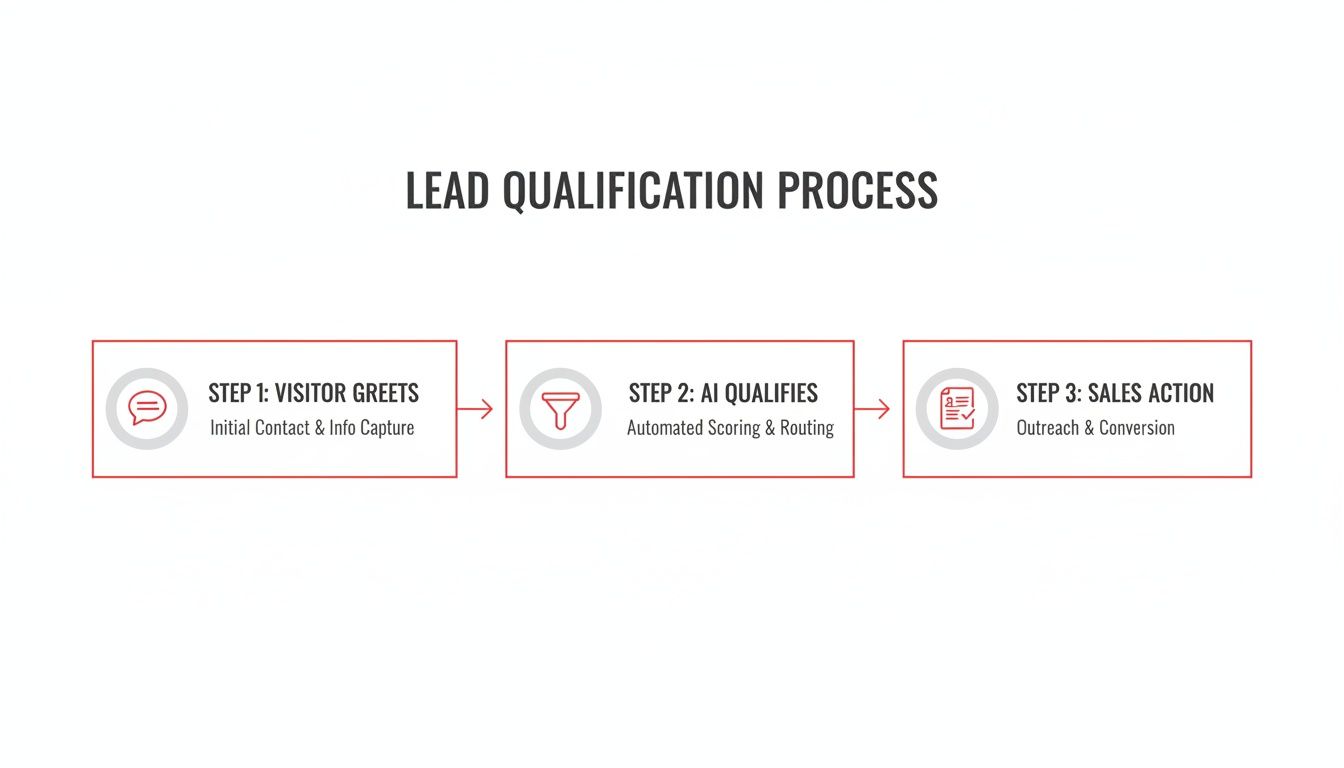
As you can see, the AI handles the initial engagement and filtering, freeing up your team to do what they do best: close deals.
You Set the Rules, the AI Does the Work
The real magic is in the customization. You get to define exactly what makes a lead "qualified" for your business. Instead of your team manually combing through contact forms, you can give your AI assistant a clear set of instructions.
Think about the possibilities. You can tell it to:
- Filter by budget: "Only flag leads with a project budget over $5,000."
- Qualify by company size: "Before you create a lead summary, find out how many employees their company has."
- Identify the decision-maker: "Make sure to ask for their job title so we know we’re talking to the right person."
This kind of intelligent sorting means your sales team only invests their energy in conversations with real potential. It’s like having an around-the-clock presales team that never gets tired.
Instead of getting a cold, one-line message from a static contact form, your sales team receives a rich, AI-generated summary. It includes the prospect's needs, budget, timeline, and the full chat transcript. Your team walks into that first call completely prepared for a warm, meaningful conversation.
A Real-World Example in Action
I once worked with a B2B marketing agency that was drowning in unqualified leads. They were getting inquiries from students, tiny startups with no budget, and businesses completely outside their service area. Their sales reps were spending hours every week just sorting the wheat from the chaff.
After setting up an AI sales assistant like LeadBlaze, they created a few simple qualification rules. The AI was trained to ask every new visitor about their monthly marketing budget and company size right at the start of the conversation.
Now, only inquiries that meet their ideal customer profile—for example, companies with over 10 employees and a marketing budget above $2,000/month—are flagged as "hot leads." These are sent directly to the sales team's dashboard with a full summary.
What about the others? The AI politely points them toward helpful resources, like a blog post or a free guide, keeping the interaction positive.
The results were immediate. The agency’s lead quality shot through the roof. More importantly, their sales team’s morale and efficiency went with it. If this sounds like a path you want to explore, you can learn more about how to create a custom bot for your own site and start seeing the same kind of transformation.
Design a High-Converting Visitor Journey

Amazing conversion rates don’t just happen by chance. I’ve seen it time and again: the companies with the best results are the ones who have meticulously mapped out the path a person takes from their very first click to that final, confident “yes.”
That path looks wildly different depending on what you’re selling. An e-commerce store with trendy skincare has a fast, visual, almost impulsive funnel. On the other hand, a B2B agency selling a six-figure service needs a much more deliberate, trust-building journey. The first step is admitting which game you’re playing and optimizing for its unique rules.
Map the Path From Click to Conversion
Let's get practical. Start by putting yourself in your visitor’s shoes. Where are they coming from? A targeted ad? A social media share? An organic search? Each starting point comes with a different expectation and level of intent.
Your job is to create a seamless, logical handoff from that entry point to a landing page that feels like the next step in the conversation.
This is where so many businesses stumble. They spend a fortune on ads only to dump everyone onto a generic homepage. That’s a massive missed opportunity. Your website should feel less like a brochure and more like a guided tour, where every turn is anticipated and every question is answered before it’s even asked.
To really nail this, you have to master the entry points. Following key programmatic landing page design best practices isn't just a suggestion; it’s a critical piece of the puzzle that ensures your first impression is powerful and persuasive.
Tailor the Funnel to Your Business Model
Let’s break down how this journey design works with two very different business models.
The B2B Service Funnel:
- The Reality: The buyer is naturally cautious, the decision involves a committee, and the sales cycle can stretch for months. A “Buy Now” button is just going to scare them off.
- The Journey: A visitor finds a blog post you wrote about a specific problem they're facing. Your call-to-action doesn’t push a sale; it invites them to read a detailed case study. From there, maybe you offer a spot in an exclusive webinar or a free consultation scheduled through a smart AI assistant. Each step is about building authority and earning trust.
The E-commerce Product Funnel:
- The Reality: Your buyer is ready to act but is also easily distracted. A competitor is always just one click away.
- The Journey: Someone clicks through from an Instagram ad showcasing your product. The landing page hits them with stunning visuals, immediate social proof like customer reviews, and a bold, unmissable “Add to Cart” button. The checkout is dead simple, removing every possible ounce of friction.
The staggering difference in industry performance highlights why a one-size-fits-all approach is doomed to fail. While the beauty industry might enjoy average conversion rates around 6.8%, B2B e-commerce often hovers at just 1.8%. This isn't because B2B is "worse"—it's because the journey is fundamentally more complex and demands more patience and nurturing. For agencies and founders, that gap screams opportunity.
This is where a little help can make a huge difference. Tools that provide instant answers, like an AI sales assistant, can deliver incredible conversion boosts of 20-50% simply by removing friction at those key decision points. You can explore more detailed conversion statistics to see exactly where your industry stacks up.
When you finally map and personalize this path, you stop hoping for conversions and start designing them. You turn casual interest into decisive action.
Measure What Matters and Iterate for Growth
You’ve put in the work to build a smarter customer journey and automate your lead qualification. Fantastic. But how do you actually know it's working? And more importantly, how do you find that next big win?
The answer is building a continuous feedback loop. This is where the real growth happens. We’re moving beyond one-time fixes and embracing a cycle of constant, data-backed improvements. It’s what separates businesses that plateau from the ones that consistently pull ahead. Forget guesswork. Your data has the story to tell.
Establish Your Core Metrics
You can't improve what you don't measure. While your final sales conversion rate is the ultimate goal—your North Star—it only tells you the end of the story. To get the full picture, you need a dashboard that tracks the health of your entire funnel.
Start by getting a handle on these essentials:
- Lead-to-Opportunity Rate: What percentage of people who raise their hand actually have buying intent? This is your gut check on whether your top-of-funnel messaging is attracting the right crowd.
- Cost Per Acquisition (CAC): Simply put, how much are you spending in marketing and sales to land one new customer? Driving this number down is just as valuable as pushing your conversion rate up.
- Funnel Stage Drop-Off: Where are the leaks? If you see a huge drop between "demo requested" and "demo completed," you've likely got a scheduling or follow-up problem to solve.
- Sales Cycle Length: How long does it take to guide a new lead from first contact to a signed deal? A shorter cycle means faster revenue and a more energized sales team.
Keeping an eye on these numbers helps you stop fighting fires and start making strategic moves. You can learn more about building this visibility with the right website visitor tracking tools.
Run Simple Yet Powerful A/B Tests
Once you have your baseline numbers, the fun begins. It's time to start experimenting with purpose. A/B testing isn't some complex process reserved for huge corporations; it's your best tool for making intelligent, incremental gains.
You can test almost anything. Start with things that have a direct impact on a visitor's decision:
- Headline Variations: Try pitting a headline that focuses on benefits against one that highlights a specific feature.
- CTA Button Copy: Which one gets more clicks: "Get Started Free" or "Request a Demo"? The only way to know for sure is to test it.
- AI Chat Prompts: Experiment with different opening lines for your AI sales assistant. Does a direct question or a helpful tip get more people talking?
The golden rule of testing is simple: change only one thing at a time. If you test a new headline, a different button color, and a new image all at once, you'll have no idea what actually made a difference. Isolate your variables to get clean, actionable insights.
For instance, one experiment I saw simply added relevant local payment options to a checkout page. The result? A 12% jump in revenue and a 7.4% lift in conversion. Sometimes the biggest wins come from the simplest changes.
Of course, your optimization efforts shouldn't stop at your website. To truly master the customer journey, you need to refine your approach on every platform, which includes dialing in your Conversion Rate Facebook Ads.
This constant cycle of testing, measuring, and learning is the engine that will drive your growth. Every test—win or lose—hands you a piece of the puzzle, making your next move that much smarter. This is how you stop guessing and start building a predictable, high-converting sales machine.
Answering Your Top Sales Conversion Questions
Alright, you've absorbed the playbook for diagnosing conversion issues, engaging your visitors, and tracking your progress. But I know what happens next. Once you start putting this into practice, the real-world questions pop up. Let's get into some of the most common ones I hear from teams just like yours.
How Long Until I Actually See a Better Conversion Rate?
This is always the first question, and the only honest answer is: it depends on what you change.
Some tweaks can deliver results almost overnight. I’ve seen teams change a confusing headline or switch a call-to-action button color and see a measurable lift in their A/B test in just a few days. These are your quick wins, the ones that build that crucial early momentum.
On the other hand, bigger moves take a bit more time to bake. Implementing a new tool, like an AI sales assistant, can start feeding you more qualified leads almost instantly. But a complete overhaul of your user journey? You’ll likely need a few weeks to a month before your analytics tell a clear story.
The real secret isn't speed—it's consistency. Bank those quick wins to build confidence and gather data. Then, reinvest that energy into the bigger, more ambitious projects that create lasting growth.
What’s a “Good” Sales Conversion Rate, Anyway?
Chasing some universal "good" conversion rate is a great way to drive yourself crazy. What's fantastic for one business could be a disaster for another. It all comes down to your industry, your price point, and your sales cycle.
For instance, the global average conversion rate might be around 2-3%, but I know niche e-commerce stores that consistently hit 5% or more. Meanwhile, a specialized B2B company with a six-figure deal size and a nine-month sales cycle might celebrate a 1-2% conversion rate as a massive victory.
Forget the global averages. Here’s a much healthier approach:
- Benchmark against yourself. Your real competition is who you were last quarter. Look at your past performance—that’s your starting line.
- Aim for steady, meaningful improvement. A great, achievable goal is to boost your current rate by 20-30% over the next quarter. This keeps you focused on real progress, not some arbitrary number.
This keeps your goals grounded in reality and your team fired up about what’s possible.
Can I Really Improve Conversions Without a Huge Budget?
Absolutely. In fact, some of the most effective conversion strategies I've seen cost more in effort than in cash. It's not about how much you spend; it's about how smart you are with what you have.
Think about it. Clarifying your core message, adding powerful customer testimonials to key pages, or simplifying a clunky sign-up form—these are all high-impact activities that are essentially free. Many A/B testing platforms even have free plans that are more than enough to get you started.
And today, powerful technology is no longer out of reach. An AI sales assistant, for example, gives you the horsepower of an entire lead qualification team for a fraction of the cost. It levels the playing field, allowing smaller teams to punch way above their weight. The goal is always to make data-driven decisions, not just to throw money at a problem and hope for the best.
Ready to stop letting good leads slip through the cracks? Let LeadBlaze act as your 24/7 AI sales assistant, turning more visitors into qualified, sales-ready conversations. Start your free trial and see how you can improve your sales conversion rate today.