
Some weeks the schedule looks healthy on Monday and thin by Thursday. Hygiene is steady, a few big cases are in treatment, and then the phones go quiet. The usual response is to try a little of everything. Boost a few Facebook posts, ask the front desk to request reviews more often, maybe run ads for implants. Most practices end up with activity, not a system.
That’s the problem behind how to get more dental patients. Growth usually breaks because the pieces don’t connect. A practice spends on visibility but loses leads on the website. It gets calls but sends too many to voicemail. It earns goodwill from existing patients but never turns that into a reliable referral channel.
The practices that grow consistently don’t rely on one tactic. They build a playbook that links local search, website conversion, paid traffic, reviews, referrals, phone handling, and follow-up into one patient acquisition process. That’s what works in the field. Not random marketing. Not more noise. A tighter path from search to scheduled appointment to first visit.
The Modern Dental Practice Growth Equation
Monday starts full. By Thursday, two hygiene holes open up, a crown consult has not called back, and three missed calls from new patients never made it into the schedule. That is not a marketing volume problem. It is a patient acquisition system problem.
Practice owners often ask for more leads when the first fix is a clear patient acquisition target. If you do not know how many new patients each full-time dentist must add each month to replace attrition and support growth, it becomes hard to judge whether the issue is visibility, conversion, or follow-up.
For a general practice, there is a practical benchmark. Many offices need 10 to 25 new patients per full-time dentist per month to stay ahead of normal patient loss, as noted earlier. Patients move, switch insurance, postpone treatment, or disappear after a single emergency visit. If your numbers stay below that range for long, the leak is usually visible once you track the full path from first search to first appointment.
The equation is simple. The management is not.
A modern dental growth system has four parts:
- Visibility: Prospective patients need to find the practice in the channels they already use.
- Trust: They need enough confidence to contact your office instead of the competitor two blocks away.
- Conversion: Your website, phones, forms, and scheduling process need to turn interest into booked appointments.
- Follow-through: Patients need reminders, confirmation, and a good first experience so they show up, start care, and refer others.
The mistake I see most often is treating those parts as separate projects. One vendor handles SEO. Someone on the team boosts social posts. The front desk answers calls when it can. No one owns the handoff points. That is where growth stalls.
A practice can rank well and still underperform if the website is slow, the insurance information is vague, or calls hit voicemail during lunch. The opposite is also true. A polished website will not save weak local visibility. Growth comes from alignment, not isolated effort.
Channel mix matters here. New patients still book in different ways. Some want to call. Some want to submit a form after hours. Some need two or three follow-ups before they commit. If your process only works for one type of patient, you are leaving demand on the table. If you want a practical companion resource on follow-up and reminders, learn about Call Loop’s patient messaging.
This playbook works as one connected system. Local search creates demand. The website and phone process capture it. Paid campaigns fill gaps or push high-value services. Reviews and referrals reduce hesitation. Internal operations protect the investment by getting more inquiries to show, accept treatment, and return.
Master Local Search to Become the Neighborhood Choice
Most practices don’t lose local search because they lack a website. They lose because a nearby competitor looks more complete, more current, and easier to trust in Google Maps.
When someone searches for a dentist in their area, Google is trying to answer a practical question. Which office solves this person’s problem nearby, right now, with the least uncertainty? Your local SEO work should answer that question better than anyone else in your radius.
Build a complete Google Business Profile
A claimed profile isn’t enough. A competitive profile feels active and specific.
Start with the basics, but don’t stop there. Your Google Business Profile should have correct categories, business hours, service descriptions, appointment links, insurance details if relevant, and consistent contact information that matches your website. Add real photos of the office exterior, operatories, team, reception area, and signage so patients can confirm they’re choosing a legitimate, established practice.
Then do the work that most offices skip:
- Create service coverage: Add individual services such as emergency exams, cosmetic dentistry, implants, Invisalign, pediatric care, sedation options, and same-day crown availability if applicable.
- Use the Q&A section intentionally: Seed common patient questions and answer them clearly. Think insurance, financing, parking, same-day emergencies, and whether new patients are accepted.
- Refresh imagery regularly: New photos signal that the practice is current and active.
- Keep appointment links working: Broken paths cost real patients.
A useful outside reference for the local search side of healthcare practices is Reviews To The Top’s medical SEO guide. It’s a solid checklist for the structural issues that often get missed.
Match your website pages to local intent
A common mistake is trying to rank one generic “services” page for everything. Local search works better when each meaningful service has its own focused page.
If you want to show up for searches with clear intent, build pages around the terms patients use, such as:
- Emergency dentist [city]
- Cosmetic dentist [city]
- Sedation dentistry near me
- Dental implants [city]
- Family dentist [neighborhood]
Each page should answer practical questions quickly. What problem do you treat? Who is it for? What happens at the first visit? How does someone book? Avoid generic copy that could belong to any office in any state.
Patients don’t choose the practice with the fanciest wording. They choose the practice that looks nearby, credible, and easy to contact for the service they need.
The local SEO checklist that actually moves rankings
This work is less glamorous than ad campaigns, but it compounds well when done properly. Use a simple operating list.
| Local search area | What to tighten |
|---|---|
| Google Business Profile | Categories, services, photos, Q&A, booking link |
| Website service pages | One page per core service with local relevance |
| Trust signals | Reviews, team bios, office photos, accepted insurance details |
| Technical consistency | Same name, address, and phone details everywhere |
| Content support | Helpful location and service content tied to patient intent |
What usually doesn’t work
Three habits waste time.
First, stuffing city names into every sentence. Google and human readers both spot it immediately.
Second, relying on a homepage to rank for every procedure. It’s too broad.
Third, neglecting urgent-intent searches. “Emergency dentist” and similar terms often convert because the patient isn’t browsing. They need help now. If you offer emergency care and don’t make that obvious in your profile and on your site, you’re giving those patients away.
Local search wins when your practice becomes the obvious neighborhood choice. Not the loudest. The clearest.
Turn Your Website Into a 24/7 Booking Engine
A prospective patient lands on your site at 9:40 p.m. They cracked a molar, they are tired, and they want one answer fast. Can this office help me, and how do I get on the schedule? If the page makes them hunt, hesitate, or wait until morning, the lead is already slipping to the next practice.
Traffic helps only if the site converts it into booked appointments.
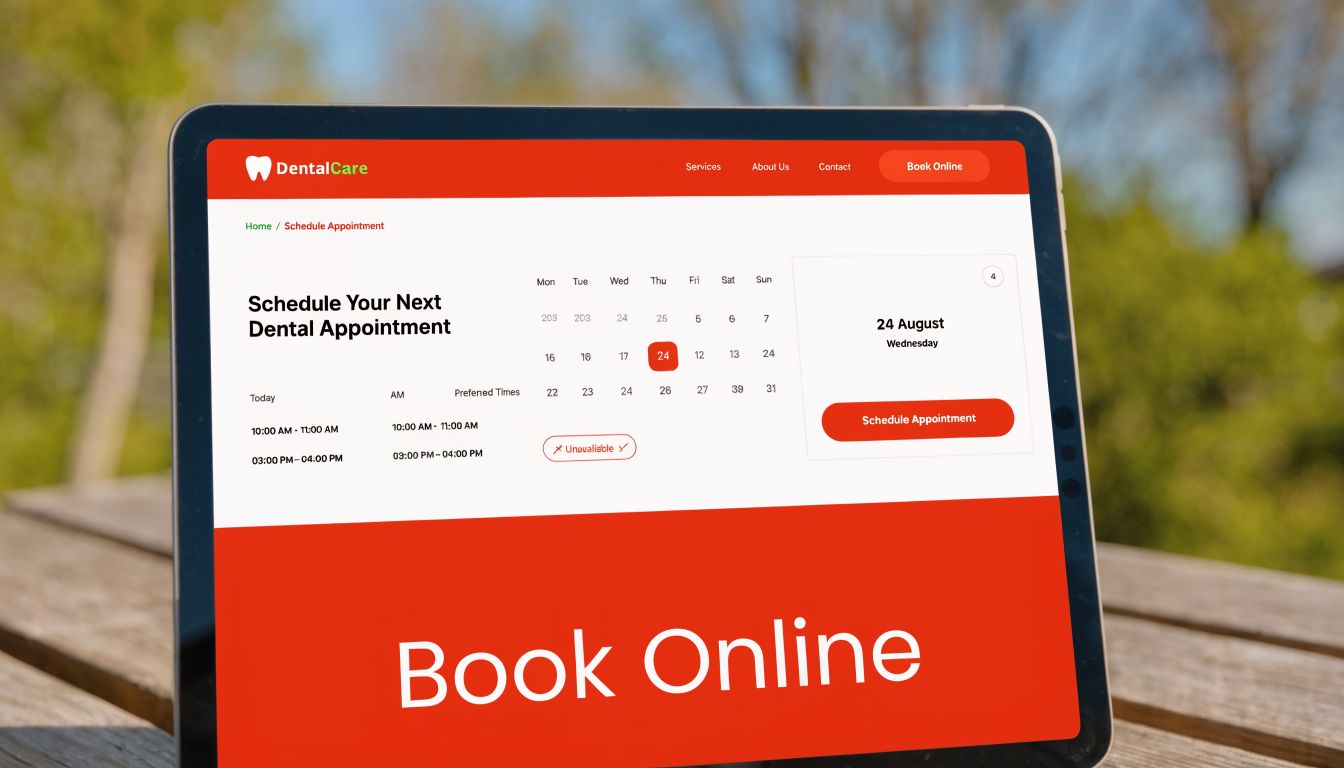
Remove friction before you buy more traffic
Website fixes usually beat a redesign.
Most dental sites lose patients for simple reasons. The service path is vague. The call to action is buried. The form asks for too much. Mobile pages load slowly. Front desk hours are clear, but the next step after hours is not.
A useful dental homepage should answer four questions in seconds:
- What do you do best? Emergency care, implants, family dentistry, cosmetic cases, Invisalign, sedation, or another priority service.
- Why should I trust you? Real doctors, real staff, real reviews, real photos.
- How do I contact you right now? Tap-to-call, online scheduling, text, or a short form.
- What happens next? Confirmation, callback timing, insurance check, or consult process.
That last point matters more than owners expect. Patients are not just judging clinical credibility. They are judging how much effort booking will take.
Build pages around decisions, not just services
A brochure site describes the practice. A booking site helps someone choose.
That means each high-value service needs its own path with a clear promise, proof, and next step. Implant pages should address candidacy, timeline, financing, and consult booking. Emergency pages should show hours, phone number, same-day process, and what to do now. Cosmetic pages should show before-and-after examples, common treatment options, and consultation steps.
This is also where channel alignment starts to matter. If Google Business Profile, organic search, referral traffic, and paid ads all send people to the homepage, conversion usually suffers. Match the landing page to the intent behind the click. Someone searching for emergency dentistry should not need three more taps to find the emergency number.
For practices running paid traffic, these PPC tips for dental patient acquisition are useful because they reinforce the same point. Click quality and landing-page fit rise or fall together.
Use proof patients notice quickly
Trust signals work best when they reduce a specific concern.
A nervous patient wants reassurance about comfort. An implant patient wants to know the doctor has done this before. A parent wants to know the office is organized and easy to deal with. Put proof next to the decision point it supports, not on a generic testimonials page no one visits.
Use a mix of proof that matches the treatment:
- Short video testimonials for fear reduction and emotional reassurance
- Recent review excerpts near booking buttons and service pages
- Before-and-after galleries for cosmetic and restorative cases
- Doctor videos that explain treatment options in plain language
- Insurance and financing details where cost hesitation tends to show up
Stock imagery weakens all of that. Real team photos, real operatories, and real patient experience cues do more work than polished generic visuals.
Here’s a useful walkthrough on modern conversational conversion design if you want to rethink passive forms and static contact pages: AI chatbot for website conversion ideas.
After-hours capture changes the economics
A dental website should do more than collect names for the front desk to sort through tomorrow.
It should capture demand when demand appears. That includes evenings, weekends, lunch breaks, and moments of urgency. If the only option is a long contact form with no response expectation, many visitors will keep searching. If the site offers online booking, clear response windows, texting, and answers to common objections, more of that demand turns into appointments without adding staff hours.
Practices often miss the bigger playbook. Website conversion is not a standalone project. It connects directly to front-desk response time, scheduling rules, call handling, and follow-up. If the site promises “book now” but the office takes a day to confirm requests, marketing gets blamed for an operations problem.
A contact form captures interest. A booking engine turns interest into a scheduled next step.
This video gives a clear picture of how website conversion improves when response happens immediately:
Audit the patient path on mobile
Use your phone and test the site like a new patient.
Search for a priority service, land on the page, and try to book. Count the taps. Watch where you hesitate. Check whether the office location, accepted insurance information, financing details, and availability cues are easy to find. Then submit a lead and measure what happens next. How fast is the response? Is the message clear? Does someone try to convert the inquiry into a real appointment, or just acknowledge receipt?
That audit usually exposes the main bottleneck. In many practices, the problem is not lack of traffic. It is a broken handoff between website visit, lead capture, and scheduling. Fix that system, and every other channel performs better.
Launch Targeted Ad Campaigns for Immediate Results
A practice can do strong local SEO work, improve the website, and still have a hole in the schedule next month. Paid search solves a different problem. It gives the office a controlled way to generate demand for specific services on a specific timeline.
That control only matters if the campaign is tied to the rest of the system. Ads, landing pages, call handling, insurance verification, and scheduling rules have to work together. If one piece breaks, cost per lead rises and the team blames the wrong channel.

Start with service-level intent
The highest-performing dental campaigns usually focus on treatments patients are already searching for. Emergency exams, implants, Invisalign, veneers, and high-value restorative work tend to produce clearer intent than broad terms like “best dentist near me,” which often mix price shoppers, existing patients, job seekers, and people still in research mode.
That means campaign structure matters more than ad copy tweaks.
Build separate campaigns or ad groups around one service line at a time. Match the keyword set, ad message, landing page, and follow-up script to that service. A person searching for same-day emergency care has different urgency, questions, and booking behavior than someone researching cosmetic options for later in the year.
A practical setup usually includes:
- Tight geo-targeting: Set the radius around where ideal patients will travel from, not where the practice owner hopes they will come from.
- Negative keywords: Block irrelevant searches before they spend the budget.
- Call and location assets: Remove friction for patients who want to contact the office fast.
- Service-specific messaging: Speak to the treatment, not the whole practice.
Don’t send paid clicks to the homepage
This is one of the fastest ways to waste ad spend.
Paid traffic should arrive on a page that continues the exact conversation started in the ad. An implant ad should lead to an implant page. An emergency ad should lead to emergency availability, symptoms treated, insurance and payment context, and a direct path to call or request care. Homepage traffic forces people to search again after they already clicked once.
I tell clients to judge landing pages by one standard. Can a nervous new patient decide and act within a minute?
A page built to convert usually includes:
- A headline that matches the ad
- A short explanation of the service
- Proof, such as reviews, credentials, or treatment photos
- A visible phone number
- A short consult or appointment form
If you want another practical perspective on campaign structure and booking-focused ad execution, PPC tips for dental patient acquisition is worth reviewing.
Use PPC where it has a defined job
Paid ads work best when the practice has a clear objective. Fill emergency chair time. Increase implant consults. Test demand for Invisalign in a new part of town. Support a newer location that does not rank well yet.
They work poorly when the office is still guessing.
I would hold off on scaling ads if calls go unanswered, if the team cannot tell which leads became booked appointments, or if the landing pages are thin. In those cases, more traffic just exposes the operational problem faster.
Use this filter before increasing spend:
| Use PPC when | Hold off when |
|---|---|
| You need faster patient flow for a specific service | The website still loses high-intent visitors |
| You can build a page that matches the ad | The front desk misses or delays follow-up |
| You can track calls, forms, and booked appointments by campaign | You cannot measure which campaigns produce patients |
| You have capacity to handle leads quickly | Trust signals are too weak to support conversion |
Well-run PPC is part of the growth system, not a separate tactic. The campaign creates demand. The landing page converts it. The front desk confirms it. The schedule absorbs it. Track all four pieces together, and paid search becomes a predictable way to add patients while the slower channels keep compounding in the background.
Build a Powerful Reputation and Referral System
A patient sees your Google reviews, asks a neighbor where they go, then lands on your site to check whether the office feels credible. Those are not separate marketing moments. They are one trust sequence, and weak spots in any part of it lower conversion.
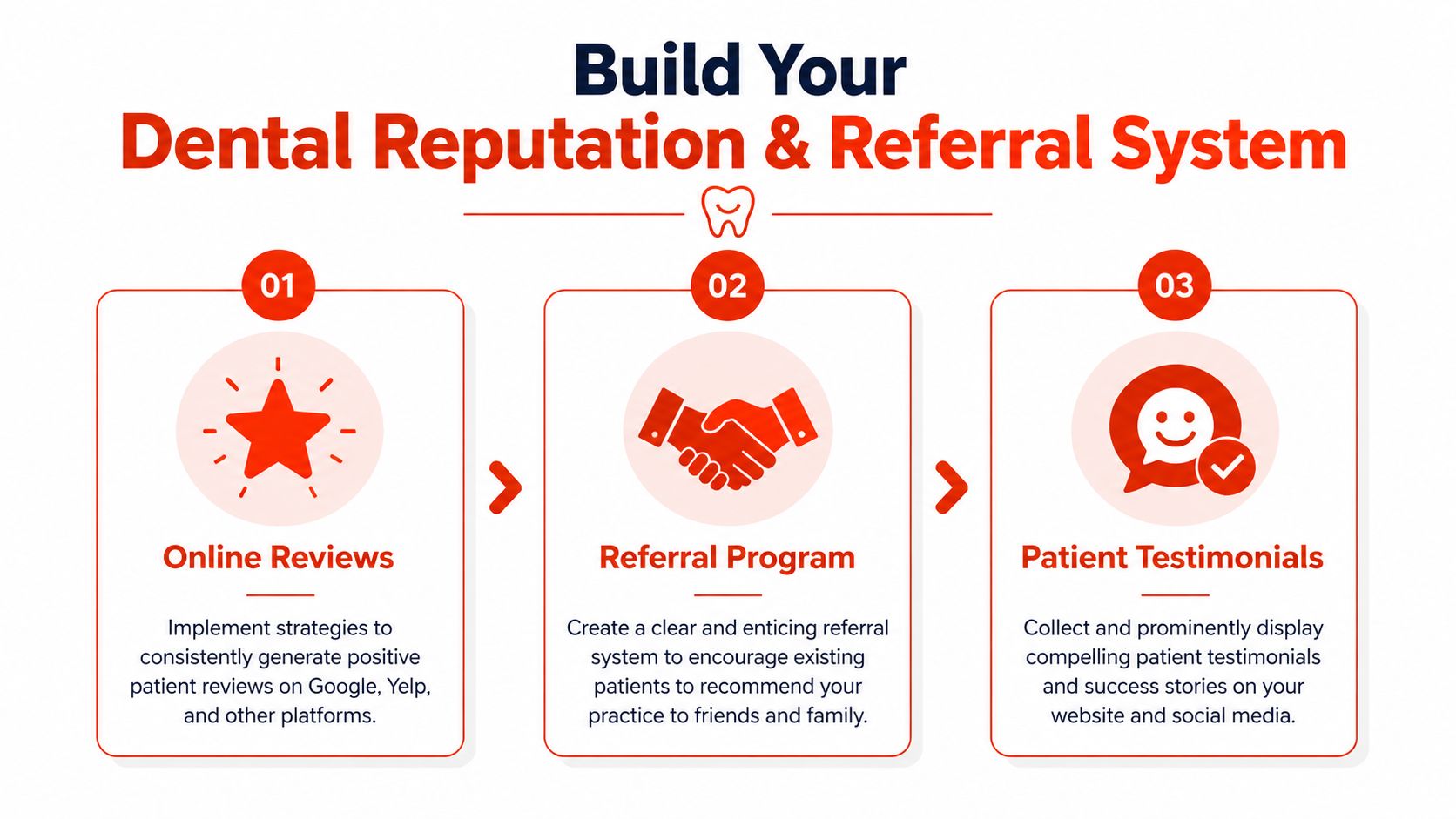
That is why I build reputation and referrals as one operating system. Reviews help the practice win the first impression. Referrals send in warmer leads. Testimonials help hesitant patients say yes to larger treatment. When those pieces run together, the practice relies less on expensive acquisition and gets better conversion from the traffic it already earns.
Reviews need a real process
“Leave us a review if you have time” produces random results because it depends on memory, confidence, and timing.
A better approach is simple. Pick the moments when satisfaction is highest, then assign the ask to a specific team role. Hygiene visits that went smoothly, same-day emergency relief, cosmetic reveals, and completed restorative cases usually perform well because the patient has a clear positive outcome in mind.
Use a short workflow the team can repeat every day:
- Ask face to face: A quick personal request gets better follow-through than a generic text alone.
- Send the link right away: Remove the extra step of searching for your profile.
- Use a short script: Staff should sound natural, not rehearsed.
- Flag unhappy patients internally: Solve the service issue first. Do not push for a public review from someone who is still frustrated.
The goal is recent, credible proof. A prospect comparing two offices will notice whether reviews are current, specific, and consistent.
Referrals perform best when they are structured
Practices often hope good service will generate enough word of mouth on its own. It does generate some. It rarely generates a predictable monthly patient count.
A referral system works because it gives satisfied patients a clear next step. It also gives the team a way to track whether the program is producing booked appointments or just casual mentions.
I keep referral programs restrained for a reason. If the reward is too aggressive, the practice can cheapen the brand or attract low-fit patients who respond to the incentive more than the office itself. If it is too vague, nobody acts on it. The middle ground works best. A simple thank-you tied to a completed first visit is usually enough.
What to include in the referral system
The strongest programs are easy to explain in one sentence and easy to track inside the practice management workflow.
Include these parts:
- A clear audience: Start with loyal recurring patients and people who already speak positively about the office.
- A straightforward offer: Keep the thank-you modest and easy to understand.
- Staff prompts at the right moments: Post-treatment, checkout, and follow-up messages are the best places to mention it.
- Tracking by source: Every referred lead should be tagged so the office can measure consults, kept appointments, and production.
- A monthly review: Check which patients referred, which referred leads showed up, and whether the offer is still worth the margin.
This is where the integrated playbook matters. The referral mention should not live on a forgotten flyer at the front desk. It should appear in post-visit emails, selective SMS follow-up, in-office signage, and provider conversations. The handoff from marketing to staff execution is what makes the program produce consistently.
Testimonials should support high-consideration treatment
Reviews and referrals do different jobs. Testimonials fill the credibility gap for treatment that requires more trust, more money, or more time to decide.
Use them where patients hesitate. Implant pages, Invisalign pages, cosmetic dentistry pages, and financing-related content are the common examples. A short patient story about pain relief, confidence, or a smooth treatment process often does more than generic copy. Placement matters too. Put the proof beside the service, consult form, or booking step, not on an isolated page no one visits.
For practices refining those conversion paths, this guide to improving website user experience for higher-converting patient journeys is useful.
Run reputation and referrals on one scoreboard
If the practice wants this channel to compound, it needs a few simple KPIs reviewed every month:
| Trust asset | Primary KPI | What to check |
|---|---|---|
| Reviews | New reviews per month | Volume, recency, sentiment, and whether key providers or locations are underrepresented |
| Referrals | New patients from referrals | Booked visits, kept visits, and production by referral source |
| Testimonials | Page-level conversion support | Whether service pages with testimonials produce more consult requests or bookings |
That gives the owner a practical way to manage trust as a growth system instead of treating it like a side effect of good service.
Optimize the Appointment and Patient Experience
A new patient clicks your ad at 8:12 a.m., calls during a break at work, gets voicemail, then books with the practice across town before lunch. The marketing did its job. The intake process lost the patient.
That handoff from interest to scheduled visit is where a lot of growth stalls. Practices spend money to create demand, then let avoidable friction reduce the return. If local SEO, the website, reviews, and ads are the front half of the system, appointment flow is the part that turns attention into production.
The common failure points are predictable:
- Missed calls during peak hours
- Callbacks that come too late
- Online forms that ask for too much too soon
- Booking paths that are hard to find on mobile
- Phone scripts that sound administrative instead of reassuring
- No clear explanation of what happens after a patient reaches out
These issues connect. A weak website conversion path creates more phone calls. Weak phone handling wastes those calls. Slow follow-up makes paid traffic more expensive than it looks in the ad platform. This section matters because it ties the earlier channels together.
Reduce friction between inquiry and appointment
The best-performing practices make it easy to contact the office in more than one way, then respond with speed and clarity.
That usually means three things. Strong phone coverage during business hours. Short online forms for patients who are not ready to call. Online scheduling where it fits the practice model, especially for hygiene visits, consults, and other straightforward appointment types.
Keep forms short. Name, contact details, reason for visit, preferred time range, and insurance status are usually enough for the first step. Every extra field lowers completion rate unless there is a clear reason to ask for it.
For the digital side of this process, this guide to improving user experience for patient booking and lead capture is a useful reference.
Treat the front desk like part of the growth system
Front desk performance changes marketing results. I have seen practices blame lead quality when the actual issue was how calls were handled in the first 30 seconds.
The job is to reduce uncertainty and secure the appointment. That requires a different approach than merely collecting information. Use the caller's name. Answer the immediate concern first. Give a clear next step. If the schedule is tight, offer the earliest realistic option and a backup. If the caller mentions pain, anxiety, cost, or cosmetic goals, respond to that concern instead of moving straight into forms and policies.
A simple call framework works well:
- Greet the patient and identify the reason for the call
- Acknowledge urgency or concern
- Answer the key question in plain language
- Offer an appointment with a specific time
- Confirm what happens next
This is not about sounding polished. It is about giving nervous or time-constrained patients enough confidence to commit.
Make the first visit easier than patients expect
Patient experience starts before anyone sits in the chair. Confirmation messages, directions, parking instructions, digital paperwork, insurance expectations, and arrival timing all shape whether the practice feels organized.
Good pre-visit communication also reduces no-shows and front-desk congestion. Patients arrive knowing what to bring, how long the visit will take, and what the appointment includes. That lowers stress for the patient and pressure on the team.
Trade-offs matter here. Full online scheduling gives patients convenience, but it can create template problems if the schedule is already tight or if new patient exam types vary by provider. Longer intake forms may help the team collect more information upfront, but they often reduce completion rates. The right setup is the one your team can execute consistently without slowing response time.
Marketing does not stop at the lead. It stops when the patient shows up, has a good first experience, and stays in care.
Practices that grow steadily usually manage this section with the same discipline they use for ads and search visibility. They track missed-call rates, form response time, booked appointment rate, show rate, and time from first contact to appointment. That is how the playbook becomes operational instead of theoretical.
Your Implementation Checklist and Key Metrics
Most practices don’t need more ideas. They need order.
Trying to do everything in one month usually creates half-finished work across five channels. A better approach is sequencing. Fix the foundation first, then layer speed on top of it.
A practical 90-day rollout
Use this as a working plan, not a rigid template.
| Phase | Focus Area | Key Actions |
|---|---|---|
| Month 1 | Local visibility and conversion basics | Tighten Google Business Profile, update core service pages, improve calls to action, add clearer booking paths, review mobile usability |
| Month 2 | Trust and intake process | Build review request workflow, launch referral tracking, shorten forms, improve phone scripts, clean up new patient follow-up |
| Month 3 | Paid acquisition pilot | Launch service-specific PPC campaigns, create dedicated landing pages, monitor booked appointments by campaign, refine based on lead quality |
This sequence works because each layer supports the next. Better visibility without conversion wastes traffic. Better ads without intake discipline waste spend. Better referrals without tracking hide what’s working.
Track the metrics that change decisions
A practice doesn’t need a giant dashboard. It needs a useful one.
Monitor these numbers consistently:
- New patients per dentist per month: This is the core growth benchmark.
- Website conversion rate: If traffic is rising but bookings aren’t, fix the site before increasing acquisition.
- Inquiry-to-appointment rate: This exposes intake friction.
- Show rate: Booked patients still need to arrive.
- Cost per new patient: Essential for paid channels.
- Referral share of new patients: Shows whether trust is becoming an acquisition asset.
- Review volume and recency: A leading indicator for conversion confidence.
For context on what strong site conversion looks like across industries, average website conversion rate benchmarks can help you pressure-test your expectations.
What to do if results stall
If growth doesn’t improve, don’t assume the market is the problem.
Check the sequence. Is local visibility weak? Are ads going to the homepage? Are calls missed? Are reviews stale? Is the team booking too far out? Usually the bottleneck is operational, not theoretical. Find the exact break, fix that, and measure again.
The practices that win at how to get more dental patients don’t chase hacks. They run a connected system, track the right numbers, and improve one weak link at a time.
If your website gets traffic but too many visitors leave without booking, LeadBlaze helps turn that traffic into qualified conversations around the clock. It gives dental practices a practical way to engage visitors instantly, answer common questions, collect the details that matter, and hand the team cleaner leads instead of a pile of cold form submissions.