It’s easy to use customer service vs customer support interchangeably, but they are fundamentally different. Getting this right isn’t just about semantics; it’s about understanding the heart of your customer experience.
Think of it this way: customer service is the entire journey, the art of building a lasting relationship. It’s proactive and emotionally driven. On the other hand, customer support is a crucial part of that journey—the reactive skill of solving a specific problem. One is the concierge ensuring you have a wonderful stay; the other is the mechanic who expertly fixes your car engine when it sputters.
Defining Customer Service and Customer Support
To truly build a brand that people love, you have to see service and support as two sides of the same coin. They work together, but they aren’t the same. Confusing them is a common mistake that holds businesses back from creating truly memorable experiences.
Customer service is the big picture. It’s the philosophy that guides every single interaction, from the first time someone hears about you to the moment they become a lifelong advocate. It’s about anticipating needs, offering genuine guidance, and making people feel seen and valued.
Customer support is the tactical, hands-on discipline within that philosophy. It’s the “how-to” team. When a product isn’t working right or a feature is confusing, your support specialists jump in with technical know-how to get the customer back on track.
“The difference between customer service and customer support is that a customer support team can fix a technical issue in the short term, but providing good customer service helps build relationships and establish a true partnership in the long term.” – Jonathan Brummel, Director of Enterprise Support at Zendesk
At a Glance How Service and Support Differ
Let’s break down the core differences in a way that’s easy to see. This table gives you a quick snapshot of how these two critical functions operate.
| Dimension | Customer Service | Customer Support |
|---|---|---|
| Focus | Proactive Relationship Building | Reactive Problem Solving |
| Goal | Increase Customer Happiness & Loyalty | Resolve Technical Issues & Roadblocks |
| Approach | Relational & Emotional | Transactional & Technical |
| Metrics | Net Promoter Score (NPS), CSAT, CLV | First Contact Resolution (FCR), AHT |
| Analogy | A helpful concierge | A skilled mechanic |
Understanding this distinction has a real, measurable impact on your bottom line. Why? Because customers who feel an emotional connection—a direct result of great service—have a 306% higher lifetime value. That's not a small number.
Whether your team is building relationships or troubleshooting issues, clear and consistent communication is everything. Using resources like customer service response templates empowers your team to handle any situation with confidence and efficiency.
This becomes especially critical on fast-paced channels. If you're looking to strengthen those real-time interactions, you might find our guide on implementing high-quality https://leadblaze.ai/blog/live-chat-support incredibly helpful. When you finally master both service and support, you create a powerful, sustainable engine for growth.
Comparing Responsibilities, Skills, and Success Metrics
We've talked about the high-level philosophy, but where the rubber really meets the road is in the day-to-day work. The difference between "customer service" and "customer support" isn't just some abstract concept—it dictates who you hire, what your team does all day, and how you even know if they're doing a good job.
Think of it this way: a customer service pro’s day is all about proactively building relationships. In contrast, a customer support specialist is a problem-solver, reactively putting out fires. This core difference is the key to building two powerful, specialized teams that work together beautifully.
This simple visual breaks it down perfectly, showing how service focuses on proactive relationship-building while support is all about reactive problem-solving.
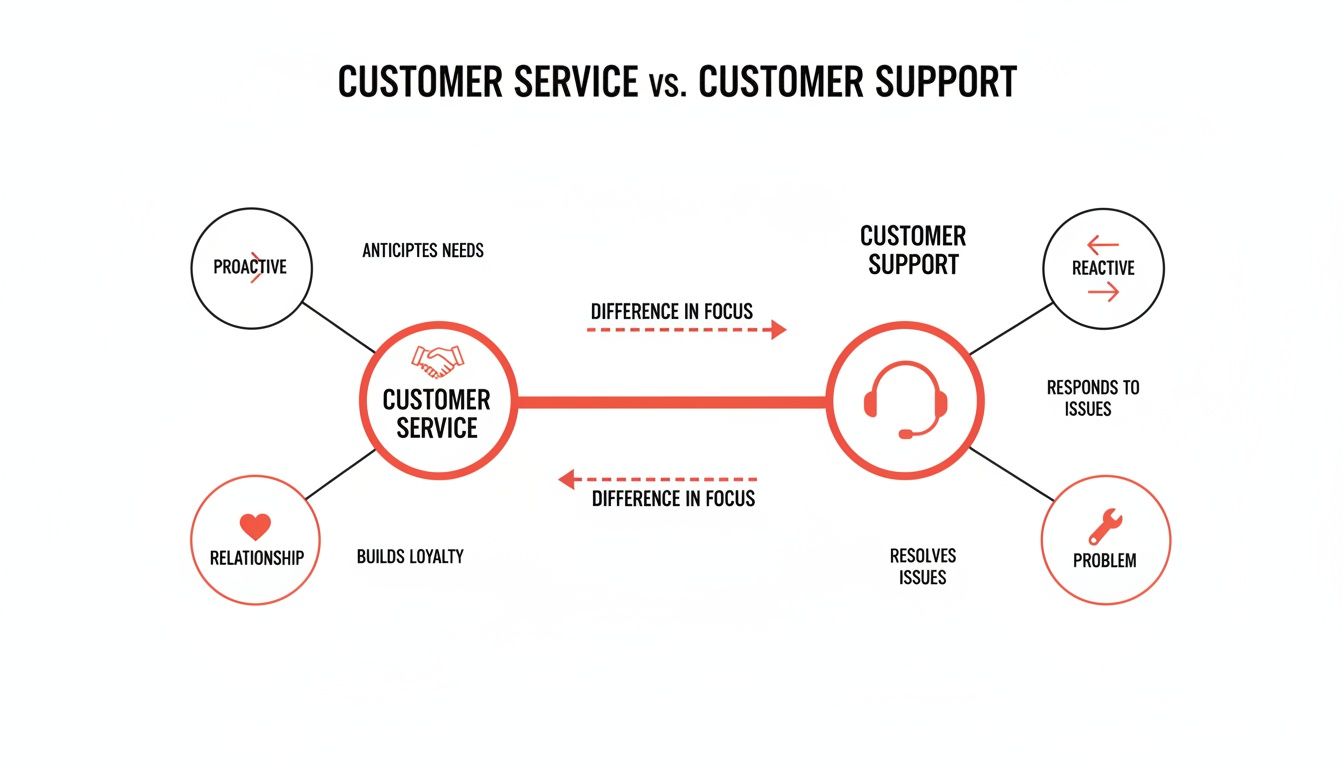
As you can see, one team is looking down the road, building long-term value. The other is focused on fixing what's broken right now.
Core Skills That Define Each Role
Because their missions are so different, you can't just hire a "people person" and expect them to thrive in either role. You need to look for distinct skill sets. While there's certainly some overlap, an amazing support specialist might struggle in a service role, and vice versa.
Customer Service professionals absolutely need to have:
- Empathy and Emotional Intelligence: This is non-negotiable. They have to genuinely connect with a customer’s feelings to build real trust.
- Patience and Positivity: Staying calm and encouraging, especially when a customer is upset, is the magic that turns a bad experience into a great one.
- Communication Skills: It’s more than just being clear. It's about being persuasive and guiding customers toward success and a deeper connection with your brand.
Customer Support specialists, on the other hand, shine with:
- Technical Proficiency: They must know your product inside and out. A deep, almost obsessive, understanding of its features and technical quirks is a must.
- Problem-Solving and Logic: These are your detectives. They need to systematically diagnose a problem, find the root cause, and implement a fix.
- Clarity and Efficiency: The true masters can take a complex technical solution and explain it in simple, easy-to-follow steps so the customer feels empowered, not overwhelmed.
A customer service agent might say, "I totally get how frustrating it is when you can't find what you're looking for. Let me show you how this new dashboard can actually save you time down the road." But a support agent is more likely to say, "I see the API call is failing. Let’s check your authentication token and endpoint configuration to get you back up and running."
How Success Is Measured Differently
It only makes sense that if the jobs and skills are different, the scorecards should be too. Customer service KPIs are all about measuring long-term relationship health. Customer support metrics, however, are focused on speed and efficiency in fixing problems. If you try to judge one team by the other's metrics, you’ll just create confusion and reward the wrong behaviors.
Here’s how their key performance indicators stack up.
Customer Service Success Metrics:
- Net Promoter Score (NPS): This is the ultimate loyalty question: "How likely are you to recommend us?"
- Customer Satisfaction (CSAT): A snapshot of happiness with a specific interaction or the brand as a whole.
- Customer Lifetime Value (CLV): This tracks the total revenue you can expect from a single customer, proving the ROI of building strong, lasting relationships.
Customer Support Success Metrics:
- First Contact Resolution (FCR): What percentage of issues are completely solved in one single conversation? This is a huge one.
- Average Handle Time (AHT): How long does it take, on average, to handle a support case from start to finish?
- Ticket Volume & Backlog: A simple but vital measure of the team's capacity—how many requests are coming in versus how many are waiting?
Getting the right metrics in focus is a game-changer. For instance, improving First Contact Resolution (FCR) by just 10% can reduce customer churn by 30%. That’s a massive impact, directly linking efficient problem-solving to customer loyalty.
To get a handle on all of this, it's worth exploring how to measure the complete customer experience across your entire company. When you do, you ensure both your service and support teams are pulling in the same direction—toward sustainable growth.
When to Prioritize Service or Focus on Support
Knowing the difference between customer service vs customer support is one thing. The real magic happens when you learn when to put your energy and resources behind one or the other. This isn’t about which is "better"—it's about making smart, strategic decisions that give your business real momentum.
Think of it like you're captaining a ship. Sometimes, you need all hands on deck patching a leak just to stay afloat (that’s support). Other times, you need your crew creating an unforgettable voyage for your passengers (that’s service). Both are vital, but your timing changes everything. The right call at the right time is the difference between simply surviving and truly thriving.
The game plan for which to prioritize shifts with your business's current reality. Once you can read the situation—your immediate needs and your bigger dreams—you can put your resources where they’ll make the biggest impact, turning every customer touchpoint into a genuine opportunity.
Scenario One: Double Down on Support During a Product Launch
You’re on the verge of launching a brilliant, but complex, new piece of software. The buzz is real, but you know from experience that the first wave of users will find bugs, have a million questions, and need a guiding hand. Right now, your absolute top priority is making sure the product simply works for them.
In a launch, one bad technical snag can send ripples of negative reviews across the internet, stopping your momentum cold. Your reputation is hanging on your ability to fix things—fast.
Here’s Your Game Plan:
- Go All-In on Technical Training: Your support team needs to know this product inside and out. They should be able to diagnose problems with absolute confidence and speed.
- Build an Amazing Knowledge Base: Get ahead of the curve by creating detailed help docs, quick video tutorials, and clear FAQs. Empower users to solve the small stuff themselves.
- Make Fast Response Times a Religion: At this stage, fixing a ticket quickly is far more valuable than a charming chat. The relationship is built on proving your product is solid and your team is reliable.
The goal isn't to wow them with conversation; it's to empower them by making the product work flawlessly. During a launch, rock-solid support is your most powerful marketing tool because it builds instant trust and shows you’re in it for the long haul.
Scenario Two: Lead with Service in a Crowded Market
Now, let's paint a different picture. You run an e-commerce store in a space where dozens of competitors sell similar products. You can’t win on price alone, and any new feature gets copied in a heartbeat. So, how do you become the go-to choice?
This is where you make exceptional customer service your secret weapon. When people can buy the same item from ten different places, they’ll always return to the business that made them feel seen, heard, and genuinely appreciated. Here, your service is your brand.
Focusing on service has a direct line to loyalty. Recent industry figures show that by 2026, e-commerce businesses hit an impressive 80% customer satisfaction (CSAT) score, while internet providers lagged at 68%. That gap says it all—service-first industries forge much stronger bonds. You can see more data on how service excellence drives satisfaction across different sectors on sparrowdesk.com.
Here’s Your Game Plan:
- Give Your Team the Freedom to Be Generous: Let your agents go off-script. Empower them to offer a personalized discount, tuck a handwritten thank-you note into a package, or give proactive advice.
- Focus on Building Real Relationships: Train your team to listen for the story behind the purchase, ask genuine questions, and find small ways to connect on a human level.
- Measure What Matters: Relationships: Shift your focus to KPIs like Net Promoter Score (NPS) and Customer Lifetime Value (CLV). These metrics will show you if your service efforts are creating true, long-term loyalty.
When you know when to lean into the technical precision of support and when to embrace the human artistry of service, you stop just running a business. You start building a customer experience that’s memorable, resilient, and destined for growth.
Creating a Unified Customer Experience

The whole debate over customer service vs customer support often misses the point. The real breakthrough isn’t about picking a side; it’s about realizing they’re two sides of the same coin, working together toward one single mission. The goal is to weave these functions together so tightly that every customer interaction—whether it’s a quick fix or a long-term conversation—feels connected and personal.
When these teams operate in separate worlds, your customer pays the price. They get bounced between departments, forced to repeat their story, and ultimately feel like just another ticket in a queue. A unified approach tears down those internal walls, creating a single, smooth journey where solving a problem and building a relationship happen in the same breath.
This isn't just a "nice-to-have." It’s a core business strategy. After all, a staggering 73% of consumers will walk away and find a competitor after just a few bad experiences. To earn their loyalty, you have to nail both the technical fix and the human connection. For a deeper dive, check out this piece on how modern customer expectations are shaping business on sparrowdesk.com.
From Silos to Synergy: How to Unite Your Teams
Bringing these teams together doesn’t happen by accident. It takes a deliberate effort to build systems that encourage collaboration and shared ownership of the customer’s happiness. When information flows freely and everyone feels responsible for the entire journey, you create something truly special.
Key Strategies for Unification:
- A Single Source of Truth: Get both teams working from the same CRM or customer platform. When everyone can see a customer's full history—from past purchases to recent support tickets—they have the context needed to provide truly personal and effective help.
- Create Powerful Feedback Loops: Your support agents are on the front lines, hearing firsthand about product bugs and user frustrations. Build a direct channel for them to feed that goldmine of information back to the product and service teams. This is how you turn reactive fixes into proactive improvements.
- Invest in Cross-Functional Training: Have your service team sit with support to understand the technical nuts and bolts. Then, have your support team shadow service to master the art of proactive outreach. This builds empathy, respect, and a powerful shared skill set.
By uniting service and support, you stop treating customers as a series of isolated problems. Instead, every interaction becomes another chapter in the long-term relationship you’re building together.
Turning Support Tickets into Service Moments
The real magic happens when you empower your support team to think like your service team. Every time a customer reaches out with a problem, it’s not just a ticket to be closed—it's a golden opportunity to deepen the relationship.
This means training your technical experts to recognize those small moments where they can go above and beyond the immediate fix. Did they just walk a customer through a confusing feature? That’s the perfect time to proactively share a helpful guide or ask about their bigger goals.
The Unified Playbook in Action
Let’s see how this plays out. Imagine a customer contacts your team, frustrated about a billing error.
The Siloed Approach: A support agent finds the mistake, corrects the bill, closes the ticket, and moves on. The problem is solved, but the customer is left feeling like a transaction. They got what they needed, but they don't feel great about it.
The Unified Approach: The support agent quickly corrects the error. But then, they notice the customer has been with the company for three years. They don’t just close the ticket. Instead, they say, "I'm so sorry for that mistake—I’ve already fixed it. As a small thank you for being such a loyal customer for so long, I've gone ahead and added a credit to your account for next month."
In the unified model, a simple support interaction transforms into a memorable service moment that builds incredible goodwill. This is how you create an experience that doesn't just solve problems but builds unbreakable loyalty, one conversation at a time.
How AI Assistants Elevate Service and Support

Today's customers want it all: immediate answers and a genuine connection. This puts a ton of pressure on growing businesses. How can you deliver amazing experiences around the clock without burning out your team? This is where a smart AI assistant changes the game.
Think of your website as more than just a digital storefront—imagine it as an intelligent, tireless team member. An AI assistant, like LeadBlaze, works to amplify both your customer support and customer service efforts at the same time. It helps you deliver the speed people crave while freeing up your human experts for what they do best: building meaningful relationships.
This isn’t about replacing people. It’s about empowering them. When you automate the routine, you give your team the space to focus on the high-value, human connections that really make your brand stand out.
AI as Your Front-Line Customer Support Specialist
Think of customer support as your rapid-response team. When something goes wrong, people want a fast, accurate fix. This is exactly where an AI assistant shines, becoming an indispensable part of your front line.
Instead of forcing someone to wait for an email reply or the start of the next business day, an AI delivers immediate, 24/7 answers. It instantly clears the queue of common questions—like "How do I reset my password?" or "Where is my invoice?"—that often tie up human agents for hours.
This kind of instant resolution is precisely what people want. For tech and SaaS companies, where support is critical, a staggering 41% of consumers prefer live chat. And it’s easy to see why, with a 73% satisfaction rate compared to just 51% for email.
By implementing a smart customer support chatbot, you can tap into this demand for efficiency. The AI becomes your first line of defense, solving simple problems on its own and intelligently gathering all the necessary details for complex issues before escalating them to a human expert.
An AI assistant doesn't just answer questions; it filters and prioritizes them. This ensures that when a human agent steps in, they have all the context they need to solve the problem efficiently, turning a potential frustration into a smooth and positive experience.
AI as Your Proactive Customer Service Ambassador
While AI is a rockstar at reactive support, its real magic is revealed when you let it drive proactive customer service. Service is all about forging relationships and creating a fantastic first impression—and an AI can engage every single person who lands on your website.
Think about it. Instead of a cold contact form, every visitor is welcomed into a helpful, personalized conversation. An AI like LeadBlaze can train on your website content to answer product questions, offer tailored recommendations, and guide potential customers to the perfect solution for them.
This proactive engagement hits several key service goals:
- It Makes Every Visitor Feel Valued: By offering immediate help, you show visitors that you’re attentive and ready to assist from the very first click.
- It Nurtures Leads Intelligently: The AI can ask qualifying questions based on your rules, spotting high-intent prospects and gathering crucial details.
- It Gathers Actionable Insights: Every conversation is a goldmine of data. You’ll learn what questions people are asking, what features they’re curious about, and where they get stuck.
For a deeper look at how technology can improve these interactions, it’s worth exploring strategies for closing the feedback loop with AI and automation.
By bringing an AI assistant into your workflow, you create a powerful system where support efficiency fuels service excellence. The AI handles the quick fixes, which frees your team to analyze the rich insights it gathers, follow up with qualified leads, and focus on the complex, relational work that creates customers for life. It’s the ultimate strategy for scaling your customer experience without scaling your headcount.
Frequently Asked Questions
Let's be honest, when you're deep in the trenches of building a business, the lines between all the "customer-facing" roles can get blurry. I've seen countless founders and small business owners grapple with the exact same questions about customer service and support.
This isn't about theory; it's about giving you clear, practical answers so you can stop wondering and start building a customer experience that people remember. Let's jump right into the questions I hear most often.
Can One Person Handle Both Service and Support in a Startup?
Absolutely. In fact, in the early days, they almost have to. When you're just starting out, resources are tight and everyone wears multiple hats. It’s completely normal for one person—often the founder—to handle both the reactive problem-solving of support and the proactive relationship-building of service.
The trick is knowing which hat you're wearing in the moment. When a customer reports a bug, you’re in support mode: your goal is a fast, accurate fix. But once that fire is out, you switch to your service hat. You might follow up a day later to see how things are going, or notice they haven't used a key feature and send them a helpful tip.
In a startup, the founder or first employee is the ultimate brand ambassador. Handling both service and support provides unfiltered insights into customer needs, pains, and joys—a priceless advantage for shaping your product and your company's future.
This dual role is a superpower for a new business. It means the person fixing the immediate problem is also thinking about the customer's long-term success, turning every support ticket into an opportunity to build a genuine connection.
What Is the Best First Step to Improve My Customer Support?
Before you hire another person or pour money into a fancy ticketing system, take this one step: build a fantastic knowledge base. Seriously. Empowering your customers to find their own answers is the most effective first move you can make.
Think about it—so many of your support requests are probably the same handful of questions asked over and over. A solid library of clear how-to articles, quick video guides, and straightforward FAQs can deflect a huge chunk of those tickets.
This simple action creates a powerful win-win:
- Customers get instant answers. More and more people actually prefer self-service, so you're giving them exactly what they want.
- Your team gets their time back. This frees them up to focus their energy on the trickier, high-stakes issues that truly need a human expert.
Start by identifying the top 10-15 questions you get every week. Create detailed answers for each one. That initial effort will pay for itself a hundred times over in both happy customers and a more efficient team.
How Can I Measure the ROI of Proactive Customer Service?
Measuring the return on proactive service can feel a bit like trying to catch smoke compared to the hard numbers of support, but it's just as vital. You just have to shift your focus from short-term transactions to long-term relationship health.
Support ROI is about efficiency—how fast you solve a problem. Service ROI is about loyalty—how much value you build over time.
Here are three core metrics to track the impact of your service efforts:
- Customer Lifetime Value (CLV): This is the holy grail. Are customers sticking around longer and spending more over their lifetime with you? Great service is one of the biggest drivers of a rising CLV.
- Net Promoter Score (NPS): By regularly asking, "How likely are you to recommend us?" you get a real-time snapshot of customer loyalty. As your service improves, you should see more customers turning into enthusiastic advocates for your brand.
- Churn Rate: This one is simple: what percentage of customers are you losing? Exceptional service makes people feel seen and valued, creating a powerful emotional barrier against them leaving for a competitor. If your churn rate is dropping, your service strategy is working.
Do I Need Different Tools for Service and Support?
When you're starting, a shared inbox can work just fine. But as your business grows, you'll feel the pain points. Eventually, using dedicated tools for each function isn't a luxury—it's a necessity for scaling effectively. The daily needs of a reactive support agent and a proactive service specialist are just different.
For customer support, you'll want tools focused on efficiency:
- Ticketing Systems: To organize and track every incoming request without anything falling through the cracks.
- Automation Rules: To automatically route issues to the right person or department.
- Performance Analytics: To measure crucial metrics like First Contact Resolution and Average Handle Time.
For customer service, your toolkit will be geared toward relationships:
- CRM (Customer Relationship Management): The single source of truth for all customer data, conversations, and history.
- Proactive Chat Tools: To engage with people on your site and offer help before they even have to ask.
- Survey Platforms: To gather feedback through NPS and CSAT surveys and truly understand how customers feel.
The magic happens when you integrate these systems. When your support desk and CRM are connected, everyone on your team gets the full picture of the customer, paving the way for a seamless and personal experience.
Ready to supercharge your customer service and support with an intelligent assistant that works 24/7? LeadBlaze engages every website visitor, answers questions instantly, and delivers qualified leads with rich context right to your team. Start your 7-day free trial and see how our AI can transform your customer experience. Learn more and get started today at https://leadblaze.ai.