Monday starts with good intentions. You mean to post on social media, follow up with last week’s website inquiries, refresh an ad, and finally rewrite the service page that hasn’t changed in two years. By noon, a customer calls, a staff issue pops up, and marketing gets pushed to “later” again.
That’s where most small businesses are with ai for small business marketing. They don’t need a futuristic transformation. They need help answering leads faster, drafting better campaigns, and getting more value from the traffic they already pay for.
The mistake is thinking AI adoption has to begin with a full software stack or a complicated strategy. It doesn’t. The practical path is smaller than that. Start with one job that costs you time or loses you leads. Prove it works. Then expand carefully without letting generic AI output flatten your brand.
Why AI for Small Business Marketing Is Now Essential
A small business owner usually isn’t short on ideas. They’re short on uninterrupted time.
The pattern is familiar. A plumber, clinic owner, agency founder, or local retailer knows marketing matters, but every task competes with operations. Emails wait. Follow-ups slip. Website visitors leave after hours with unanswered questions. Content gets written in rushed bursts, which usually means it either doesn’t happen or it goes live half-finished.

AI changes that when you treat it like a force multiplier, not a magic wand. Think of it as hiring a digital receptionist, junior copy assistant, data analyst, and campaign coordinator. Not to replace judgment, but to handle the repetitive parts that drain your day.
The shift from experiment to necessity
This isn’t a fringe trend anymore. AI adoption among small businesses surged from just 20% in 2023 to 92% by late 2025. In the same reporting, 58% of SMB leaders said AI saves them over 20 hours monthly, 66% said it saves $500 to $2,000 per month, and 78% called it a significant advancement according to ChoiceLocal’s roundup of small business AI adoption data.
That matters for one reason. Your competitors don’t need to become brilliant marketers overnight. They just need to respond faster, publish more consistently, and follow up better than you do.
Practical rule: In small business marketing, the first company to respond often gets the conversation. The company that follows up well usually gets the sale.
The best use of AI isn’t “more content.” It’s better coverage. A website that engages visitors after hours. Ads that get refreshed without starting from scratch. Emails that get drafted faster. Landing pages that don’t sit untouched because nobody has time to rewrite them.
What this looks like in the real world
For some teams, the easiest entry point is chat, lead qualification, and ad support. If you’re evaluating that side of the stack, this guide to automated ad creation for growth teams is useful because it frames AI as workflow support, not just another dashboard to manage.
That’s the mindset that works. Use AI where speed and consistency matter most. Keep humans in charge of positioning, offers, and brand judgment.
A local business doesn’t win by sounding bigger. It wins by being clearer, faster, and more helpful.
Five High-Impact AI Marketing Plays for SMBs
Most small businesses don’t need ten AI tools. They need a few plays that solve specific bottlenecks.
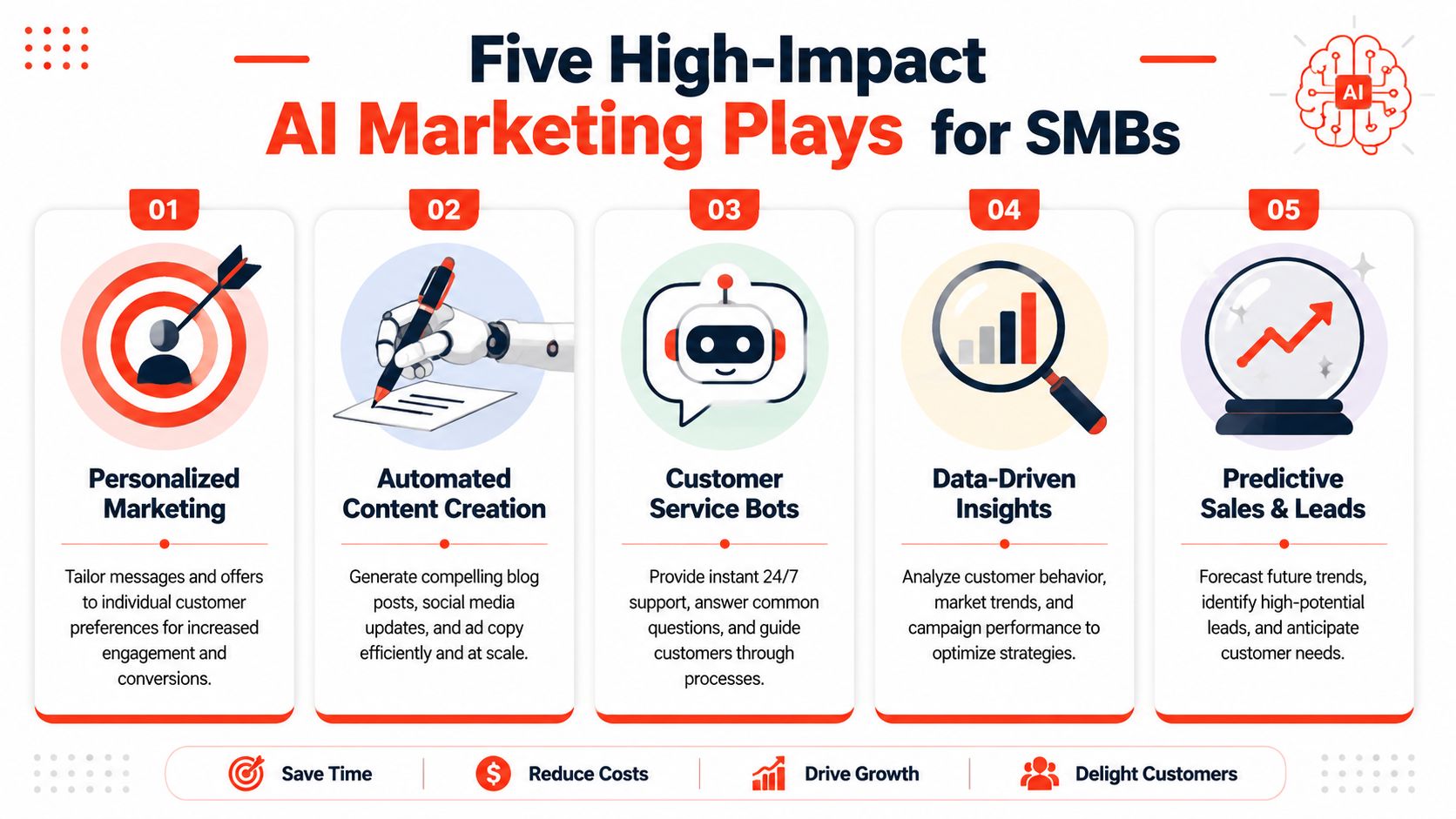
The easiest way to evaluate ai for small business marketing is to ask one question: where does money leak today? Usually the leak is one of five things. Missed leads. Weak personalization. Wasted ad spend. Slow content production. Or poor visibility into what buyers are doing.
The five plays that move the needle
24/7 lead capture and qualification
An AI chatbot is your round-the-clock digital receptionist. It greets visitors, answers common questions, and asks the next useful question instead of waiting for someone to fill out a contact form. If chat is your likely first move, this breakdown of an AI chatbot for small business websites shows the practical setup considerations.Hyper-personalized customer offers
AI can sort customers by interest, behavior, or recent activity so your messages match where they are. That might mean sending one offer to repeat buyers and a different message to new leads who only visited your pricing page.Smarter ad spending
AI helps generate variants, test angles, and spot patterns in performance faster than a manual cycle usually allows. This is useful when you’re running limited-budget campaigns and can’t afford to waste spend on weak messaging.Effortless content creation
Writing assistants can draft outlines, social captions, FAQs, email variants, and first-pass landing page copy. Used well, they remove blank-page friction. Used poorly, they flood your channels with generic text.Predictive customer insights
AI analytics can identify which visitors or leads look most like previous buyers. That shifts attention from “follow up with everyone” to “prioritize the people showing real buying signals.”
What the strongest data supports
Two use cases stand out because they connect directly to lead quality and conversion efficiency. NLP-powered chat assistants can increase qualified lead capture by 15 to 35% by engaging visitors who would otherwise leave without acting, especially during off-hours. Predictive lead scoring can also boost conversion rates on high-intent leads by 20 to 40%, based on Improvado’s overview of AI marketing analytics applications.
That’s why I usually advise small businesses to start with lead capture or lead prioritization before they start obsessing over AI blog writing. A prettier workflow doesn’t help much if inquiries still sit untouched.
Start where delay costs money. For most SMBs, that means response time, qualification, or follow-up quality.
AI marketing plays compared
| AI Marketing Play | Implementation Effort | Potential Impact | Best For… |
|---|---|---|---|
| 24/7 Lead Capture & Qualification | Low to Medium | High | Service businesses, agencies, clinics, contractors |
| Hyper-Personalized Customer Offers | Medium | Medium to High | E-commerce, repeat-purchase businesses, memberships |
| Smarter Ad Spending | Medium | Medium to High | Teams already running paid campaigns |
| Effortless Content Creation | Low | Medium | Lean teams producing blogs, emails, and social posts |
| Predictive Customer Insights | Medium to High | High | Businesses with enough lead and CRM history to analyze |
How to choose your first play
Pick based on your bottleneck, not hype.
- If visitors come in but don't convert: Start with chat and qualification.
- If your sales team wastes time on weak inquiries: Start with scoring and routing.
- If ads are running but results feel uneven: Use AI for creative variations and testing.
- If marketing is inconsistent because nobody has time to write: Use AI drafting, but keep human editing.
- If you have customer data sitting idle: Focus on segmentation and insights.
For online sellers comparing workflow tools, this list of marketing automation platforms for Australian e-commerce entrepreneurs is helpful because it frames automation choices around business model, not just feature lists.
One note of caution. Don't judge a play by how impressive the demo looks. Judge it by whether it removes a daily bottleneck.
Your Phased AI Implementation Roadmap
The businesses that get value from AI don't usually move first by buying the most software. They move first by choosing a narrow use case and forcing it to prove itself.
That's the cleanest way to adopt ai for small business marketing without creating confusion for your team.

Phase 1 gets you a quick win
Start with the point where leads stall. For many SMBs, that's the website. People visit, have a question, don't want to fill out a form, and leave.
A practical first move is an AI sales assistant that greets visitors, answers common questions, and collects qualification details before a human gets involved. One option in that category is LeadBlaze, which can be added to a site with a plugin or code snippet, learns from site content, and lets teams set qualification rules, capture fields, and tone controls. The setup decision isn't really about AI. It's about whether you want your site acting like a brochure or a front-desk rep.
Keep the first deployment tight:
- Choose one page group: service pages, pricing pages, or high-intent landing pages.
- Define three to five qualifying questions: budget, timeline, location, service type, or purchase intent.
- Route only useful outcomes: book a call, collect lead details, or hand off to a person.
- Review transcripts or summaries daily: tighten weak replies and remove dead-end prompts.
If you need examples of adjacent systems that pair well with this phase, this overview of marketing automation tools for small business helps show how chat, follow-up, and workflow automation fit together.
Phase 2 builds efficiency without adding chaos
Once the first workflow is stable, expand into assisted content production. AI earns back time in this phase, but only if you set boundaries.
Use it to draft:
- Email campaigns: first drafts, subject line options, and segment-specific variations
- Social posts: repurposed snippets from longer content
- Landing page copy: rough structure, FAQs, and CTA alternatives
- Ad variants: multiple hooks for testing
Don't use it to publish untouched content at scale. That's where quality drops fast.
Give AI the first draft and your team the final word. That's the balance that keeps output useful.
A short visual overview can help if your team is still sorting the stages of adoption:
Phase 3 sharpens performance
After AI is handling one lead workflow and one content workflow, move into optimization.
This phase is less about adding new tools and more about making better decisions with the systems already in place. Look at which questions produce the strongest leads. Compare which message angles produce better inquiries. Watch where people drop out of chat or abandon a page after reading an offer.
A simple roadmap works better than a dramatic rollout:
- Stabilize one workflow
- Measure results for a fixed period
- Document what changed
- Expand only after the first use case is clearly useful
That sequence keeps AI from becoming a collection of experiments nobody owns.
How to Measure Your AI Marketing ROI
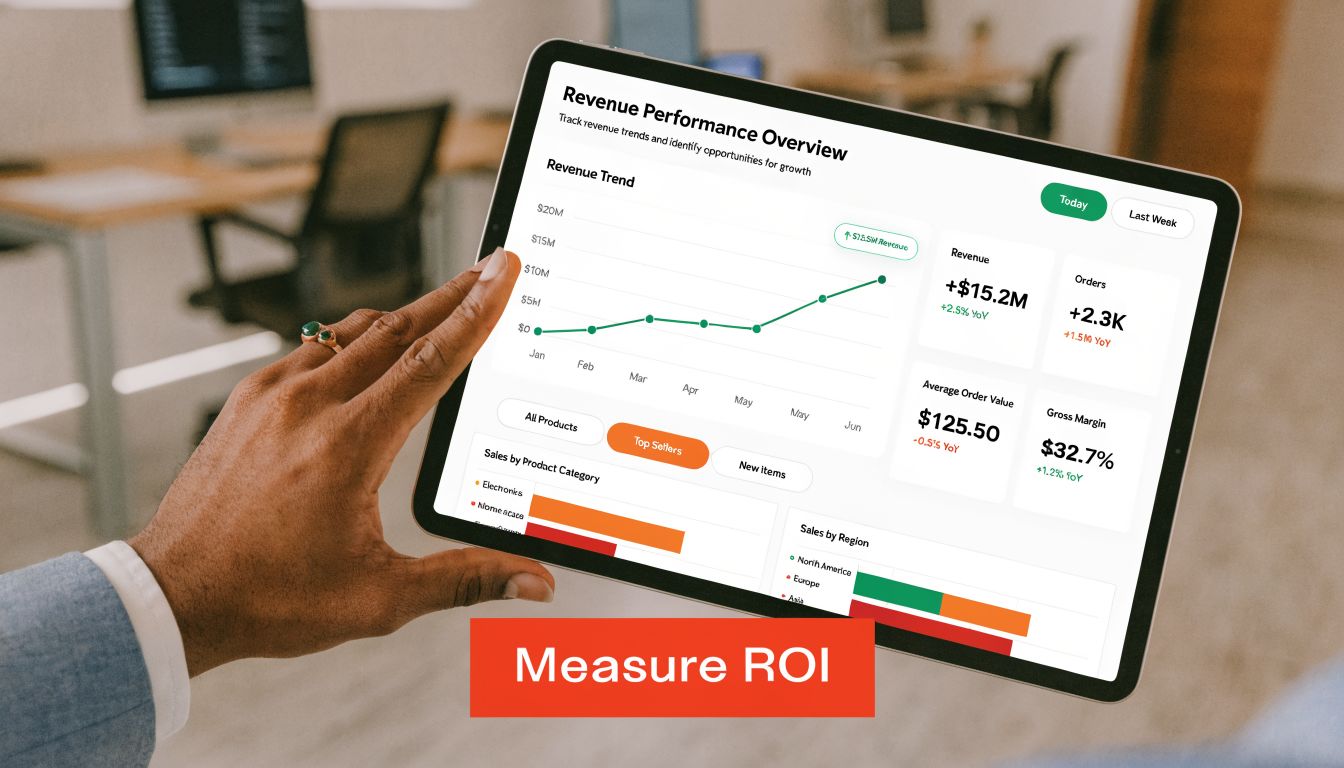
AI only deserves budget if it changes business outcomes. Time saved matters, but time saved without better leads or stronger conversion is just cheaper activity.
That's why measurement has to connect to the specific job the tool performs.
Match each AI use case to a business KPI
If you're using AI for conversations and qualification, the key question is whether those conversations produce better opportunities. This guide to conversational AI for sales is useful because it frames chat performance around sales outcomes, not novelty.
Use a practical KPI map like this:
| AI Use Case | Primary KPI | Secondary KPI | What to watch |
|---|---|---|---|
| Lead capture chatbot | Website conversion rate | Qualified lead volume | Are more visitors becoming usable leads? |
| Lead qualification | Sales acceptance rate | Follow-up speed | Are reps spending less time on poor-fit inquiries? |
| Content drafting | Production time per asset | Publish consistency | Are you shipping more without hurting quality? |
| Personalized offers | Response rate | Repeat engagement | Are segments reacting differently to tailored messaging? |
| Ad optimization | Cost per qualified lead | Landing page conversion | Are better messages attracting better prospects? |
The simplest ROI model
Small businesses often overcomplicate this. You don't need a giant attribution model to get started.
Track three layers:
- Operational gain: Did the team save time on drafting, replying, routing, or reviewing?
- Pipeline gain: Did more leads become qualified conversations?
- Revenue gain: Did those qualified conversations turn into booked jobs, demos, or sales?
If the tool improves only the first layer, be careful. Efficiency is useful, but AI marketing should eventually show up in pipeline or revenue.
Measurement rule: Don't ask whether AI is impressive. Ask whether it changed the number of qualified conversations your business creates.
What a healthy review cycle looks like
Review AI performance weekly at first. Monthly is too slow when you're still tuning prompts, qualification rules, or routing logic.
Look for signals like:
- Lead quality drift: Are more low-fit inquiries sneaking through?
- Response quality issues: Are answers accurate and on-brand?
- Channel differences: Is AI helping organic traffic more than paid traffic, or the reverse?
- Team adoption: Are people using the outputs, or working around them?
The ROI conversation gets clearer when you compare before and after on the same workflow. Same page, same offer, same audience, different process. That's how you tell whether AI is helping or just creating activity.
Avoid These Common AI Marketing Pitfalls
The biggest AI marketing mistakes aren't technical. They're strategic.
Small businesses usually get into trouble when they automate too much, trust first drafts too quickly, or chase tools before they define the problem. The most damaging version of this is brand voice erosion.
Brand voice gets lost faster than owners expect
A critical warning comes from Unbounce's reporting on AI use by small businesses. With 54% of SMBs now using AI, many fall into the trap of relying on unedited, generic AI output. That's a real risk because small businesses usually win on familiarity and trust, not polished corporate language.
You can hear this problem immediately when it shows up. Every business starts sounding “professional,” efficient, and “customer-centric.” Nobody sounds local, specific, or human anymore.
That's not a minor style issue. It affects conversion because buyers often choose a smaller business based on confidence, tone, and clarity.
Four mistakes that cause most problems
-
Automating your first draft and your final draft
AI should accelerate thinking, not replace editorial judgment. When nobody rewrites the output, weak claims, bland phrases, and awkward wording go live. -
Using one generic prompt for every channel
Website copy, ad copy, email, and chat need different jobs done. If you use the same prompt everywhere, you flatten message quality fast. -
Setting the tool live and never reviewing it
AI needs supervision. Offers change. Services change. Customer objections change. A neglected system gets stale. -
Buying tools because the demo is slick
A nice interface doesn't mean the tool solves your bottleneck. Start with the problem. Then choose the software.
How to protect your voice while scaling output
The fix isn't avoiding AI. The fix is building a human-AI hybrid workflow.
Try this approach:
- Create a short brand voice guide: list phrases you use, phrases you avoid, tone examples, and audience pain points.
- Break large tasks into smaller prompts: ask for an outline, then a headline set, then an FAQ, instead of one massive content request.
- Assign a human reviewer: one person should own final approvals for customer-facing output.
- Edit for specificity: replace generic promises with clear language about services, locations, objections, and next steps.
If the copy could belong to any company in your category, it isn't ready to publish.
For local businesses especially, authenticity is part of the offer. AI should help you say your message more consistently. It shouldn't turn your business into a template.
Taking Your First Step into AI Marketing
Most business owners don't need more theory. They need a first move that's small enough to start and useful enough to justify continuing.
That's the lesson with ai for small business marketing. Don't begin with “How do we transform the whole company?” Begin with “Where are we losing time or leads every week?”
Start narrower than you think
A good first step is one workflow, one owner, and one success metric.
That could mean:
- Adding AI chat to high-intent pages
- Using AI to draft email follow-ups
- Generating ad copy variations for testing
- Creating first-draft landing page copy from customer FAQs
Keep the scope controlled. If you're trying to improve five channels at once, you won't know what worked.
The best rollout is boring on purpose
The winning pattern is simple. Start with a quick win. Measure it. Protect your brand voice. Then expand.
That sequence matters because AI can either make a small team sharper or make a messy process faster. Those are very different outcomes.
If you later expand into visual content, short explainers, or social clips, tools like a high-fidelity AI video generator can fit the stack well. Just apply the same discipline. Use the tool to speed up production, not to outsource your judgment.
The small businesses that get the most from AI usually do three things well:
- They choose one painful bottleneck first
- They define what success looks like before launch
- They keep a human in the loop for tone, accuracy, and offers
AI is accessible now. That's the opportunity. It's also the trap, because easy access makes it tempting to publish fast and think later.
Pick one workflow today. Not six. One. If it saves time, improves response quality, or creates more qualified conversations, you'll have a real reason to scale from there.
If you want a practical first step, LeadBlaze gives small businesses a way to turn website traffic into qualified conversations around the clock, without relying on static forms. It's a straightforward place to test whether AI can improve lead capture, qualification, and handoff before you invest in a broader rollout.