Your contact form is working. The problem is that it’s working for everyone.
You get quote requests, demo requests, “just exploring” messages, competitors poking around, job seekers using the wrong form, and buyers who looked serious until sales called and found out they weren’t a fit. That pile of submissions feels like pipeline, but a lot of it is just activity.
That’s why business owners keep asking what is lead qualification. They’re not really asking for a definition. They’re asking how to stop burning time on people who will never buy, while responding faster to the ones who might.
The old answer was a form with a few required fields. The better answer today is to qualify people while they’re still on your site, while their intent is visible and before their attention disappears.
The True Meaning of a Qualified Lead
A qualified lead is not just a person who filled out a form. It’s a person whose profile and behavior suggest there’s a real chance of a sale.
That distinction matters because most websites collect interest, not intent. Someone downloads a guide, asks for pricing, or submits a generic contact form. Those actions can mean “ready to buy,” but they can also mean “researching for later,” “comparison shopping,” or “I want a quick answer and then I’m gone.”
Lead qualification is the process of sorting those people before your team wastes time. In practice, that means checking two things at once: fit and readiness. Fit asks whether this person or company matches the type of customer you serve. Readiness asks whether there’s enough buying intent to justify immediate follow-up.
Amplitude’s guide makes the operational distinction clear. In B2B, qualification evaluates fit, intent, authority, timing, and budget, and it separates Marketing Qualified Leads from Sales Qualified Leads, where SQLs are the leads sales has validated as having real need, budget, and buying authority, which directly affects pipeline efficiency (Amplitude on qualified lead stages).
MQLs and SQLs are not the same thing
An MQL is usually a lead that has shown enough engagement for marketing to say, “This looks promising.”
An SQL is a smaller group that sales can work. That person has a clearer problem, a stronger reason to act, and enough buying context to justify rep time.
A simple way to think about it is this:
- MQL: Raised a hand
- SQL: Worth a call now
- Disqualified lead: Not a fit, not ready, or not real
Practical rule: A lead isn’t qualified because it exists in your CRM. It’s qualified when you know enough to decide what should happen next.
Qualification is also a speed problem
Qualification is often treated like an admin task. It’s not. It’s a race.
Research summarized by Verse.ai from Lead Response Management found that leads contacted within 5 minutes are 21x more likely to convert, and the odds of qualifying a lead are 100x higher within 5 minutes compared to 30 minutes (Lead Response Management response-time findings). That changes how you should think about the whole process. A lead’s value doesn’t sit still while your team “gets to it.”
If you’re a local business trying to improve both lead quality and lead flow, this practical guide on how to get more local customers is useful because better visibility only helps if you can qualify the resulting traffic quickly.
The meaning of lead qualification is simple. It’s the system you use to separate curiosity from commercial intent before time kills the opportunity.
Key Frameworks for Sorting Good Leads from Bad
Frameworks matter because “good lead” is too vague to run a team on. Reps need a shared way to judge whether someone deserves follow-up, nurture, or a polite no.
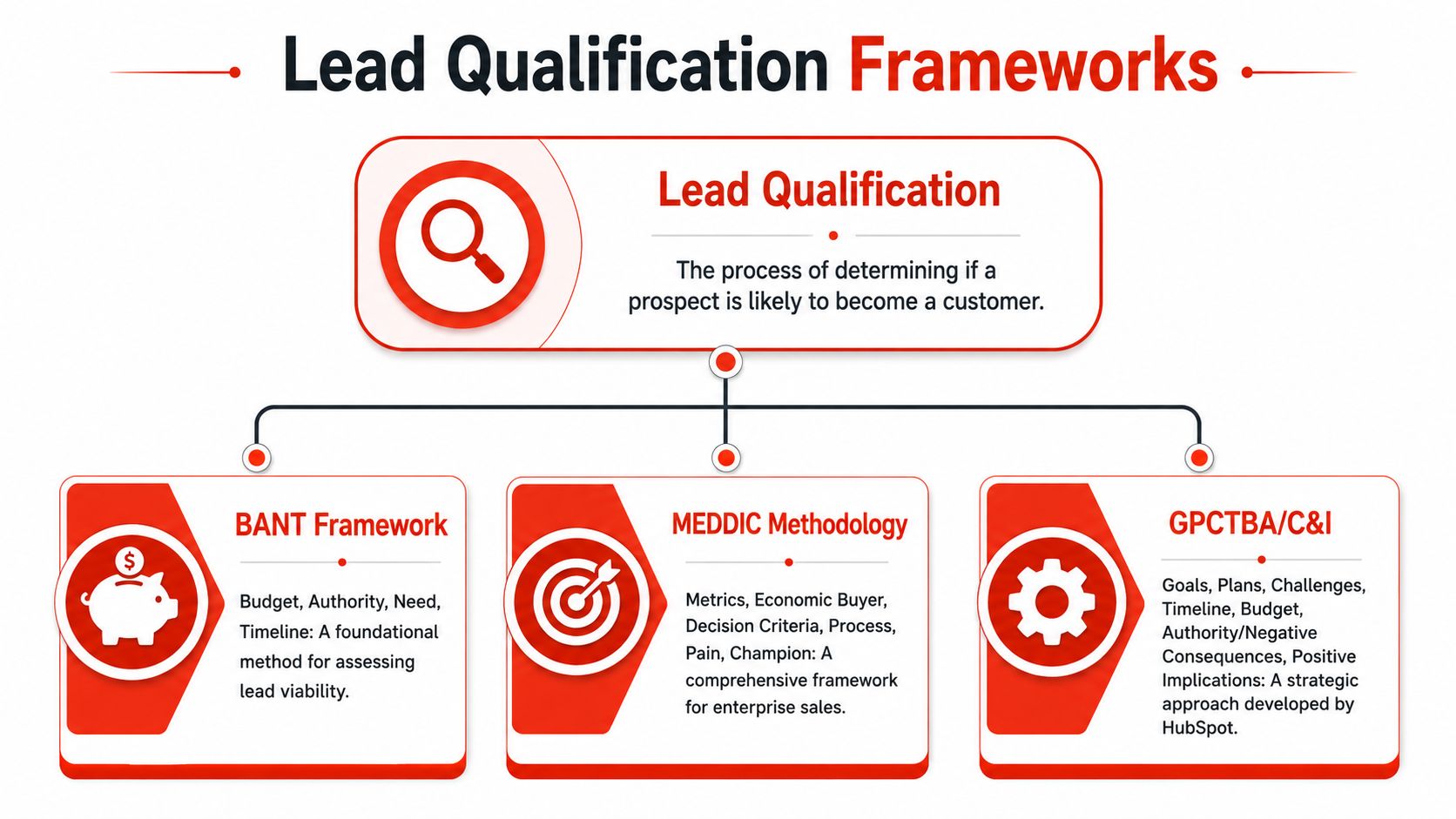
One useful way to understand what is lead qualification in daily work is to see it as a set of consistent questions. Some teams use classic sales frameworks. Others use a simpler fit-and-intent model. What matters is that your process can be repeated by more than one person.
BANT still works when used correctly
BANT stands for Budget, Authority, Need, and Timeline. People dismiss it because it can sound rigid, but the framework is still useful when you treat it like a guide instead of a script.
Here’s what that sounds like in practice:
Budget
“Have you already set aside spend for solving this problem, or are you still exploring options?”Authority
“Who else is involved in making this decision?”Need
“What’s happening right now that made you look for a solution?”Timeline
“Are you trying to solve this this month, this quarter, or later?”
BANT is especially useful for service businesses, agencies, consultants, and sales teams that need to quickly decide whether a lead should move to a call.
CHAMP starts with the pain, not the wallet
Some teams prefer CHAMP, which starts with Challenges and then works through authority, money, and prioritization. That can feel more natural on a website or in an early conversation because buyers usually know their problem before they know their budget.
A contractor, clinic, or agency often gets better answers from “What are you trying to fix?” than from “What’s your budget?”
That’s why CHAMP often works well in conversational qualification. It lets the buyer tell you what’s broken first.
Good qualification questions don’t interrogate. They reduce ambiguity.
Fit versus intent is the modern shortcut
A lot of SMBs don’t need a heavy enterprise framework. They need a fast way to tell whether someone matches the business and whether they’re showing buying signals.
A practical model looks like this:
| Lens | What you’re checking | Example signals |
|---|---|---|
| Fit | Whether the lead matches your ideal customer profile | Industry, location, company type, use case |
| Intent | Whether the lead looks ready for real follow-up | Pricing-page visit, repeat visit, specific questions, urgency |
Website behavior becomes valuable. A short form may tell you a prospect's job title. It rarely tells you they visited your pricing page twice, came back from a branded search, and asked about implementation. Those signals often say more than a dropdown field.
For a practical companion to this topic, LeadBlaze's own guide to lead generation best practices pairs well with these frameworks because it connects qualification to how leads are captured in the first place.
Pick the framework your team will actually use
Use this simple rule:
- Choose BANT if you sell through calls and need a clean handoff to sales.
- Choose CHAMP if buyers respond better when conversations start with pain points.
- Choose Fit and Intent if your website is a major entry point and behavior tells you more than a form does.
Frameworks don't qualify leads by themselves. Teams do. The framework just stops every rep from using a different definition of “promising.”
The Business Case for Strong Lead Qualification
Weak qualification creates hidden costs. Marketing pays to attract traffic. Sales spends time chasing people who won't buy. Forecasts fill up with deals that were never real. Everyone stays busy, and nobody trusts the numbers.
Strong qualification fixes that by forcing decisions earlier.
It protects rep time
A sales rep's calendar is limited. Every call with a poor-fit lead takes time away from someone with a real problem and a real reason to act. Good qualification acts like a front desk at a busy clinic. The point isn't to turn people away for fun. The point is to route each person to the right next step.
That might mean sales now, nurture later, or disqualify completely.
It improves marketing judgment
Once qualification is defined clearly, marketing can stop celebrating raw lead volume and start asking better questions. Which campaigns bring in the right kinds of buyers? Which landing pages attract the wrong audience? Which offers create noise instead of demand?
You don't need more names in the database. You need more leads that resemble customers you want.
It makes the pipeline more believable
A pipeline full of unqualified leads is like a warehouse full of boxes with no labels. It looks productive until someone has to ship something.
The fastest way to improve forecast quality is usually not more reporting. It's better qualification at the front of the funnel.
When teams tighten qualification, they usually get fewer false positives, cleaner handoffs, and fewer arguments between marketing and sales. That's not a soft benefit. It changes how the business allocates time, ad spend, and attention.
Manual Tedium vs Automated Precision
Manual qualification works when lead volume is low and expectations are modest. A founder or rep checks form submissions, looks up the company, scans LinkedIn, sends an email, maybe places a call, and updates the CRM later.
That process breaks fast.
What manual qualification gets wrong
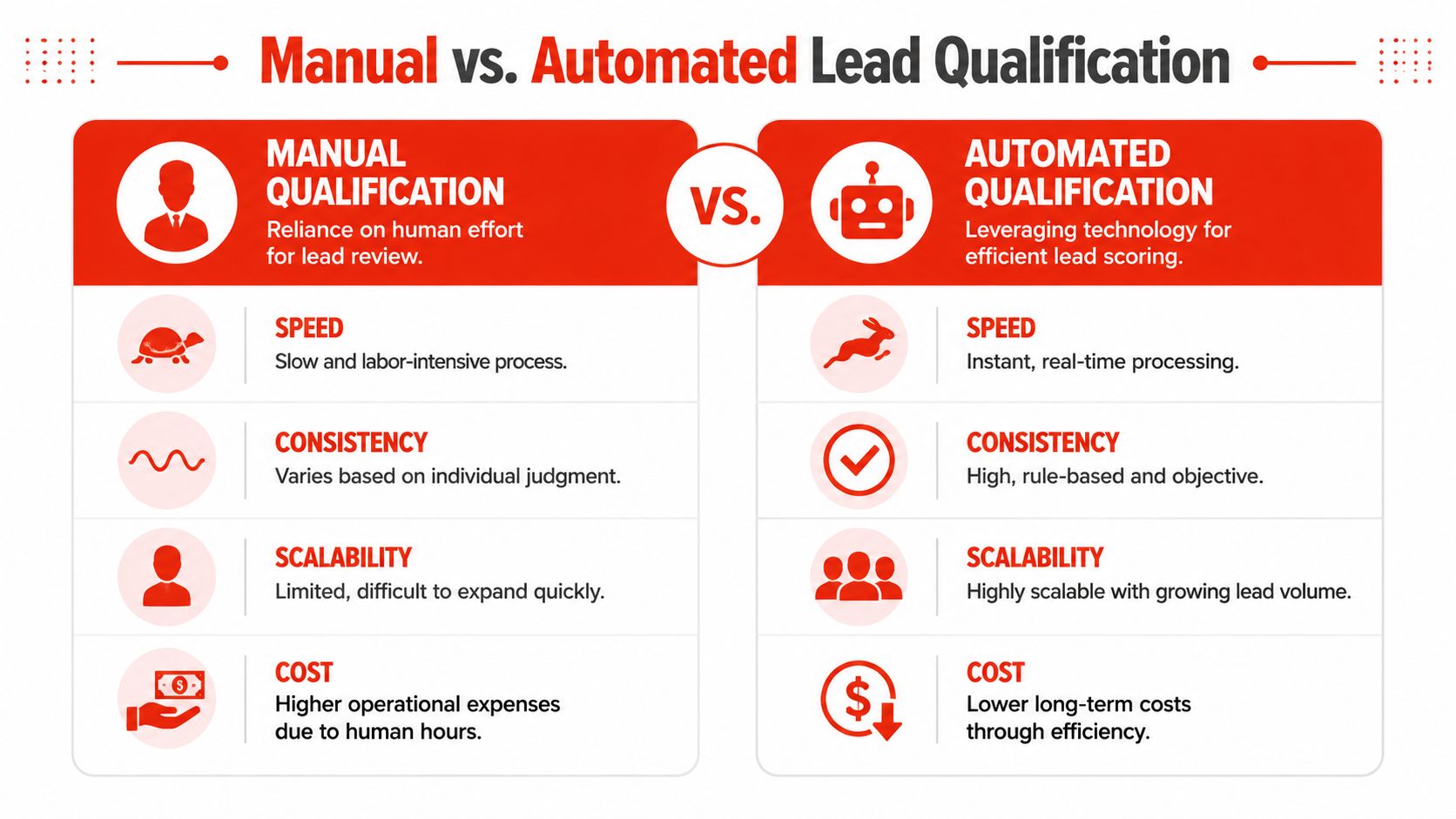
The biggest problem isn't effort. It's inconsistency.
One rep treats a vague inquiry as high potential. Another ignores it. One person asks strong follow-up questions. Another just books the call. Someone checks the CRM carefully. Someone else forgets. The result is a qualification process that changes depending on who happened to see the lead first.
Manual workflows also struggle outside business hours. If a visitor lands on your site at night, on a weekend, or during a busy stretch, the handoff slows down. By the time someone replies, the prospect may have already moved on.
What automation changes
Automation doesn't replace judgment. It standardizes the first layer of it.
According to Cirrus Insight, 69% of high-performing sales teams now use AI in lead generation, and AI improves qualification accuracy by 40%, speeds qualification 3x, and increases conversion rates by 25–35% (Cirrus Insight lead generation statistics). That matters because qualification is repetitive in the early stages. The same checks happen over and over: fit, urgency, use case, authority, routing.
A useful setup often includes:
- Rule-based scoring for fit signals such as location, service type, or company profile
- Automated routing so qualified inquiries go to the right rep or inbox
- Conversational capture so the system asks follow-up questions instead of waiting for a human
- CRM syncing so context doesn't disappear between first touch and sales follow-up
If your team handles calls as part of qualification, operational plumbing matters too. This guide on connecting VoIP and CRM platforms is relevant because response speed falls apart when call logs, notes, and lead records live in separate tools.
Automation is better for volume. Manual review is still useful for edge cases
This doesn't mean every lead should be decided by software alone.
Use automation for the repeatable parts. Keep humans involved where nuance matters, such as unusual accounts, complex service requests, or high-value deals with messy buying groups. If you're exploring website-first qualification, this walkthrough on how to create a bot is a practical example of turning repetitive screening into a consistent workflow.
The trade-off is straightforward. Manual qualification gives flexibility but loses speed and consistency. Automated qualification gives speed and consistency, then lets your team spend its time where judgment matters.
How to Implement Qualification on Your Website
Most websites still qualify leads the old way. They show a contact form, ask for name, email, phone, and maybe one open text box. That setup collects contact data, but it doesn't do much qualifying.
A stronger website qualification process collects context while the visitor is still engaged.
Start with an ICP and a scoring model
Before you change forms or add a chat layer, define your Ideal Customer Profile. What kind of customers do you want more of? Which industries, service areas, business types, or use cases tend to close well and stay profitable?
Clay describes mature qualification systems as a numeric scoring model built by defining an ICP, researching company and online behavior, creating a point system, and then engaging prospects. That structured approach reduces false positives and concentrates sales effort on high-potential leads (Clay on the lead qualification process).
A simple website scoring model might include:
- Positive points for visiting pricing, requesting a quote, or asking a specific service question
- More points for matching your service area or ideal account type
- Fewer points for vague inquiries with no clear use case
- Disqualifying rules for job applications, spam, or requests outside your service scope
Replace long forms with guided questions
Static forms assume buyers know what to tell you. Often they don't.
A better approach is to ask short follow-up questions based on what the visitor is trying to do. A local clinic might ask whether the person is a new or returning patient. A contractor might ask project type and location. An agency might ask whether the prospect needs SEO, paid media, or web design.
This creates a smoother experience than dumping eight required fields onto one page. It also gives your team cleaner intake data.
For businesses that want a more conversational approach, a lead generation chatbot can handle that branching logic on the site itself rather than forcing visitors through a rigid form.
Use conversational qualification on high-intent pages
The major shift is moving qualification onto the website in real time.
If someone lands on your pricing page, returns to your services page, or asks a detailed question, that's the moment to qualify. A conversational assistant can ask what they need, when they need it, and whether they're in your target segment. That interaction can happen instantly, even when your team is unavailable.
One option in this category is LeadBlaze, which acts as a website AI assistant that greets visitors, asks qualification questions, captures context, and summarizes the conversation for the team.
A quick product overview makes the implementation easier to picture:
Route the lead by next action, not by gut feeling
After the conversation, the system should decide the next step:
| Lead type | Best next action |
|---|---|
| Strong fit and urgent | Send to sales or booking immediately |
| Good fit but early | Add to nurture and follow up later |
| Poor fit | Disqualify or redirect politely |
That's the core change. Your website stops being a passive collection box and starts acting like a front-line qualifier.
Critical Mistakes That Let Great Leads Slip Away
A lot of lead qualification problems don't look dramatic. They look normal. A form gets submitted. A rep follows up later. A buyer disappears. The team shrugs and moves on.
That's exactly why these mistakes are expensive.

Mistake one: trusting self-reported fields too much
Default's guidance points to a major gap in many qualification strategies. Teams over-rely on static fields like budget or title, while stronger approaches use behavioral intent signals such as pricing-page visits or repeat engagement, which can be more predictive for high-intent traffic that never fills out a long form (Default on behavioral intent in lead qualification).
This shows up constantly. Someone selects a job title that sounds junior, so the team ignores them. Later you find out they were doing the initial research for the decision maker. Or someone leaves the budget field blank, but their behavior on the site clearly shows active buying interest.
Behavior often tells the truth faster than forms do.
Mistake two: making qualification too strict
Some businesses build gates so narrow that they block buyers who would have closed with the right conversation.
Examples include:
- Rejecting early-stage buyers because they can't state a budget yet
- Ignoring leads without the “right” title even when they influence the purchase
- Forcing every inquiry into one path when some visitors need education and others need immediate sales help
You want standards, not rigidity.
A qualification system should filter noise, not punish ambiguity.
Mistake three: failing to define disqualification clearly
A lead should not sit in limbo forever. If someone is outside your geography, outside your service scope, or obviously not a fit, mark that clearly.
That protects your team's attention and gives marketing cleaner data. It also helps reps detach from weak opportunities. For teams trying to build that discipline, this piece on hireSDR.io rejection advice is useful because qualification gets better when reps are comfortable closing the door on poor-fit prospects.
Mistake four: treating all website visitors the same
A homepage visitor and a pricing-page return visitor should not get the same experience.
If your site only offers one generic form, you flatten all that intent into one bucket. That's how strong opportunities end up mixed in with junk. Dynamic qualification works because it recognizes that behavior changes the conversation you should have.
Lead Qualification FAQs
How often should you review your lead qualification criteria
Review it whenever your closed-won pattern changes, your offer changes, or your team starts complaining that lead quality feels off. In a smaller business, that often means a regular check with sales and marketing to compare recent wins, losses, and disqualified inquiries. If the same kinds of poor-fit leads keep showing up, your criteria or capture flow probably needs adjustment.
What should you do with a lead that's a good fit but not ready yet
Don't force that lead into a sales conversation before they're ready. Put them into a nurture path with relevant follow-up based on their use case. The key is to keep the context you already gathered so the next interaction doesn't start from zero.
When should you disqualify a lead completely
Disqualify when the lead is clearly outside your target market, outside your service area, outside your offering, or obviously not a buyer. Do it early and document why. A clean “no” is better than letting weak leads clutter the pipeline and distort reporting.
Is a form fill automatically a qualified lead
No. It's a signal, not a verdict.
A form submission tells you someone was willing to take a step. It doesn't tell you whether they're a fit, whether they're serious, or what should happen next. That's why strong teams separate inquiries from qualified opportunities.
Are conversational tools better than forms
Not always. A short form can still work well for simple, low-friction actions.
But conversational qualification is often better when your service has multiple paths, when buying intent shows up in behavior, or when you need to ask follow-up questions in real time. Forms are static. Conversations adapt.
What's the simplest way for an SMB to improve qualification this month
Start by tightening your ideal customer profile, shorten your form, add two or three better qualifying questions, and route leads by clear rules instead of gut feel. If your traffic volume supports it, add conversational qualification on high-intent pages so buyers can engage immediately instead of waiting for a callback.
If your website is still collecting names instead of qualifying buyers, LeadBlaze gives you a practical way to move from static forms to real-time conversations. It can greet visitors, ask qualifying questions, capture context, and hand your team a cleaner lead record so they spend less time sorting and more time closing.