Most advice on online lead generation services is backwards. It tells you to buy more traffic, launch more campaigns, and widen the funnel. That sounds productive. It also burns cash fast when your site, team, and follow-up process can’t tell a serious buyer from a casual browser.
I’ve watched SMBs pay for PPC, SEO retainers, list-building, and agency packages, then end up with the same problem. Too many names. Too little context. Slow follow-up. Sales teams chasing people who were never going to buy.
If you’re choosing online lead generation services in 2026, stop asking, “How do I get more leads?” Ask, “How do I get better conversations from the traffic I already have?” That’s the question that protects ROI.
Why More Website Traffic Is Not the Answer
More traffic is not a strategy. It’s a distribution input. If your qualification process is weak, more traffic just creates more noise.
That matters most for SMBs. Agencies, clinics, contractors, and local service businesses don’t have spare sales capacity. When a team spends the day sorting weak inquiries, returning dead-end calls, and reading vague form submissions, the true cost isn’t just ad spend. It’s lost selling time.
A lot of mainstream advice still pushes volume-first tactics. More SEO content. More paid clicks. More lead magnets. More top-of-funnel reach. The problem is simple. More top-of-funnel traffic is not always better. For many SMBs, fewer but better-qualified conversations outperform volume-focused lead generation, especially when sales time is limited, as noted in this local lead generation services guide.
The bottleneck is usually qualification
Most websites already have some level of demand. The issue is that they treat every visitor the same. A homepage lurker, a pricing-page visitor, and someone comparing service options all get the same static form or generic CTA.
That setup creates three expensive problems:
- Sales gets junk mixed with real intent: The team can’t quickly see who deserves immediate follow-up.
- Marketing optimizes the wrong metric: Traffic growth looks good on a report even when pipeline quality doesn’t improve.
- Visitors leave without context: If they won’t fill out a form, most businesses learn nothing.
Practical rule: If your team complains about lead quality, don’t buy more traffic first. Fix routing, qualification, and response speed first.
If you want a cleaner framework for that mindset shift, this rundown of lead generation best practices is worth reviewing. The useful part isn’t the generic tactics. It’s the reminder that capture alone isn’t the job. Qualification is.
Lead efficiency beats lead volume
The businesses that win here usually don’t “generate more leads” in the simplistic sense. They waste less attention. They identify intent earlier, filter faster, and get their sales team into better conversations sooner.
That’s the lens you should use for every service you’re considering. Not how many contacts it can dump into a CRM. How well it helps you ignore the wrong people and respond to the right ones.
Understanding Online Lead Generation Services
A modern online lead generation service shouldn’t behave like a locked storefront with a clipboard by the door. That’s what old lead capture felt like. A visitor arrived, saw a form, left their details if they were patient, and hoped someone would reply later.
A useful service works more like a 24/7 digital concierge. It engages visitors, learns why they’re there, asks the next sensible question, captures the right context, and routes the conversation properly.
What the service actually does
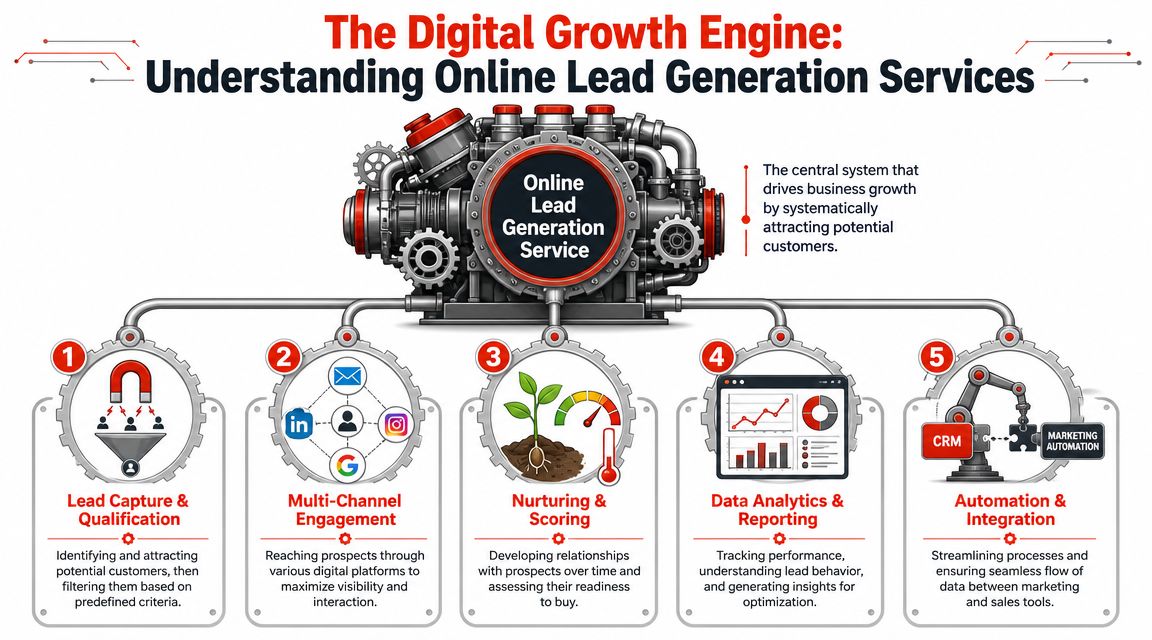
At a practical level, online lead generation services combine a few jobs that used to sit in separate tools or separate people:
- Capture attention: Through website prompts, chat, landing pages, forms, email capture, or other entry points.
- Qualify intent: By asking useful questions, identifying fit, and separating curiosity from buying intent.
- Nurture interest: Through follow-up workflows, reminders, summaries, and handoff logic.
- Route the lead: To sales, support, booking, or automation based on what the visitor needs.
- Measure outcomes: So you can see which source and interaction pattern produces qualified pipeline.
That last point gets ignored too often. A service that only captures contact details is incomplete. If it can’t help your team understand what happened and what to do next, it’s just adding admin work.
The old model versus the useful model
The old model said, “Collect the email and follow up later.”
The better model says, “Use the visit itself to learn enough to decide whether this person deserves immediate attention.”
Good online lead generation services don’t just create a lead. They reduce uncertainty for the next person who touches that lead.
That’s why multi-channel capability matters. Some buyers prefer forms. Others respond to chat, SMS, or email capture. If you’re thinking beyond web forms, this piece on Efficient lead generation via SMS is useful because it shows how conversational capture can extend beyond the website without making the process clunky.
The main categories you’ll run into
Most options fall into three broad buckets, with one important hybrid inside the software category:
- Software and AI assistants that automate capture, qualification, routing, and reporting.
- Agencies that run campaigns and sometimes manage qualification on your behalf.
- Specialists focused on one acquisition channel such as PPC, SEO, or outbound.
The mistake is treating these as interchangeable. They aren’t. One solves traffic acquisition. Another solves qualification. Another solves execution capacity. If you buy the wrong category, you won’t fix the bottleneck.
The Four Main Types of Lead Generation Solutions
Not all lead generation solutions do the same job. Some create demand. Some capture it. Some qualify it. Some just send you a report and call it a win. If you don’t separate those functions, you’ll hire a service that looks busy and still doesn’t improve revenue.
The broader market is moving toward software because businesses want faster qualification and response. The global lead generation software market is projected to reach $9.6 billion by 2028, growing at 17.5% annually, and one cited benchmark says responding within 5 minutes can increase conversion rates by 9x, which helps explain the shift toward automated, instant-response systems in this lead generation software market outlook.
Comparing online lead generation services
| Service Type | Best For | Typical Cost | Speed to Results | Your Level of Control |
|---|---|---|---|---|
| AI assistants and software | SMBs that already get website traffic and need better qualification | Varies by tool and usage model | Fast once installed and configured | High |
| Full-service agencies | Teams that need outside execution across channels | Usually higher and ongoing | Moderate | Medium to low |
| Paid media specialists | Businesses that need traffic quickly | Ongoing ad spend plus management fees | Fast on traffic, mixed on quality | Medium |
| Inbound content strategists | Businesses investing in long-term organic demand | Ongoing monthly investment | Slower | Medium to high |
AI assistants and software
This is the category I recommend most often when the problem is weak conversion from existing website traffic. These tools sit close to the moment of intent. They can greet visitors, ask qualification questions, summarize the exchange, and push the result into your workflow.
One example is automated lead generation software, which outlines how software-first systems reduce dependence on static forms. The appeal is straightforward. You keep control of qualification logic instead of outsourcing your sales process to a monthly retainer.
Best fit: businesses with traffic already coming in, but too much leakage between visit and follow-up.
Trade-off: software doesn't create demand on its own. If no one visits your site, software won't fix that.
Full-service agencies
Agencies make sense when your internal team lacks execution bandwidth. They can manage campaigns, landing pages, creative, and reporting. Some are strong. Many are expensive middle layers between you and the actual channels.
Their weakness is often operational distance. They may deliver leads, but they don't live inside your sales inbox or booking process. That means they often optimize toward campaign activity instead of lead-handling reality.
Best fit: teams that need outsourced marketing execution, not just qualification.
Paid media specialists
A PPC or paid social specialist can generate traffic quickly. That's the upside. The downside is that traffic without qualification discipline gets expensive fast.
This route works when you know your economics, your offer converts, and your follow-up process is tight. It fails when a business buys clicks before fixing intake.
If you're exploring adjacent partner-driven channels too, this guide to lead gen affiliate marketing is a useful contrast. It shows another acquisition path, but the same warning applies. A lead source is only as good as your ability to filter and follow up.
Inbound content strategists
SEO and content still matter. They build durable demand, answer buyer questions, and can compound over time. But they are not a shortcut if your site converts poorly.
Best fit: companies with patience, clear positioning, and a willingness to invest in content that matches buyer intent.
Weakness: content strategy is often blamed for "poor leads" when the true problem is what happens after the click.
If your site already gets relevant visitors, buying a service that only adds more visitors is usually the wrong first move.
Business Benefits and How to Measure Success
The best online lead generation services don't just fill a spreadsheet. They improve how your business uses selling time.
That's the benefit SMBs care about most, whether they say it that way or not. A contractor wants fewer junk inquiries. A clinic wants staff focused on serious appointments. An agency wants account teams spending less time on bad-fit prospects. Better lead handling is an operational advantage.
What actually improves
When you combine CRM enrichment, lead scoring, and behavioral tracking, the handoff to sales gets sharper. The context is better. The prioritization is better. The follow-up is less random.
According to this data lead generation analysis, AI-assisted scoring can improve conversion rates by up to 30% versus traditional methods, and overall AI use in lead generation is reported to improve results by about 50% when enrichment, scoring, and behavioral tracking work together.
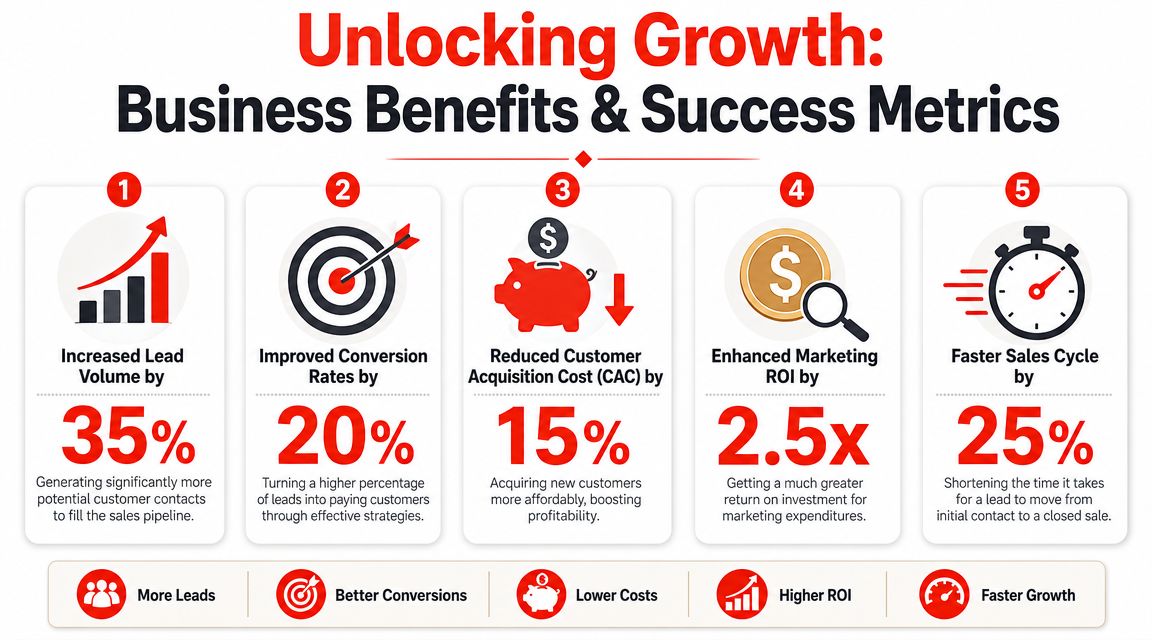
Those numbers matter for one reason. They point to a better pipeline, not a prettier dashboard.
The metrics that deserve your attention
Stop leading with traffic, impressions, and raw form fills. Start with the metrics that tell you whether sales got something useful.
Use this scorecard:
- Lead quality: Are the leads a genuine fit for your service, budget range, geography, or use case?
- Visit-to-qualified-lead rate: Of the people who arrive, how many become sales-worthy conversations?
- Response readiness: Does your team know who to contact first and why?
- Cost per qualified lead: Not cost per contact. Cost per contact is a vanity metric when half the list is junk.
- ROI: Did the service produce pipeline and closed business that justify the spend?
How to interpret the data
A rise in lead volume with flat close rates is often bad news. It usually means your filtering got worse.
A lower total lead count with stronger close quality is often progress. Your team is spending time where it counts. That's especially true if sales says the conversations are more informed and the lead summaries are more usable.
What to watch: If marketing celebrates more leads while sales complains about quality, your reporting is broken.
The main advantage is simple. Your sales team spends less time figuring out who a lead is and more time deciding how to close them.
How to Choose the Right Vendor A Practical Checklist
Vendor demos are designed to make everything sound solved. Clean UI. Smooth automation. A few nice workflows. Plenty of promises about pipeline. That's exactly why you need a checklist.
A vendor should earn your trust by answering operational questions clearly. If they dodge, generalize, or turn every question into a sales pitch, walk away.
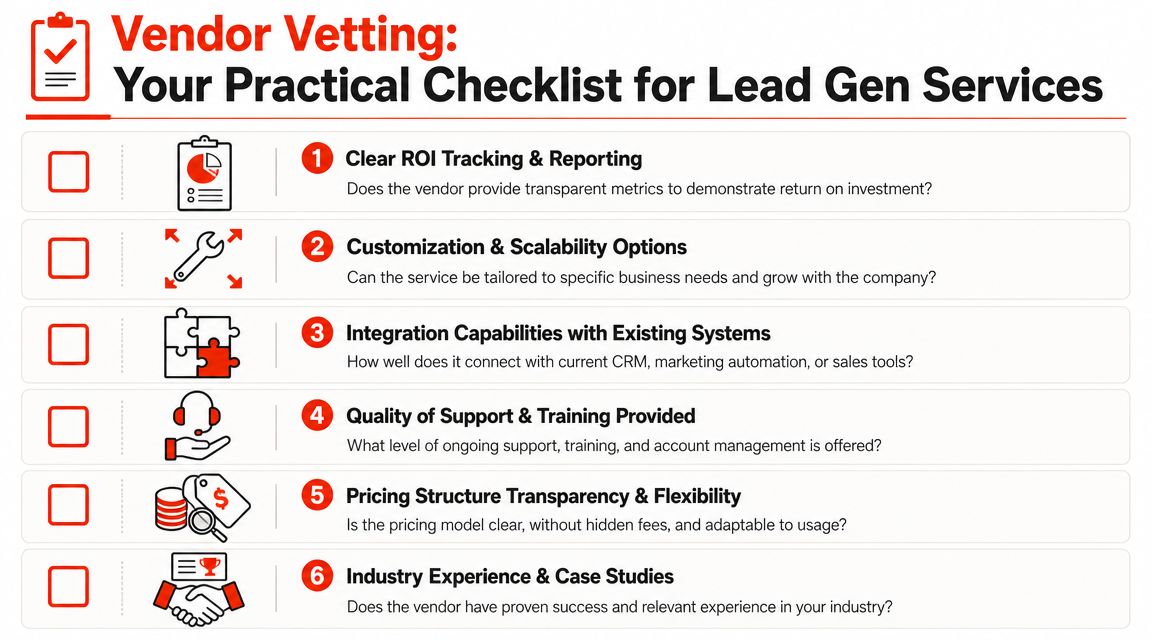
Start with this visual checklist, then use the questions below in every call.
Ask how they identify intent
A technically stronger setup combines anonymous visitor identification with real-time engagement, allowing teams to prioritize high-intent visitors based on actions such as high-value page views or downloads instead of waiting on a form fill, as described in this lead generation tools guide.
That means your first question shouldn't be, "How many leads can you get me?"
Ask this instead:
- How do you detect buying intent before a form is submitted?
- What behaviors can trigger routing or follow-up?
- Can we customize qualification rules for our sales process?
If you want a broader look at what to compare in this category, review these AI lead generation tools and notice how much variation there is in qualification depth.
Ask what happens after capture
Most vendors sell capture. Very few sell handling.
You need to know:
- Where do lead summaries go: CRM, email, Slack, inbox, dashboard?
- What context does the rep receive: Transcript, summary, qualification tags, source data?
- How quickly can the team act: Immediately, batched, or delayed?
- Who owns setup and support: Your team, an account manager, or nobody?
Here's a useful walk-through on the broader topic before vendor calls:
Ask pricing questions that expose hidden cost
Don't stop at the monthly fee. Ask about all the labor around it.
- Implementation burden: Will your team need a developer?
- Training demand: How much babysitting does the system need?
- Conversation limits or seat limits: Do you get punished for usage?
- Contract terms: Can you leave if it doesn't work?
If a vendor can't explain the path from visitor interaction to salesperson action in plain English, they don't understand your problem well enough to solve it.
Good vendors answer specific workflow questions. Weak ones retreat into feature lists.
Your Implementation Roadmap From Trial to ROI
Implementation doesn't need to be complicated. It needs to be disciplined. The mistake most SMBs make is installing a tool, glancing at early activity, and declaring success or failure before they've set clear rules.
A short, focused rollout works better.
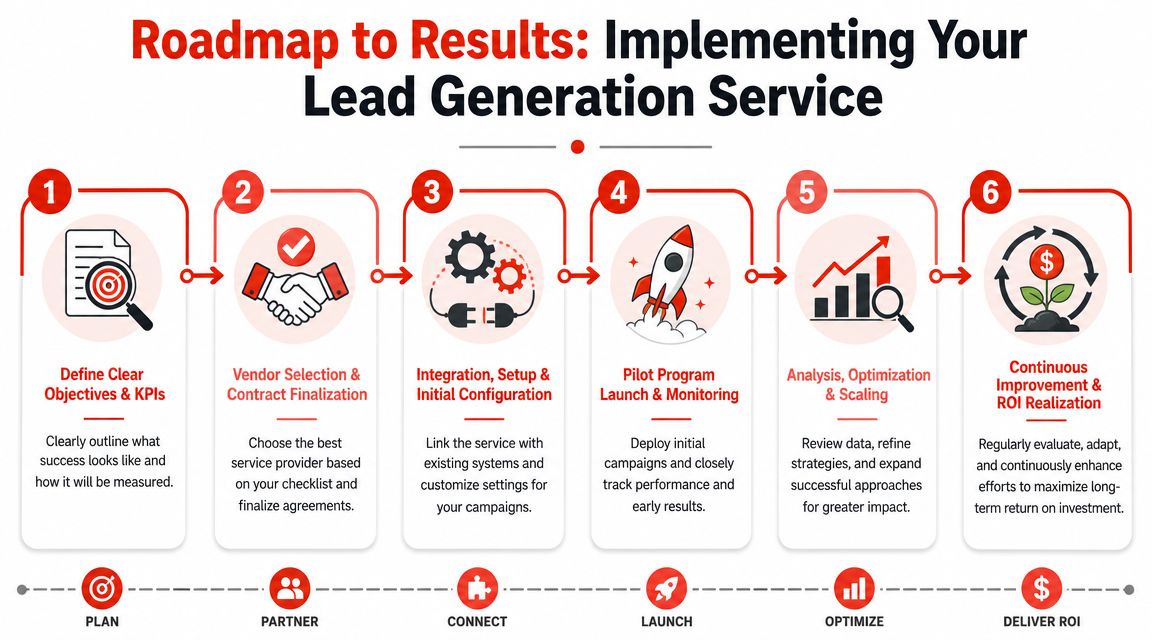
Step one through three
Start with the traffic you already have. One benchmark says websites generate 16% of MQLs from organic and referral traffic, and the average B2B cost per lead is around $198 to $200, which is why optimizing conversion on existing visits matters so much, according to these lead generation statistics.
Then do the following:
-
Define success for the trial
Pick a narrow target. Better lead quality, faster qualification, cleaner routing, or more booked conversations from existing website traffic. Don't try to improve everything at once. -
Set qualification rules
Decide what the system should ask and what disqualifies a lead. Service area, budget fit, urgency, business type, or appointment need. Keep it practical. -
Install with minimal friction
Use the plugin or code snippet, connect your notifications, and make sure the right person gets alerted when a qualified lead appears.
Step four and five
Once it's live, watch the interactions closely.
- Review lead summaries: Are they giving your team useful context?
- Check disqualification patterns: Are bad-fit visitors being filtered early?
- Refine prompts and routing: If the conversations are vague, the setup is vague.
- Align handoff rules: Decide which leads go to sales, support, or automated follow-up.
A simple example
Say you're a local clinic. You already get website traffic from search, maps, and referrals. Your old form collects name, phone, and a generic message. Staff call back later and spend time figuring out whether the person needs the right service, is in the right area, or is even ready to book.
A better rollout would ask the key qualifying questions upfront, summarize the request clearly, and route urgent or high-fit inquiries immediately. The clinic doesn't need more names. It needs fewer interruptions and better appointment conversations.
Start small. A tight trial with clear qualification logic tells you more than a broad rollout with fuzzy goals.
The businesses that see ROI fastest usually don't launch a giant system. They fix one broken handoff, prove the value, and expand from there.
Your Next Step to Generating Better Leads
Most lead gen advice is obsessed with volume because volume is easy to sell. It's much harder to discuss candidly messy follow-up, weak qualification, and the staff time wasted on bad leads. But that's where ROI gets won or lost.
Many guides also ignore what happens after capture. That's a serious omission. Buyers expect fast answers, and SMBs often can't staff round-the-clock response. The value of online lead generation services shifts from "more leads" to around-the-clock qualification and summarization, as highlighted in this marketing and enrollment analysis.
If your team also runs email follow-up, even small execution details matter. Something as basic as email subject line capitalization can affect how polished and trustworthy outreach feels after that first interaction.
The takeaway is simple. Choose the service that helps your team respond faster, filter harder, and act with context. That's what produces better leads.
If you want to test that approach without overhauling your stack, LeadBlaze is a practical place to start. It adds a 24/7 AI sales assistant to your website, qualifies visitors in real time, captures the details that matter, and gives your team concise summaries instead of messy transcripts. The setup is lightweight, the trial is simple, and the point is clear. Turn existing website traffic into better sales conversations.