Think of a bot for sales as your ultimate front-line sales assistant. It’s an automated tool designed to handle all those repetitive, yet crucial, first-touch interactions right on your website. This isn’t just about popping up a chat window; it’s about having a dedicated team member who works 24/7 to engage visitors, answer their first questions, and figure out who is a serious prospect—all without ever taking a coffee break.
What Is a Modern Bot for Sales?
Imagine for a moment that every single person who landed on your website was greeted instantly by an expert sales coordinator. This person wouldn’t just say, “Can I help you?” They’d ask smart, targeted questions to understand what the visitor needs, what their budget looks like, and how soon they’re looking to buy.
Once they’ve identified a hot lead, they’d pass them directly to one of your human sales reps with a neat summary of the conversation. That’s exactly what a modern bot for sales is built to do. It takes over the initial, time-sucking parts of the sales process so your team can focus their energy where it matters most: building relationships and closing deals.
The Evolution from Simple Chatbot to AI Assistant
It’s important to understand that not all bots are the same. When most people hear “chatbot,” they picture those clunky, script-based tools that get stuck in a loop if you ask a question the wrong way. They follow a rigid decision tree, and the conversation often ends with a frustrating “Sorry, I don’t understand.”
A true bot for sales is a different beast entirely. It’s powered by conversational AI, which gives it some serious advantages:
- It Understands Intent: It can figure out what a user is asking, even if they make a typo or phrase their question unusually.
- It Adapts on the Fly: The conversation isn’t fixed. The bot can pivot and change direction based on the user’s answers, making the chat feel much more natural.
- It Gets Smarter: Many of these AI bots learn from past conversations, constantly improving their ability to qualify leads effectively.
A key distinction is that rule-based chatbots follow a script, while conversational AI sales bots manage a conversation. The former is a passive tool; the latter is an active participant in the sales process.
To make this crystal clear, let’s break down the key differences.
Table: Rule-Based Chatbots vs Conversational AI Sales Bots
| Feature | Rule-Based Chatbot | Conversational AI Bot for Sales |
|---|---|---|
| Interaction Style | Follows a pre-programmed script or menu | Engages in natural, two-way dialogue |
| Flexibility | Rigid. Fails if user deviates from the script | Highly flexible. Adapts to user queries |
| Lead Qualification | Basic keyword matching | Deep, intent-based qualification |
| Personalization | Limited; same experience for everyone | Hyper-personalized based on user input |
| Ideal Use Case | Simple FAQs, directing traffic | Qualifying leads, booking meetings, sales |
| Learning Ability | None. Requires manual updates | Learns and improves from interactions |
As you can see, while a rule-based bot has its place for simple tasks, a conversational AI bot is what you need for genuine sales engagement.
The Growing Importance in Modern Business
This isn’t just a passing trend; it’s a fundamental shift in how companies connect with potential customers. The global chatbot market, which includes these advanced sales bots, was valued at an estimated $15.57 billion in 2025 and is projected to skyrocket to $46.64 billion by 2029. That kind of growth shows just how much real-world value businesses are getting from this technology.
By automating the initial outreach and qualification steps, a sales bot lays the groundwork for a more efficient and scalable sales machine. It’s a core piece of the puzzle for creating powerful systems like automated PPC funnels with AI, ensuring your team’s valuable time is always spent on the opportunities most likely to convert.
Why Integrating a Sales Bot Is a Game Changer
Bringing a sales bot into your workflow is so much more than a simple tech upgrade. It completely overhauls how you find and win new customers. Think of it like this: you’re turning a single storefront that’s only open from nine to five into a global operation that’s always on, ready to connect with people anytime, anywhere. This isn’t just about being convenient—it’s about capturing every single opportunity your marketing team creates.
The most obvious win is 24/7 lead capture. Let’s be realistic, your best customers aren’t only browsing during your office hours. Someone could be digging for solutions late on a Sunday night or from the other side of the world. Without a bot, their initial spark of interest could fizzle out by Monday morning. A sales bot, on the other hand, is right there to greet them, handle initial questions, and grab their contact info on the spot.
This simple change means you stop missing leads just because of bad timing. It turns your website from a static brochure into a lead-generating machine that never sleeps.
Automate Qualification and Let Your Team Focus on Closing
One of the biggest time-sucks for any sales team is sifting through endless inquiries to find the real gems. How many hours do your reps spend on discovery calls, only to realize the person isn’t a good fit? A sales bot acts as the perfect gatekeeper, automating that entire filtering process with dead-on precision.
You can set up your bot to ask all the crucial qualifying questions right away:
- What’s your company size?
- What’s the ballpark budget for this project?
- What specific problem are you trying to fix?
- How quickly are you looking to make a decision?
Based on their answers, the bot can instantly flag high-intent leads and either pop a meeting directly onto a sales rep’s calendar or send an alert for immediate follow-up. This frees your people to do what they do best: build relationships and close deals. It’s a massive boost for both productivity and job satisfaction. To nail this, it’s key to follow a clear set of guidelines, which you can explore in our guide on chat bot best practices.
Give Customers a Better Experience, Instantly
We live in a world of instant gratification, and speed is the name of the game. A slow reply to an interested lead can be the difference between winning their business and watching them go to a competitor. A sales bot completely removes that risk by offering helpful, immediate interactions the second a visitor lands on your site.
That instant engagement makes people feel seen and valued. A good bot can even personalize its responses based on a visitor’s behavior—like the pages they’ve viewed or how they found your site. This creates a much more tailored experience that builds trust and guides prospects down the sales funnel much faster.
A bot doesn’t just answer questions; it accelerates the entire sales cycle. By providing immediate value and qualifying leads in real-time, it compresses a process that once took days into a matter of minutes.
This idea is part of a much bigger shift in how businesses operate. To really understand why a sales bot is such a big deal, it helps to look at broader strategic business process automation examples, which show how automation is making entire organizations more efficient.
The numbers tell the same story. The AI chatbot market for sales is exploding, hitting $1.2 billion in 2024 and projected to more than double to $2.8 billion by 2025. Businesses that are already using them report revenue jumps of 15% to 35%. This is driven by things like a 45% improvement in lead qualification accuracy and just plain better support throughout the customer’s journey.
How Real Businesses Win with Sales Bots
The theory behind a bot for sales is interesting, but seeing how it actually drives growth is what really matters. It’s time to move past the concepts and dive into real stories of how small and medium-sized businesses are using these tools to get some seriously impressive results.
These aren’t just made-up scenarios. Think of them as practical blueprints for success, showing how the right bot can fix common sales bottlenecks and open up new doors for revenue. Each example unpacks a specific challenge, the bot strategy used to solve it, and the real-world ROI.
The B2B SaaS Company Tripling Demo Bookings
A growing B2B software company had a classic “good problem” that was ironically stalling their growth. Their marketing was bringing tons of traffic to their website, but the sales team was drowning in endless email chains just trying to schedule a single product demo. Leads were going cold while reps were stuck playing calendar tag.
Their fix? A sales bot with one crystal-clear mission: automate demo scheduling.
- The Strategy: They set up the bot to engage visitors on high-intent pages, like their pricing and features sections. It would ask a couple of quick qualifying questions (like company size and job role) and then, bam, it would show the sales team’s calendar right there in the chat window.
- The Result: In just three months, they tripled the number of qualified demos booked every week. The sales cycle got a lot shorter because interested leads could book a meeting the second they were most curious, with zero friction.
The E-commerce Brand Slashing Cart Abandonment
An online retailer selling custom furniture spotted a worrying trend. A huge percentage of shoppers were adding items to their cart only to leave before checking out. They figured out that last-minute questions about shipping, returns, or even what a fabric felt like were causing people to hesitate.
So, they brought in a sales bot to act as a proactive shopping assistant.
- The Strategy: The bot was set up to trigger whenever a user showed “exit intent” on the checkout page. It would pop up with a friendly, “Have any last-minute questions before you order?” It was loaded with answers to all the most common questions that come up right before a purchase.
- The Result: The bot cut cart abandonment by over 20%. It even started boosting the average order value by suggesting complementary products. What started as a support tool quickly became a powerful sales engine.
The real power of a sales bot lies in its ability to intervene at the exact moment a prospect needs help or a gentle nudge. This proactive engagement turns passive website visitors into active, qualified leads.
And the data backs this up. Websites that use AI chatbots see an average 23% increase in conversion rates. Even more impressive, some companies report up to a 67% jump in total sales after getting a bot on their site, proving just how effective they are at engaging prospects at make-or-break moments. You can find more details in these chatbot performance statistics from Master of Code.
The Real Estate Agency Booking Viewings 24/7
A local real estate agency was losing potential clients after 5 PM and on weekends. An interested buyer might see a listing online at 9 PM on a Saturday, but by the time an agent called them back on Monday morning, that buyer had already booked viewings with three other agencies.
To stop losing these time-sensitive leads, they put a sales bot on their property listing pages.
- The Strategy: The bot was trained to answer specific questions about each property, from square footage to local school districts. Its main job was to get the visitor’s contact info and schedule a viewing directly into the agents’ shared calendar.
- The Result: The agency started capturing leads around the clock, boosting their total number of scheduled viewings by 40%. The bot made sure no opportunity slipped through the cracks, giving them a huge edge in a very competitive market.
Choosing the Right Sales Bot
Picking the right sales bot feels less like buying a piece of software and more like hiring a new team member. It’s a critical decision. The wrong choice can lead to headaches and wasted money, but the right one can become a genuine engine for growth. The trick is to look past the flashy marketing and zero in on the features that will actually make a difference for your team.
The absolute first thing to check is seamless integration. If a sales bot can’t talk to your existing CRM or email platform, it’s a non-starter. You’ll just end up with isolated data and your team will be stuck manually copying and pasting information—the very thing you’re trying to avoid.
The Make-or-Break Features
As you start comparing different platforms, there are a few things that should be non-negotiable. These are the core functions that separate a bot that just answers questions from one that actually qualifies leads and drives revenue. A good tool should feel like a natural extension of your sales process, not some clunky thing you’ve bolted on.
Here’s what to insist on:
- Effortless CRM Integration: The bot has to be able to automatically send lead data—names, emails, chat summaries—straight into your CRM. This creates a single source of truth and lets your sales reps follow up immediately with all the right context.
- A Flexible Conversation Builder: You need to be in the driver’s seat. Look for a simple, no-code interface (usually a drag-and-drop builder) that lets you design conversation paths that mirror your ideal customer’s journey, all without needing a developer.
- Automated Lead Scoring: A truly smart bot can qualify leads on the fly based on how they answer questions. It can then instantly flag the high-value prospects and hand them off to a human rep while they’re still hot.
Thinking About Tomorrow and Everyday Use
A tool that works for you today has to be able to keep up as you grow. Scalability isn’t just about handling more chats; it’s about whether the platform can evolve with your strategy. A bot that’s great for capturing five leads a day might completely fall apart when you’re getting fifty.
Just as important is how easy the platform is to use. Your sales and marketing folks are the ones who will be in the trenches, building and tweaking the bot’s conversations. If the dashboard is too technical or confusing, they’ll never use it to its full potential. Always prioritize a clean, intuitive design that makes sense to non-techies.
A sales bot should make your team’s life easier, not harder. The best ones are incredibly powerful yet simple to manage, letting you get started and make changes quickly without a steep learning curve.
And don’t forget about customer support. When something goes wrong or you have a critical question, you need to know you can get a fast, helpful answer. A company that provides solid support is one that’s truly invested in your success. For a closer look at the top options out there, our guide on the best AI sales assistant software breaks down the market leaders.
Your Vendor Evaluation Checklist
Before you sign on the dotted line, you need to ask the right questions. This checklist will help you cut through the sales pitches and figure out what each platform really brings to the table.
- Integration: “Which CRMs do you have native integrations with? How deep does that connection go?”
- Customization: “Can I completely customize the bot’s personality, branding, and logic without having to write any code?”
- Analytics: “What kind of performance metrics can I track? Can I see data on conversion rates and the quality of leads you’re generating?”
- Onboarding: “What does your setup process look like, and what kind of support do we get?”
- Scalability: “As my business grows, will I run into limits on conversations, users, or the number of websites I can use this on?”
- Pricing: “Is your pricing easy to understand? Are there any hidden fees for features I’m going to need?”
Asking these questions upfront ensures you’re making a smart investment that actually aligns with your sales goals.
How to Get Your First Sales Bot Up and Running
Putting your first sales bot to work isn’t some massive technical headache. It’s a strategic move, and the secret to getting it right is to start small and focused. Don’t try to build a bot that can do everything at once. Pick a single, measurable goal.
This laser-like focus simplifies everything that comes next and helps you prove its worth almost immediately. Maybe your goal is to increase qualified demo bookings by 25% this quarter. Or perhaps you want to capture 30% more leads after your team has gone home for the day. Having a number to aim for keeps you grounded and prevents you from getting bogged down in features you don’t need.
With a clear goal in mind, you can move on to the fun part: mapping out the conversation.
Designing a Natural Conversation
Think of your bot’s conversation flow like a guided tour. You wouldn’t greet a first-time visitor on your homepage the same way you’d talk to a repeat visitor on your pricing page. Your bot shouldn’t either. The trick is to build different conversational paths for different people, making every interaction feel personal and genuinely helpful.
Start by sketching out a few common visitor types. For instance:
- The Window Shopper: This person is just browsing your homepage. The bot’s job here is to be a friendly guide, offering general info and gently pointing them toward a problem you can solve.
- The Serious Buyer: They’re on your pricing or features page, which means they’re much closer to making a decision. The bot should be more direct here—asking qualifying questions and offering to book a demo.
- The Returning Lead: If your CRM recognizes this visitor, the bot can offer a personalized greeting. It could welcome them back by name and ask if they had any more questions since their last visit.
Mapping these flows helps you script conversations that feel less like a robot and more like a real person, all while steering prospects toward your main objective.
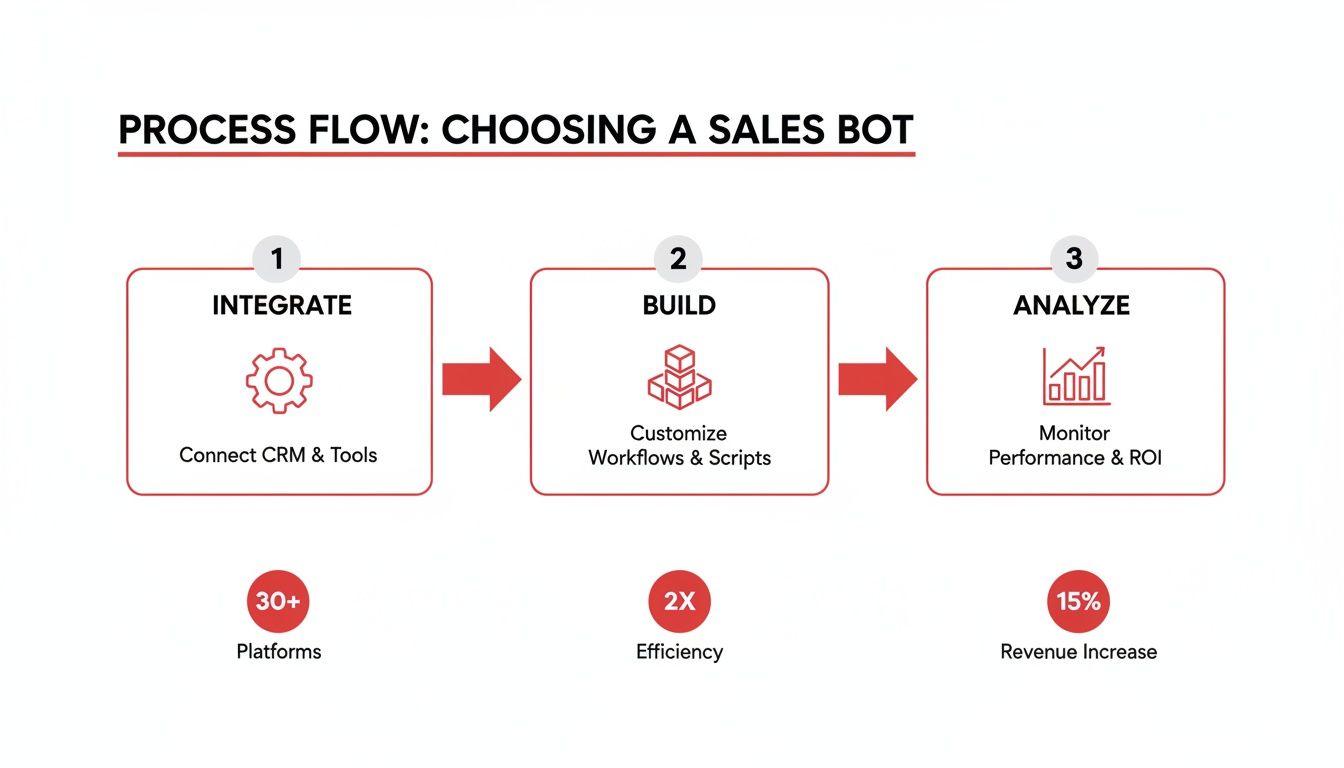
As this process shows, a successful sales bot is all about a continuous cycle: integrate it, build out conversations, and analyze the results to make it even better.
Taking the Final Steps to Go Live
Once you’ve defined your goals and sketched out your conversation flows, the last piece is execution. Tools like LeadBlaze have made this part incredibly simple. You can often get your chatbot for website up and running in minutes by installing a plugin or just pasting a short code snippet into your website’s header. No need to call in a developer.
But flipping the switch to “on” isn’t the end of the story. The real work—and the real results—come from what you do next.
A sales bot is not a “set it and forget it” gadget. It’s an active member of your sales team. It needs ongoing coaching and a clear handover process for your human reps to close the deal.
This is where you turn a neat tool into a revenue-generating machine. Focus on these three critical actions after you launch:
- Test and Tweak: Never stop experimenting. Try different welcome messages, ask different questions, and test new calls-to-action. You’d be surprised how small changes can lead to huge jumps in engagement and conversions.
- Connect Your Core Tools: Make sure every lead, note, and conversation transcript automatically flows into your CRM. This gives your sales team the full picture so they can have a warm, productive follow-up call.
- Train Your Sales Team: Your bot is about to create a fresh stream of pre-qualified leads. Get your reps ready. Show them how to read the bot’s summaries and follow up effectively on these warm opportunities to close more deals.
Following this simple roadmap ensures you’re not just adding a widget to your site. You’re deploying a powerful new asset that starts adding real value from day one.
Got Questions About Sales Bots? We’ve Got Answers.
Jumping into any new sales tool is bound to bring up a few questions. It’s smart to be curious—even a little skeptical. This section is here to tackle the most common concerns we hear from businesses just like yours when they’re thinking about bringing a bot for sales on board.
Our goal is to give you clear, straight-to-the-point answers so you can make a confident decision. Let’s cut through the noise, bust some myths, and get right to the facts.
Will a Sales Bot Replace My Human Sales Team?
This is always the first question, and I can answer it with a firm no. A sales bot is an assistant, not a replacement. Think of it as the ultimate SDR—one that never sleeps, never takes a break, and handles all the repetitive, top-of-funnel tasks that eat up your sales team’s day.
Here’s what the bot does:
- Greets every single person who lands on your website.
- Instantly answers those common, first-touch questions.
- Qualifies leads based on the exact criteria you give it.
This frees up your actual salespeople to do what they do best: build relationships, give amazing demos, and close complex deals. The bot tees up the warm leads, letting your team focus on hitting their numbers.
How Much Technical Skill Do I Need to Set This Up?
Probably a lot less than you’re thinking. The days of needing a developer on standby to launch a simple chatbot are long over. Modern sales bot platforms are built for business users—the sales and marketing folks on the front lines, not programmers.
Most of the top tools have intuitive, no-code builders. You’re usually looking at a simple drag-and-drop interface to design the conversation flows. Getting it live on your site is often as simple as installing a one-click plugin for something like WordPress or pasting a tiny snippet of code into your site’s header. Sure, a super-complex, custom integration might require a bit of technical help, but the core setup and day-to-day management are designed for anyone on your team to handle.
How Do I Know If It’s Actually Working?
You measure it with cold, hard data. The success of a sales bot isn’t about a “feeling”—it’s about tracking clear, tangible metrics that connect directly to your sales goals. You need to look at the numbers to see the real story.
The ROI of a sales bot isn’t just about the deals it helps close. It’s also measured in the hours of productivity it gives back to your sales team, allowing them to focus on high-value, revenue-generating activities.
Here are the key performance indicators (KPIs) you should be watching:
- Leads Captured and Qualified: How many new, solid leads did the bot identify?
- Conversion Rate: What percentage of those bot-qualified leads actually booked a meeting or became a customer?
- Demo or Meeting Bookings: The raw number of appointments the bot scheduled for your team.
- Reduced Response Time: How much faster are you engaging with new leads? (This one is huge).
For a direct return on investment (ROI) calculation, just compare the revenue from deals that started with the bot against the cost of the software. It’s a straightforward way to see its financial impact.
Can a Sales Bot Actually Personalize Conversations?
Absolutely. This is where modern sales bots really shine. We’re way past the era of clunky, one-size-fits-all scripts. Today, personalization is at the very core of how these tools work, creating a far more relevant and engaging experience for every visitor.
A smart bot can tailor its entire conversation based on clues like:
- Visitor Source: Did they come from a specific Google Ad or a LinkedIn post?
- Current Page: Are they on your pricing page or reading a case study?
- Visitor History: Is this their first time here, or are they a returning lead?
Better yet, advanced conversational AI can understand the intent behind what someone types, allowing it to pull up the perfect answer or resource instantly. This creates a helpful, one-on-one dialogue that builds trust and makes people far more likely to take the next step.
Ready to stop missing out on leads and start engaging every website visitor? LeadBlaze is the 24/7 AI sales assistant that turns your traffic into qualified opportunities. Get started with a free 7-day trial and see the difference in minutes.